How Modern Global Conflict Tracking Reveals Deepening Multilateral Gridlock
Institutional data highlights the profound international stability impact as regional security alignments alter cross-border systems.

Recent international relations updates demonstrate that systematic global conflict tracking remains vital for evaluating sudden foreign policy changes across competing states. As multi-nation alliance news highlights shifting defense pacts, the deployment of humanitarian crisis relief must adapt to modern friction points. Furthermore, newly signed cross-border trade agreements are heavily influenced by macro global events, creating a profound international stability impact that shapes the modern geopolitical landscape. According to the latest United Nations assembly updates, member states are actively adjusting their shared global security policy to address deep structural divisions within the multilateral system.
Evaluating these interlocking systems requires objective parameters rather than speculative forecasts. Data published by the Institute for Economics and Peace (IEP) indicates that geopolitical fragmentation has risen across financial, political, and trade dimensions over the past fifteen years. This friction is particularly evident within the United Nations Security Council, where the use of vetoes has increased while passed resolutions have steadily declined. Consequently, regional bodies like the European Union (EU) are modifying their diplomatic strategies to safeguard localized interests amid broader multilateral gridlock.
Interlocking Systems in Modern Global Conflict Tracking
The contemporary landscape of global conflict tracking reveals that historical regional boundaries are increasingly fluid. Modern security tracking show that independent friction zones are coalescing into broader, interconnected strategic systems. The Horn of Africa and the Greater Middle East serve as primary examples of this systemic integration.
Geopolitical alignments across these two zones are increasingly reinforced by financial sponsorships, maritime shipping vulnerabilities, and illicit gold trade networks. Strategic tracking by the International Crisis Group indicates that actions taken by regional powers resonate across both geographic theaters simultaneously. This interconnectedness means an isolated diplomatic shift in one region can trigger rapid re-alignments across the other.
Institutional Gridlock and United Nations Assembly Updates
Compounding these regional dynamics is the operational gridlock affecting traditional multilateral dispute mechanisms. Recent United Nations assembly updates emphasize that the primary bodies responsible for maintaining peace face deep structural divisions. The rising frequency of Security Council vetoes reflects a wider divergence in the strategic priorities of permanent members.
To fill this vacuum, the UN Peacebuilding Commission has expanded its advisory role, providing written guidance directly to the General Assembly. During a recent high-level session, Assembly President Annalena Baerbock noted that active conflicts have reached historically high levels while voluntary humanitarian funding has contracted significantly. In response, member states voted 153 to 1 to establish the International Decade of Strengthening of Peace for Future Generations, aiming to protect institutional continuity.
Analysis: Assessing the International Stability Impact
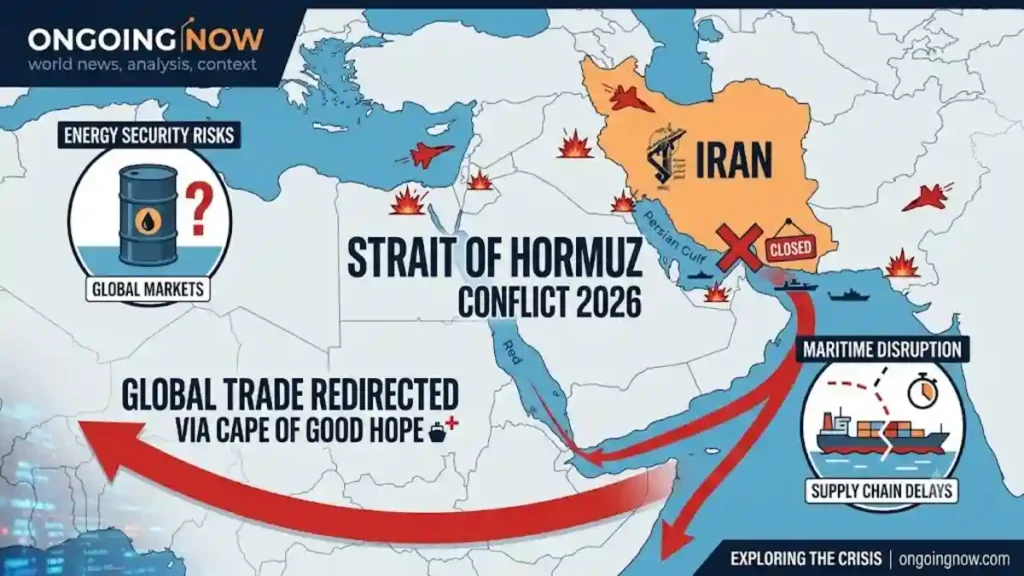
An objective assessment of the international stability impact reveals that fragmentation carries severe economic penalties for developing economies. When maritime corridors are militarized or contested, the resulting disruptions directly affect consumer prices far beyond the immediate conflict zone. This dynamic creates a direct link between localized security changes and global macroeconomic vulnerability.
+---------------------------------------------------------------------------------+
|                  GLOBAL SECURITY AND RESOURCE ALLOCATION TRENDS                |
+----------------------------------------------------+----------------------------+
| Metric Category                                    | Verified Two-Year Trend    |
+----------------------------------------------------+----------------------------+
| Active Armed Conflicts Worldwide                   | Reached record high        |
| Voluntary Humanitarian Funding Contributions       | Decreased by 40 percent    |
| UN Security Council Resolutions Passed             | Measurably declined        |
| Global Military Expenditure Allocation             | Expanded rapidly           |
+----------------------------------------------------+----------------------------+
| Caveat: Data based on institutional reporting from the IEP and United Nations    |
| financial tracking systems. Localized deviations exist based on regional grants.  |
+---------------------------------------------------------------------------------+
As the grid above demonstrates, the divergence between rising military expenditures and falling humanitarian aid presents an operational challenge for international organizations. When resource allocations shift toward defense procurement, the capacity for preventative diplomacy decreases. This imbalance accelerates the rate at which localized disputes escalate into systemic crises.
Human and Community Impact in Fractured Zones
The structural breakdown of regional security has a direct, measurable impact on civilian populations, particularly women and children. Research from the Georgetown Institute for Women, Peace and Security (GIWPS) shows that modern conflicts are increasingly characterized by the weaponization of critical resources. The strategic restriction of agricultural production and food distribution networks is frequently used to enforce territorial control.
These practices lead to systemic displacement, forcing communities to abandon established agricultural lands and migration corridors. In Yemen, the UN Office for the Coordination of Humanitarian Affairs (OCHA) continues to report severe delivery shortfalls due to local security interference. Director of the Crisis Response Division Edem Wosornu emphasized during an open briefing that civilian protection must remain insulated from broader political negotiations.
Geopolitical Shifts and Foreign Policy Changes
The alignment of regional powers frequently drives sudden foreign policy changes that disrupt long-standing diplomatic balances. In West Africa, the transitional authorities in Burkina Faso officially severed diplomatic relations with France, illustrating a broader realignment across the Sahel. This decoupling is accompanied by an increased domestic reliance on military reserve forces, with the national assembly targeting a force of 100,000 personnel.
Simultaneously, state authorities have increased legal oversight regarding civil society groups and religious associations to prevent domestic dissent. These sudden policy shifts complicate international coordination, as external partners must constantly re-evaluate their local access and security protocols. The resulting fragmentation limits the efficacy of standardized regional stabilization initiatives.
Why This Matters: The Mechanics of Modern Alliances
Understanding the mechanics of modern alliances is essential for tracking how small-scale updates translate into macro global events. Traditional, highly formal treaties are increasingly supplemented by flexible, interest-driven strategic partnerships. These alignments allow states to cooperate on specific security goals while maintaining independent positions on broader trade and environmental policies.
This flexibility introduces volatility into global conflict tracking, as partner alignments can shift rapidly depending on localized threats. For instance, competing maritime interests in the Red Sea have led to overlapping naval task forces with entirely different chains of command. This operational density increases the risk of miscalculation, requiring constant communication between parallel command structures to avoid accidental escalation.
Comparative Insight: Historical Parallel of Systemic Fragmentation
The current period of institutional gridlock and regional alignment closely resembles the diplomatic environment of the early 1970s. During that era, the standard bipolar structure of the Cold War fractured into a more complex, multipolar framework characterized by regional proxy competition. The sudden shifts in Middle Eastern alliances during that decade caused immediate volatility in international energy markets and cross-border trade agreements.
+---------------------------------------------------------------------------------+
|                  COMPARATIVE GEOPOLITICAL FRAGMENTATION ANALYSIS               |
+----------------------------------------------------+----------------------------+
| Feature / Indicator                                | 1970s Era vs. 2020s-2030s  |
+----------------------------------------------------+----------------------------+
| Primary Systemic Driver                            | Ideological/Resource Split |
| Multilateral Institutional Status                  | Cold War Veto Deadlock     |
| Main Economic Consequence                          | Global Stagflation Shocks  |
| Resolution Mechanism Preference                    | Bilateral Accords Preferred|
+----------------------------------------------------+----------------------------+
The historical comparison indicates that when multilateral institutions face prolonged gridlock, states invariably favor bilateral or regional arrangements. While these smaller groupings offer faster implementation, they generally lack the universal legitimacy required to settle cross-border border disputes permanently. Consequently, the reliance on localized pacts tends to prolong the lifecycle of structural conflicts.
Diplomatic Realignments and Cross-Border Trade Agreements
The friction identified by global conflict tracking regularly influences the negotiation and implementation of cross-border trade agreements. Commercial treaties are no longer evaluated solely on economic merits; they are increasingly used as tools of statecraft to secure critical supply chains. This integration of economics and national defense shapes modern international relations updates.
States are re-shoring or “friend-shoring” their manufacturing dependencies to insulate their economies from sudden foreign policy changes by systemic rivals. This transition creates new economic blocks, altering shipping routes and port management strategies across key maritime choke points. As a result, commercial access is becoming deeply dependent on shared security commitments.
Verified Institutional Perspectives on Global Security Policy
Official statements from international leadership highlight the difficulty of maintaining a cohesive global security policy when trust between major states is low. In an address regarding institutional reform priorities, UN Secretary-General António Guterres emphasized that multilateralism requires predictable frameworks to function effectively. Without clear, shared parameters, individual state interventions risk exacerbating local instability.
“Peacebuilding is not only about preventing the recurrence of conflict but also about building resilient societies by investing in people, in trust and in the institutions that bind communities together,” stated Ambassador Lok Bahadur Thapa of Nepal during a UN General Assembly session.
This perspective underscores that sustainable stability cannot be achieved through military intervention alone. It requires a balanced approach that combines immediate humanitarian crisis relief with long-term institutional development. When these elements are decoupled, the underlying drivers of regional friction remain unresolved.
Regional Cascades and Sub-Saharan Friction Points
In East Africa, the relationship between Ethiopia and Eritrea illustrates how localized resource disputes can affect broader regional stability. Diplomatic friction regarding maritime port access has led to increased military readiness along shared borders. This tension is further complicated by internal security challenges within Ethiopia, where federal forces interact with localized Amhara and Oromo militias.
The potential alignment of these domestic factions with external state sponsors creates a complex environment for global conflict tracking. Security analysts monitor these developments closely, as an escalation in the Horn of Africa could disrupt shipping corridors throughout the Red Sea. The situation highlights the degree to which domestic political transitions influence wider international stability.
Measured Outcomes of Current Geopolitical Adjustments
The long-term effects of these geopolitical adjustments indicate a permanent transition away from a singular, unified global governance model. Instead, the international community is adapting to a fragmented framework where multiple regional centers of influence manage their own security architectures. This shift requires diplomatic corps to maintain highly specialized, localized strategies rather than relying on generalized international norms.
While this decentralized approach can contain certain localized crises, it complicates the resolution of trans-national challenges such as climate-driven displacement and supply chain volatility. Effective management of these macro global events will depend on the capacity of competing blocks to maintain open communication channels. Objective tracking remains the baseline requirement for navigating this complex international landscape.
Stay sharp with Ongoing Now!
—
Source and Data Limitations: This analysis is compiled exclusively from verified institutional reporting, including official United Nations General Assembly and Security Council session records, the Institute for Economics and Peace (IEP) 2026 updates, the International Crisis Group Conflict Tracker, and the Georgetown Institute for Women, Peace and Security (GIWPS) case studies. All metrics reflect data processed up to the current date of July 2026. Data limitations include delays in field reporting from active conflict zones in the Sahel and the Horn of Africa, restricted independent journalist access in specific administrative regions, and variances in state-reported military procurement expenditures. Speculative projections regarding future deployment schedules or unverified diplomatic breakthroughs have been strictly excluded to maintain objective journalistic standards.