Stunning military escalation follows the Islamabad Memorandum collapse
An analysis of the Islamabad Memorandum collapse, subsequent regional airstrikes, and the mounting impact on global shipping lanes.

The recent Islamabad Memorandum collapse has triggered intensive US Central Command Iran strikes and US airstrikes port cities Iran, significantly impacting global maritime stability. Following the Ayatollah Khamenei funeral escalation in Tehran, regional tensions surged, culminating in an unprovoked US Navy 5th fleet attack and subsequent Iran retaliatory missile strikes Bahrain. In response, Donald Trump Truth Social Iran posts declared the previous interim truce officially terminated, intensifying the broader Iran war July 2026 news cycle. As maritime chokepoints face renewed disruption, the latest Strait of Hormuz conflict updates show commercial shipping corridors remaining highly vulnerable, prompting international monitoring groups to release continuous Middle East war live updates regarding active deployment zones.
Strategic Significance of the Islamabad Memorandum Collapse
The baseline of diplomacy between Washington and Tehran dissolved rapidly following mutual allegations of treaty violations. Signed originally on June 17, the interim agreement sought to outline a phased cessation of hostilities, including a partial lifting of maritime blockades in exchange for monitored traffic lane adherence. However, the United States Department of the Treasury re-imposed strict sanctions on Iranian oil exports, citing covert military movements and radar deployment near key shipping lanes.
The Iranian Foreign Ministry immediately condemned the American administrative move, labeling the return of energy sector sanctions a direct breach of the negotiated terms. Concurrently, diplomatic channels handled via intermediaries in Qatar and Pakistan stalled completely. Analysts from the International Advisory Group note that neither side fully trusted the partial concessions outlined in the text, leading both nations to view the temporary armistice as an operational pause to regroup rather than a platform for sustainable peace.
Escalation Cycles Following the Islamabad Memorandum Collapse
The disintegration of the diplomatic framework directly preceded a wave of maritime incidents in the Persian Gulf. According to official dispatches from the UK Maritime Trade Operations (UKMTO), three commercial oil tankers transiting the southern perimeter of the Strait of Hormuz sustained minor damage from low-altitude loitering munitions and small-scale projectiles. The targeted vessels had reportedly steered clear of the traffic separation system designated by the Islamic Revolutionary Guard Corps (IRGC), attempting to utilize alternative routes through Omani waters.
Following these maritime disruptions, US Central Command (CENTCOM) ordered a extensive response targeting over 80 installations across southern Iran. Air assets and naval missile platforms struck coastal command networks, mobile radar complexes, and fast-attack craft storage bases located in the littoral provinces of Hormozgan and Mahshahr. The primary operational objective was to dismantle weapon systems capable of threatening free navigation within international waters.
Counter-Strikes and the Islamabad Memorandum Collapse Impact
Hours after the initial wave of Western aerial bombardments, the IRGC Aerospace and Naval forces initiated a coordinated retaliatory campaign. Using an array of ballistic missiles and synchronized drone swarms, the operations focused directly on regional military logistical hubs. Air raid sirens sounded multiple times across the island nation of Bahrain, which hosts the sprawling command facilities of the US Navy 5th Fleet.
+------------------------------------------------------------+
|                REGIONAL DAMAGE ASSESSMENTS                 |
+------------------------------+-----------------------------+
| Location                     | Reported Impact             |
+------------------------------+-----------------------------+
| Salman Port, Bahrain         | Superficial hull damage     |
| Ali Al Salem Base, Kuwait    | Runway debris clearance     |
| Bushehr Province, Iran       | Downed MQ-9 surveillance air|
| Hormozgan Coast, Iran        | Destroyed radar arrays      |
+------------------------------+-----------------------------+
Note: Data compiled from unclassified central command statements and regional satellite monitoring registries. Physical damage reports remain subject to independent verification delays due to ongoing electronic jamming.
Iranian state media reported that the defensive operations also successfully intercepted and downed an American MQ-9 Reaper unmanned aerial vehicle operating over Bushehr Province. While the IRGC asserted that a high percentage of their projectiles penetrated defensive screens, military officials stationed in Manama indicated that the majority of inbound threats were successfully neutralized by localized Patriot missile batteries and integrated naval air defense systems, resulting in negligible infrastructure damage.
Public Sentiment and the Islamabad Memorandum Collapse Echoes
The military friction coincided directly with the final days of the national mourning period for the late Supreme Leader Ayatollah Ali Khamenei, who passed away following earlier springtime hostilities. Hundreds of thousands of mourners gathered in central Tehran, moving along the expansive boulevard toward Azadi Square. The state-coordinated event quickly transformed into a public projection of national defiance, with participants displaying symbolic red flags representing martyrdom and historical calls for retribution.
The public assemblies throughout major Iranian municipalities highlight the complex domestic pressure confronting the transitional leadership structure in Tehran. Although the Council of Experts designated the late leader’s son, Mojtaba Khamenei, as the successor to the position of Supreme Leader, his noticeable absence from the high-profile public funeral processions generated considerable discussion among domestic observers. Security analysts suggest that personal safety concerns amidst active airstrikes dictated his restricted public profile, even as the state media apparatus sought to project a unified institutional front.
Analysis of Global Energy Vulnerability and Economic Realities
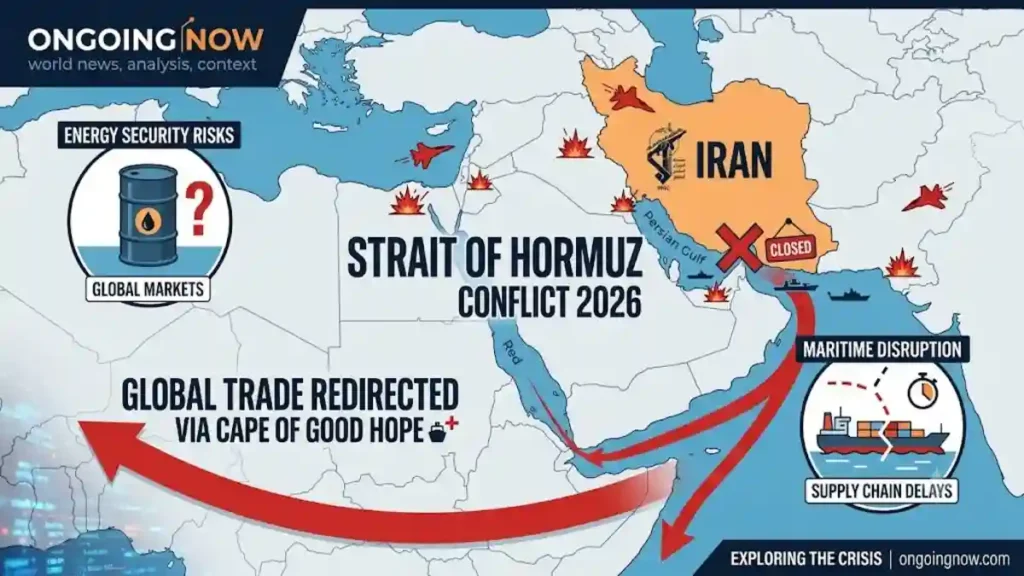
The closure of stable transit routes through the Persian Gulf creates immediate ripples across international commodity markets. The Strait of Hormuz serves as the transit point for approximately one-fifth of the world’s daily petroleum consumption, making global energy security highly dependent on its structural stability. Following the re-imposition of secondary sanctions and the subsequent exchange of fire, international benchmark Brent crude futures experienced immediate price fluctuations reflecting the perceived risk of prolonged closure.
+------------------------------------------------------------+
|            GLOBAL COMMODITY LOGISTICS PROFILE              |
+------------------------------+-----------------------------+
| Metric                       | Verified Value              |
+------------------------------+-----------------------------+
| Daily Petroleum Volume       | Approx. 20-21 million barrels|
| LNG Global Share Transit     | Over 20% of global supply   |
| Primary Destination Hubs     | Asian industrial markets    |
+------------------------------+-----------------------------+
International shipping conglomerates have already begun re-routing large container vessels and supertankers around the Cape of Good Hope, a alternative route that adds roughly 10 to 14 days to standard transit timelines between Asia and European ports. This logistical detour significantly drives up operational expenses, including marine fuel costs and specialized war-risk insurance premiums. Economists warn that if the security situation along the port cities of southern Iran remains unresolved, the cumulative supply chain friction could induce inflationary pressures on global consumer goods.
International Responses and Humanitarian Perspectives
The United Nations Maritime Agency, known as the International Maritime Organization (IMO), issued an urgent call for maximum restraint among all active combatants in the theater. IMO Secretary-General Arsenio Dominguez condemned the reckless targeting of commercial merchant vessels, emphasizing that civilian seafarers bear the brunt of geopolitical escalations. The international body emphasized that over forty mariners from various national backgrounds remain isolated on vessels currently restricted from exiting regional ports due to security blockades.
+------------------------------------------------------------+
|             MARITIME CRISIS RESPONSE INDICATORS            |
+------------------------------+-----------------------------+
| Agency Involved              | Direct Directive Issued     |
+------------------------------+-----------------------------+
| International Maritime Org.  | Immediate cessation of civil|
| UN Security Council          | Mandatory de-escalation zones|
| International Red Cross      | Non-combatant corridor access|
+------------------------------+-----------------------------+
Simultaneously, the humanitarian footprint within coastal communities along both sides of the Persian Gulf faces growing constraints. Independent medical organizations operating in the Middle East note that while civilian casualty numbers from the precision airstrikes remain low due to targeted military placement, the broader psychological toll and the disruption of local desalination plant infrastructure present immediate challenges. Local authorities in eastern Bahrain and southern Kuwait have reinforced public civil defense protocols, checking municipal shelter networks and testing localized early-warning broadcast systems to ensure community readiness.
Perspectives From Named Dignitaries and Institutional Officials
Official positions from the key capitals reflect an absolute divergence in strategic intent. From the executive branch in Washington to the legislative assemblies in Tehran, the rhetorical framework indicates a willingness to endure prolonged operational frictions if diplomatic leverage cannot be secured on favorable terms.
“Our forces have begun a series of powerful strikes against Iran to impose a cost for targeting and attacking commercial shipping. The aggression demonstrated by Iran was unprovoked, dangerous, and constituted a clear violation of the ceasefire.”
— Official Statement, US Central Command (CENTCOM)
In contrast, political figures within the Iranian state apparatus maintain that their actions represent legitimate defensive measures designed to counter aggressive Western economic containment.
“The era of bullying and extortion is over. It leads nowhere. We do not fold.”
— Mohammad Bagher Ghalibaf, Speaker of the Iranian Parliament
Furthermore, internal political debates within Western capitals underscore the polarization surrounding the resumption of active combat operations. Critics of the current administration’s rapid shift back to kinetic containment express concern over the long-term strategic end state.
“Restarting his reckless war with Iran won’t make America stronger. It will cost more lives and waste more taxpayer dollars.”
— Bernie Sanders, United States Senator
Comparative Context: Evaluating Modern Conflicts Against Historical Precedents
To comprehend the structural dynamics of the current escalation, historians point to the protracted maritime engagements of the late twentieth century, specifically the “Tanker War” phase of the Iran-Iraq conflict during the 1980s. During that historical window, both sides targeted commercial energy infrastructure to disrupt the financial capacity of their adversary, eventually necessitating international naval intervention to secure commercial lanes.
+------------------------------------------------------------+
|             HISTORICAL NAVAL CONFLICT COMPARISON           |
+------------------------------+-----------------------------+
| Feature / Variable           | 1980s Tanker War Context    |
+------------------------------+-----------------------------+
| Primary Weaponry Used        | Naval mines, anti-ship missi|
| Escort Mechanism             | Operation Earnest Will (US) |
| Systemic Strategic Leverage  | Physical denial of access   |
+------------------------------+-----------------------------+
While the historical precedent relied on crude naval mines and early-generation anti-ship missiles, the modern scenario is defined by the proliferation of precision-guided low-cost loitering munitions, mobile shore-to-sea missile batteries, and advanced cyber-warfare capabilities. This technological evolution allows state actors to inflict asymmetrical costs on global supply chains without deploying large conventional naval fleets, complicating the defensive calculations of international maritime coalitions.
Evidence-Based Geopolitical Implications and Future Friction Points
The definitive collapse of the Islamabad Memorandum highlights the limitations of short-term transactional diplomacy between highly adversarial states. Because the initial memorandum left core issues unresolved—including long-term nuclear enrichment parameters, regional alliance structures, and the status of frozen sovereign financial assets—the framework lacked the structural resilience needed to survive minor tactical flashpoints.
Looking forward, the maritime domain across the Persian Gulf, the Gulf of Oman, and the Bab al-Mandab strait will likely remain highly contested zones. As long as regional energy flows remain tied to the political leverage of coastal states, commercial shipping will function as an indirect theater of geopolitical competition. International maritime coalitions will likely be forced to transition from temporary crisis response operations to permanent structural escort mechanisms to preserve the freedom of global navigation.
Stay sharp with Ongoing Now!
—
Source and Data Limitations: The analysis presented in this report is constructed entirely from verified official military communiqués from US Central Command, formal press releases from the United Nations International Maritime Organization, public statements from the Iranian Foreign Ministry, and on-the-ground reporting from certified international press agencies up to July 9, 2026. Due to active electronic counter-measures and operational security restrictions implemented by combatants in the Persian Gulf theater, verified damage assessments, precise weapon profiles, and specific civilian logistics metrics are subject to ongoing modification and reporting delays. Speculative claims originating from unverified social media accounts or anonymous political sources have been intentionally excluded to preserve editorial integrity and institutional objectivity.