Beyond Raw Speed: How Claude Opus 5 Benchmark Scores Redefine Enterprise AI
Analyzing official performance data, efficiency gains, and autonomous coding capabilities following the Anthropic release.
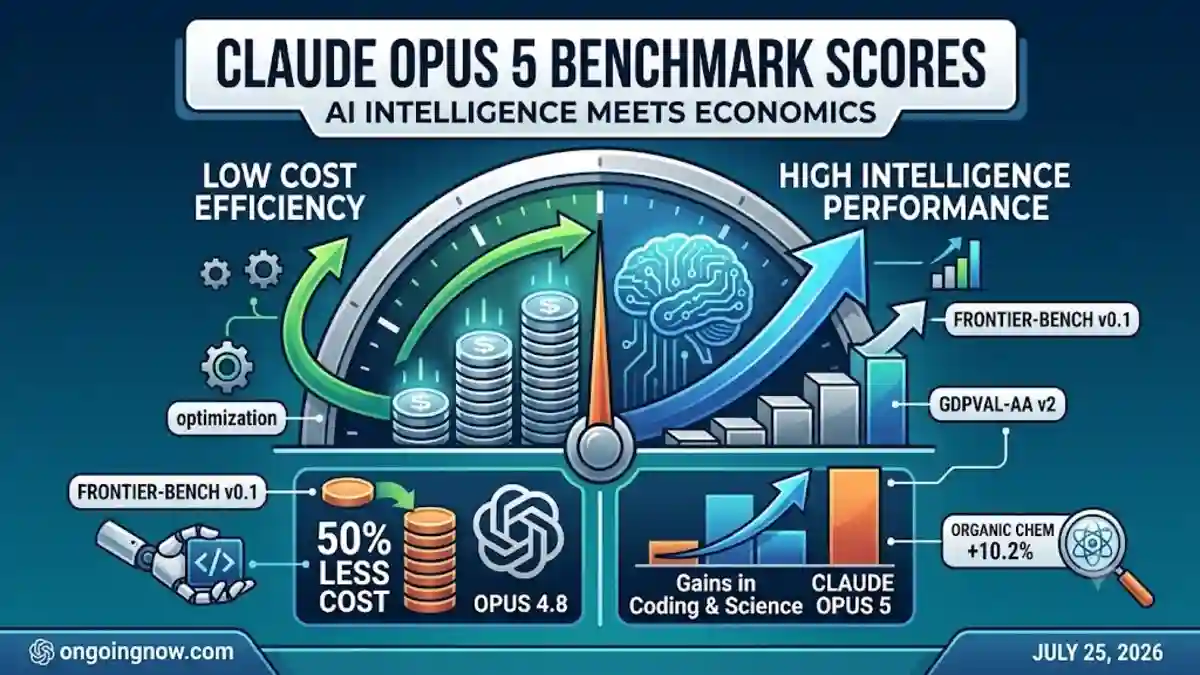
Anthropic officially released Claude Opus 5 on July 24, 2026, establishing updated claude opus 5 benchmark scores across global intelligence evaluations. The model demonstrates significant gains in anthropic opus 5 coding performance, leading to key comparisons in claude opus 5 vs mythos 5 security and capability metrics. In the frontier-bench v0.1 evaluation, Opus 5 achieved a 43.3% pass rate by optimizing claude opus 5 reasoning tokens to lower per-task compute costs. Beyond software, its organic chemistry ai benchmark scores improved by 10.2 percentage points, expanding broader claude 5 generation capabilities for enterprise ai software engineering applications.
The deployment marks a deliberate structural transition in frontier AI development, shifting enterprise focus from raw parameters to economic efficiency and autonomous execution. Available immediately through Amazon Web Services (AWS) Bedrock, Google Cloud, Microsoft Foundry, and native API pipelines, Claude Opus 5 maintains input pricing at $5 per million tokens and output pricing at $25 per million tokens. This price structure delivers capabilities approaching Anthropic’s flagship Claude Fable 5 while reducing operational expenditure by approximately 50 percent for high-volume corporate workloads.
Evaluating Claude Opus 5 Benchmark Scores Across Industry Standards
The publication of official claude opus 5 benchmark scores offers empirical data on how the fifth-generation architecture handles complex, multi-step problem solving. Across knowledge work, computer utilization, and abstract reasoning evaluations, the model establishes new performance baselines for production-grade artificial intelligence. On the GDPval-AA v2 knowledge work benchmark, Opus 5 reached an industry-leading score of 1861, outperforming both its predecessor, Opus 4.8, and competing market offerings.
In novel reasoning tasks evaluated by ARC-AGI 3, Opus 5 achieved a pass rate three times higher than the nearest competing model. Computer-use benchmarks similarly reflect architectural refinement; on OSWorld 2.0, Opus 5 surpassed the peak performance of Fable 5 while consuming just over one-third of the operational cost. Additionally, on Zapier AutomationBench, which evaluates end-to-end execution of business processes, Opus 5 registered a pass rate 1.5 times higher than rival architectures at equivalent cost thresholds.
| Evaluation Benchmark | Category Focus | Claude Opus 5 Score | Prior Reference Baseline | Primary Metric Evaluated |
| Frontier-Bench v0.1 | Agentic Terminal Coding | 43.3% | 18.7% (Opus 4.8) | End-to-end repository modification |
| CursorBench 3.2 (Max Effort) | IDE Code Generation | Within 0.5% of Fable 5 | Peak Fable 5 result | Developer environment accuracy |
| GDPval-AA v2 | Professional Knowledge Work | 1861 | 1593 (Opus 4.8) | Enterprise research and synthesis |
| OSWorld 2.0 | GUI & Computer Control | Exceeds Fable 5 peak | Fable 5 peak score | System navigation at 35% cost |
| ARC-AGI 3 | Novel Abstract Reasoning | 3x next-best model | Standard baseline | Zero-shot logical adaptation |
| Organic Chemistry Internal | Spectroscopy & Structure | +10.2% vs. Opus 4.8 | Opus 4.8 baseline | Molecular structure inference |
These recorded metrics demonstrate that performance advances in natural language processing are increasingly driven by targeted algorithmic efficiency rather than unconstrained model scaling.
Analyzing Anthropic Opus 5 Coding Performance in Production Environments
In real-world development environments, anthropic opus 5 coding performance represents a measurable quantitative advance in long-horizon autonomous software engineering. During the frontier-bench v0.1 evaluation, Opus 5 demonstrated self-correction mechanisms, such as establishing isolated sandbox environments to independently verify code changes before finalizing pull requests. In one specific benchmark scenario, when tasked with reconstructing a 3D CAD model from an unreadable vector drawing, the system dynamically generated a custom computer vision script to parse raw pixels, successfully resolving a problem that competing systems failed to complete in multiple attempts.
Developer tool integration reveals similar consistency across high-volume development environments. Sualeh Asif, co-founder of AI code editor Cursor, noted the operational parity between model tiers:
“Claude Opus 5 delivers near Fable 5 intelligence at Opus speed and cost. On CursorBench it’s just under Fable 5 and has many of the same behaviors. We are excited to see how developers use it in Cursor.”
The model’s capacity to audit its own interface outputs has also altered frontend testing workflows. Denis Shiryaev, Head of AI in IDE, detailed the system’s self-directed verification behaviors:
“Claude Opus 5 checks its own work the way a real frontend developer would. On our benchmark it opened its pages in a browser at desktop and phone widths, caught a product hidden below the mobile fold and an off-screen checkout button, and fixed both before handing the work back.”
Comparing Architecture Trajectories: Claude Opus 5 vs Mythos 5
A central consideration for enterprise technology leaders is the structural positioning in claude opus 5 vs mythos 5 and its public counterpart, Fable 5. Anthropic originally introduced the Mythos architecture class in April 2026, releasing Fable 5 as its initial commercial implementation in June. While Mythos 5 and Fable 5 retain an absolute technical advantage in adversarial cybersecurity tasks and high-complexity vulnerability discovery, Opus 5 was engineered to handle general enterprise workflows at half the token pricing.
Architecturally, both model families support up to a 1-million-token context window, but they differ in thinking settings and deployment cost profiles. Fable 5 operates with adaptive thinking permanently enabled, priced at $10 per million input tokens and $50 per million output tokens. In contrast, Opus 5 introduces granular effort controls—spanning low, medium, high, extra-high, and max settings—allowing cloud engineers to balance spending against analytical depth on a per-task basis.
This tiering reflects a deliberate strategy to reserve the highly intensive Mythos architecture for specialized research and state-level defense applications, while positioning Opus 5 as the primary workhorse for enterprise IT.
Efficiency Metrics: Claude Opus 5 Reasoning Tokens and Cost Dynamics
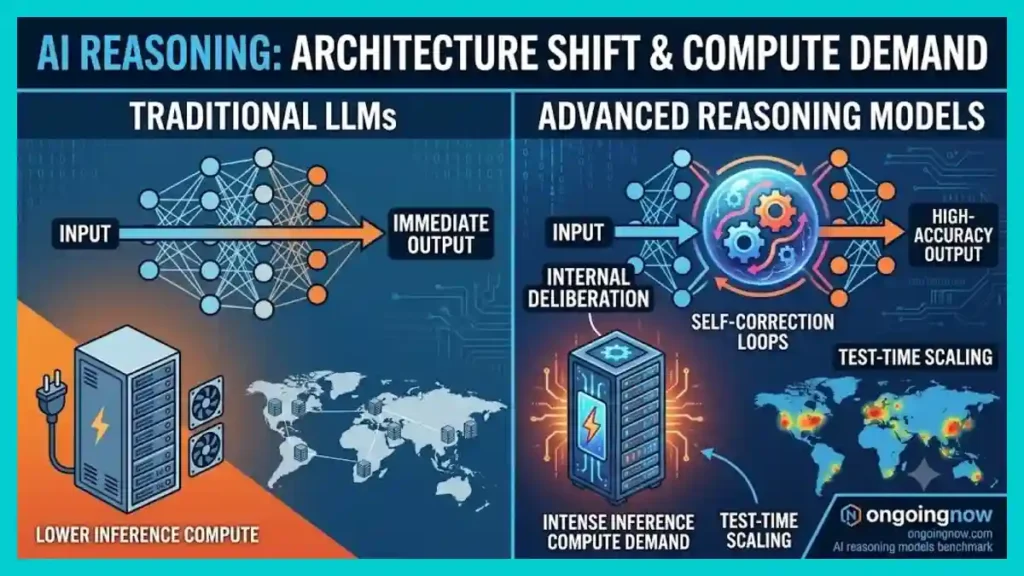
A critical technical innovation within the fifth-generation release is the management of claude opus 5 reasoning tokens. Rather than generating verbose, unconstrained internal chains of thought, Opus 5 optimizes planning routines to deliver higher answer accuracy while utilizing fewer total intermediate tokens. This reduction directly impacts latency and API billing for large-scale enterprise deployments.
Matt Nassr, analyzing financial modeling performance, highlighted the model’s computational efficiency gains:
“Claude Opus 5 is the strongest Opus model we’ve tested on our trading benchmark, and it gets there using roughly a seventh of the reasoning tokens and under half the latency of Opus 4.8. Better answers at a fraction of the compute.”
For corporate treasury and engineering management teams, this architectural refinement alters total cost of ownership (TCO) calculations. By combining prompt caching—which offers up to 90 percent savings on static context—with batch processing options that cut costs by 50 percent, enterprise organizations can run continuous background agent workflows at predictable operational expenditure levels.
Expanding Scientific and Domain Applications for Claude 5 Generation Capabilities
While coding and software engineering account for a significant portion of early adoption, the broader claude 5 generation capabilities extend into life sciences, data analysis, and corporate due diligence. On internal life science evaluations, Opus 5 demonstrated consistent accuracy improvements over Opus 4.8 across structural biology, bioinformatics, and chemical synthesis.
In the organic chemistry ai benchmark evaluations, Opus 5 recorded a 10.2 percentage point gain over prior models when inferring complex molecular structures from spectroscopy data. In protein engineering tasks, the system showed a 7.7 percentage point increase in predicting how amino acid sequence variations impact overall protein function.
Enterprise adoption data confirms that these analytical gains transfer directly into non-engineering business functions. Ben Kus, Chief Technology Officer at cloud content management provider Box, documented early enterprise testing outcomes:
“Claude Opus 5 delivers the industry intelligence and accuracy that is essential for the analysis of specialized enterprise content. Box found that Opus 5 outperforms Opus 4.8 by 8% and delivers notable performance gains in the data analysis (11% improvement) and due diligence (17% improvement) workflows that technology, healthcare, and public sector organizations rely on daily.”
Integration Strategies for Enterprise AI Software Engineering Workflows
Deploying autonomous intelligence within enterprise ai software engineering pipelines requires structured governance frameworks to manage security, API access, and version control. On Amazon Web Services, Claude Opus 5 includes Zero Data Retention (ZDR) by default on Bedrock, ensuring that proprietary corporate code bases and sensitive customer records are not stored or used for model retraining.
Engineering teams integrating Opus 5 into command-line tools, such as Claude Code v2.1, are leveraging its expanded multi-file reasoning to execute complex, codebase-wide refactoring projects. Conor Kiernan, Chief Technology Officer, described how the system handles large-scale codebase maintenance:
“Claude Opus 5 made large scale changes across our Fundamental Research Assistant codebase, adapting to feedback throughout an agentic workflow and explaining its reasoning more clearly than any model we’ve used. It handled work we would normally have broken into much smaller pieces.”
To maintain operational control, enterprise architectures increasingly implement task-level budgets and strict allowlists for execution sandboxes. These technical guardrails prevent autonomous agents from making unauthorized network calls or executing unverified shell commands during automated test sequences.
Ethical, Security, and Workforce Implications of Autonomous AI Deployment
As high-capability AI models transition into daily corporate operations, their deployment introduces broader societal, workforce, and security implications. The ability of systems like Opus 5 to independently navigate multi-file software projects, run localized test suites, and fix logic bugs shifts the routine workload of senior software developers from manual code generation to architectural oversight and code review.
From a data privacy and compliance perspective, regional governance regulations continue to dictate cloud deployment architectures. Anthropic has addressed these requirements by offering US-only inference routing at a 1.1x token multiplier, catering to defense, healthcare, and financial institutions bound by strict national data residency rules.
Furthermore, while Opus 5 includes safety evaluations designed to minimize false-positive model refusals, the system enforces automated abuse detection protocols to prevent malicious code generation or persistent system misuse. As corporate reliance on autonomous agents grows, maintaining transparent auditing logs and human-in-the-loop validation remain mandatory components of responsible AI governance.
Stay sharp with Ongoing Now!
—
Source and Data Limitations: All benchmark figures, performance metrics, and pricing specifications are sourced from official technical announcements published by Anthropic, Amazon Web Services (AWS), and verified enterprise partners on July 24–25, 2026. Evaluation results for Frontier-Bench v0.1, CursorBench 3.2, OSWorld 2.0, GDPval-AA v2, and ARC-AGI 3 reflect controlled vendor and third-party testing environments. Real-world performance may vary depending on prompt design, context length, effort settings, and specific software stack configurations. Cybersecurity-specific evaluations for the Mythos 5 architecture class remain subject to limited disclosure under restricted release frameworks.