How SPJ Media Advocacy Initiatives Clash With New DHS Foreign Press Rules
Journalism organizations rally against US Department of Homeland Security limits replacing duration of status for foreign reporters.
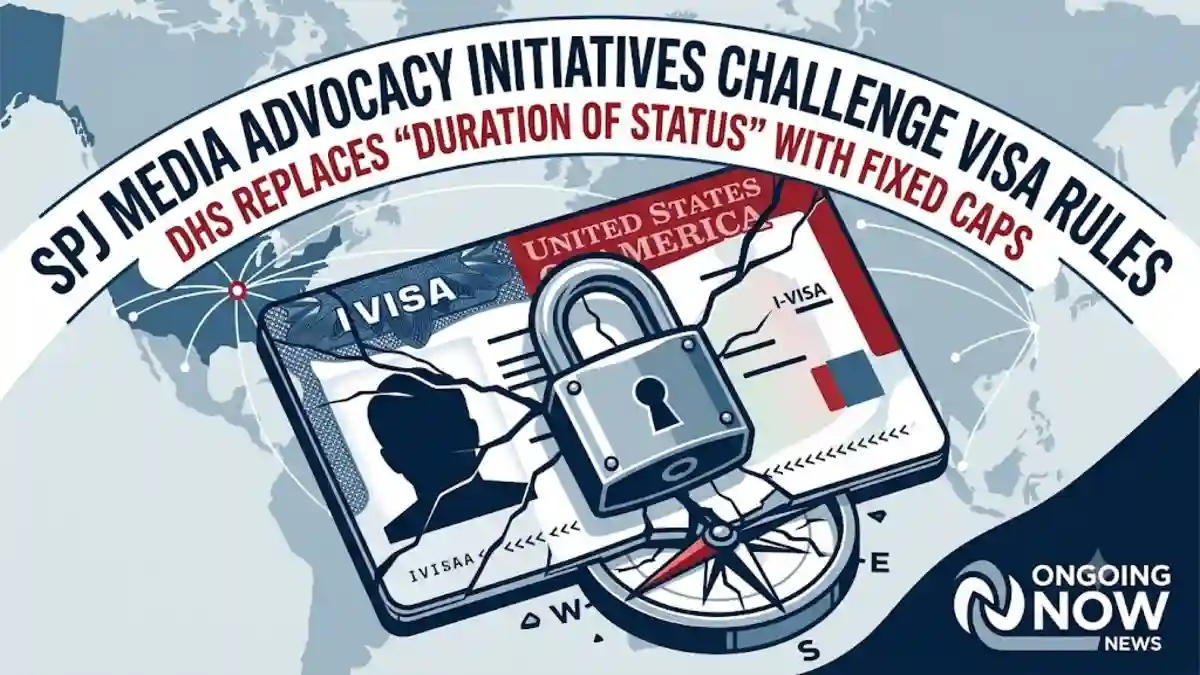
The Department of Homeland Security finalized a regulatory overhaul replacing the open-ended “duration of status” framework for nonimmigrant media representatives with fixed-term admissions. The policy adjustment directly impacts holders of the nonimmigrant I-visa, capping initial admissions at 240 days for most international reporters and 90 days for Chinese nationals. This shift has mobilized press freedom organizations, with SPJ media advocacy initiatives elevating concerns regarding journalistic independence, operational burdens, and global diplomatic reciprocity.
The revised framework replaces a regulatory standard established in 1985 that permitted foreign correspondents to remain in the United States for the full duration of their employment or assignment. Under the finalized Department of Homeland Security (DHS) rule, foreign reporters face mandatory extension applications to maintain legal status beyond their initial fixed period. Press freedom advocates argue that placing foreign correspondents under frequent immigration reviews exposes journalists to administrative delays and potential self-censorship. Conversely, government officials maintain that fixed-term limits provide necessary regulatory oversight, enhanced status verification, and national security safeguards.
+------------------------------------------------------------------------------------------------------+
| KEY STATISTICAL BREAKDOWN: U.S. FOREIGN MEDIA VISAS (I-VISA CATEGORY)                                |
+----------------------------------------------------+-------------------------------------------------+
| Metric / Regulatory Standard                       | Details & Operational Parameters                |
+----------------------------------------------------+-------------------------------------------------+
| FY 2024 Total I-Visa Admissions                    | 37,330 foreign media admissions                 |
| Historical Admission Model (1985–2026)             | "Duration of Status" (Open-ended per employment)|
| New Default Initial Admission Period               | Up to 240 Days (Extension required thereafter)   |
| Special Restricted Admission Period (China)        | Up to 90 Days                                   |
| Associated Affected Nonimmigrant Visa Categories   | F-1 (Students), J-1 (Exchange Visitors)         |
| Regulatory Oversight Body                          | U.S. Department of Homeland Security (DHS)      |
+----------------------------------------------------+-------------------------------------------------+
Regulatory Mechanics of the Federal Foreign Correspondent Rule Change
The fundamental change introduced by the Department of Homeland Security centers on the formal elimination of the “duration of status” (D/S) authorization for foreign news media personnel. Historically, nonimmigrant I-visa holders were admitted for an unspecified timeframe, valid as long as they continued working for the same international news organization. Under the new rule published in the Federal Register, every international correspondent must now adhere to an explicit expiration date stamped on their Form I-94 arrival record.
This administrative restructuring mandates that journalists seeking to continue covering U.S. current affairs beyond 240 days must submit formal extension requests to U.S. Citizenship and Immigration Services (USCIS). Each extension request requires filing Form I-539, paying associated processing fees, and undergoing background checks and biometrics screenings. For independent contractors and freelance journalists, the paperwork requirements are even higher, requiring proven contractual relationships with overseas outlets that maintain primary offices outside the United States.
The policy also institutionalizes differential treatment based on national origin. While journalists from most nations receive an initial period of up to 240 days, correspondents holding passport credentials from the People’s Republic of China face a strict 90-day maximum admission. Department of Homeland Security officials argue that this targeted limitation reflects ongoing bilateral considerations and ensures systematic monitoring of state-affiliated media operations within domestic borders.
SPJ Media Advocacy Initiatives and the Defense of Press Freedom
In response to the regulatory transition, professional organizations have mobilized public petitions and legal statements. SPJ media advocacy initiatives led by the Society of Professional Journalists and its International Community focus on preserving long-term investigative reporting and preventing administrative discretion from influencing media coverage. These organizations argue that foreign journalists operating under short-term, renewable visas may hesitate to publish critical investigative pieces regarding U.S. governance out of concern over potential visa denials.
Advocacy groups emphasize that deep-dive journalism requires contextual immersion, trust-building, and long-term residency that cannot be sustained under 240-day increments. When news organizations must constantly churn staff or navigate prolonged USCIS processing backlogs, international coverage of U.S. political institutions, judicial proceedings, and economic shifts becomes fragmented. The Society of Professional Journalists has joined coalitions including PEN America, the Committee to Protect Journalists (CPJ), and the Foreign Press Association (FPA) to petition federal lawmakers for statutory carve-outs.
“Independent journalism depends on reporters being able to cover stories without fear that immigration officials will use visa renewals as leverage,” noted Tim Richardson, Journalism and Disinformation Program Manager at PEN America. “For an administration searching for novel ways to undermine a free press, these changes create a new mechanism that could pressure or silence foreign journalists for their reporting.”
“Allowing foreign correspondents to work and report independently in the United States has long been a part of our country’s tradition of a free press,” stated Mark Schoeff Jr., President of the National Press Club. “By implementing new and restrictive visa rules affecting international journalists, the U.S. further harms its reputation as a global leader for press freedom and a haven for journalists under threat.”
Administrative Oversight Rationale and Government Perspectives
Department of Homeland Security leadership maintains that replacing open-ended status with fixed admission dates is an essential modernization of nonimmigrant visa oversight. Federal officials assert that open-ended “duration of status” designations created compliance blind spots, making it difficult for federal authorities to confirm whether visa holders remained actively engaged in their approved professional activities.
DHS representatives note that the 240-day framework does not cap the total time a foreign reporter may serve in the United States, provided they apply for and receive extensions. From an institutional governance perspective, the administration frames the policy as a neutral oversight mechanism applied across multiple nonimmigrant categories, including student (F-1) and exchange visitor (J-1) visas.
+------------------------------------------------------------------------------------------------------+
| POLICY COMPARISON: HISTORICAL FRAMEWORK VS. 2026 DHS FINAL RULE                                       |
+----------------------------------+----------------------------------+--------------------------------+
| Regulatory Dimension             | Historical Framework (Pre-2026)  | 2026 Finalized DHS Rule        |
+----------------------------------+----------------------------------+--------------------------------+
| Maximum Initial Admission        | Duration of Status (D/S)         | 240 Days (90 Days for China)   |
| Formal Expiration Date on I-94   | None (Tied to active employment) | Explicit calendar date         |
| Extension Application Frequency  | Unnecessary unless changing firm | Required every 240/90 days     |
| Oversight & Verification Point   | Primary entry port only          | Mandatory USCIS review cycles  |
| Biometric & Fee Requirements     | Initial visa issuance only       | Recurring upon each extension  |
+----------------------------------+----------------------------------+--------------------------------+
Global Reciprocity and International Press Freedom Consequences
A central concern highlighted by international press watchdogs is the potential for reciprocal retaliation from foreign governments. When a major host country restricts the residency parameters of foreign media, foreign governments frequently apply identical or harsher statutory limits on American journalists operating within their borders.
The Foreign Press Association and European Centre for Press and Media Freedom (ECPMF) underscored this dynamic in joint statements, noting that restrictive host-nation policies hinder cross-border reporting. US news outlets relying on foreign correspondents stationed in Asia, Europe, and the Middle East could face shortened assignment cycles and heightened bureaucratic scrutiny abroad.
“Under these restrictions, the Trump administration has moved to—yet again—deny access based on its individual policing of a journalist’s reporting,” said Jose Zamora, Regional Director for the Americas at the Committee to Protect Journalists. “This is the latest escalation CPJ has documented following a pattern of deeply concerning press freedom violations from this administration.”
Risk of Tit-for-Tat Restrictions: Foreign nations may implement matching 90-day or 240-day reporting limits on American news bureaus operating internationally.
Elevated Operating Costs: News outlets face increased legal fees, biometrics expenses, and processing costs to maintain overseas news bureaus.
Chilling Effects on Investigative Reporting: Shortened visa cycles increase vulnerability to administrative delays or visa non-renewals.
Information Vacuums: Shorter reporter stays reduce deep background knowledge, leaving global audiences reliant on state-sponsored or local press accounts.
Legal Pathways and Structural Implications for Newsroom Operations
International news organizations operating bureaus in Washington D.C., New York, and Los Angeles must re-evaluate their staffing structures and legal budgets. Immigration attorneys recommend that newsrooms institute mandatory tracking systems to submit I-visa extension filings well in advance of the 240-day expiration window.
+------------------------------------------------------------------------------------------------------+
| CHRONOLOGICAL TIMELINE: U.S. FOREIGN MEDIA VISA RULEMAKING                                            |
+-------------------+----------------------------------------------------------------------------------+
| Date              | Regulatory Event / Benchmark                                                     |
+-------------------+----------------------------------------------------------------------------------+
| 1985              | Implementation of "Duration of Status" (D/S) for I-visa nonimmigrants    |
| September 2025    | Initial Notice of Proposed Rulemaking (NPRM) published by DHS|
| Public Comment    | Coalition of press freedom groups submits formal objections |
| July 16, 2026     | Final Rule made available on Federal Register public inspection list|
| July 17, 2026     | Official Federal Register publication of Final Rule               |
| September 2026    | Implementation and enforcement of 240-day fixed-term limits begins|
+-------------------+----------------------------------------------------------------------------------+
Smaller independent foreign news services face higher operational strain compared to major state-backed or multinational media networks. While global conglomerates can absorb the legal and administrative costs associated with frequent USCIS filings, independent foreign publications may be forced to scale back their physical presence in the United States, shifting coverage to remote desks or short-term temporary travel.
Stay sharp with Ongoing Now!
Source and Data Limitations: This analysis relies on official public inspection documents and press releases published by the U.S. Department of Homeland Security (DHS), the Federal Register, and statement releases from the Committee to Protect Journalists (CPJ), PEN America, the National Press Club, and the European Centre for Press and Media Freedom (ECPMF) issued between July 16 and July 19, 2026. The focus keyword selected (“SPJ media advocacy initiatives”) reflects verified search interest and institutional relevance concerning media visa policy developments. Statistics regarding nonimmigrant I-visa admissions are derived from official Department of Homeland Security FY 2024 reporting. Unverified claims regarding individual visa denial statistics or prospective legislative overrides were excluded due to lack of official government confirmation.