White House Iran Strategy Reveals Shift in Global Policy
President Donald Trump has stated that the United States will not engage in diplomatic talks with Tehran without an “unconditional surrender,” marking a significant hardening of the White House Iran strategy.

The current standoff, which follows the launch of Operation Epic Fury on February 28, 2026, has entered a critical phase as U.S. and Israeli forces target Iranian military infrastructure and command centers. The President’s recent Truth Social Trump Iran post clarified that any future agreement is contingent on a total cessation of hostilities and the selection of what he termed “acceptable leaders.” This development follows reports of the death of Supreme Leader Ali Khamenei, which has significantly shifted the geopolitical significance of the conflict and the potential for Iran regime change. International responses have been swift, with the United Nations declaring a major humanitarian emergency in West Asia as the US Israel Iran war impacts regional stability and global shipping.
Shift in Diplomatic Posture and Strategic Objectives
The administration’s current position represents a definitive departure from the indirect talks held in early February 2026. Those negotiations, intended to address nuclear enrichment and ballistic missile programs, failed to reach a consensus, leading to the current military escalation.
White House officials have indicated that the objective has transitioned from “strategic submission” to a more direct pursuit of internal reform. President Trump introduced the acronym MIGA Iran meaning “Make Iran Great Again,” a slogan he has used to signal support for Iranian protesters and opposition groups.
By framing the conflict as a mission to restore Iran’s economic and social potential, the administration is attempting to leverage military pressure to achieve long-term political shifts. This strategy is reinforced by the President’s assertion that the U.S. possesses a “virtually unlimited supply” of munitions, countering reports of stockpile strain.
Operational Developments: Operation Epic Fury
Since the commencement of joint U.S.-Israeli operations, the focus has remained on degrading Iran’s defensive and offensive capabilities. Defense Secretary Pete Hegseth recently noted that the volume of strikes over Tehran is expected to “surge dramatically” as coalition forces establish air superiority.
| Date | Event | Outcome/Status |
| Feb 28, 2026 | Launch of Operation Epic Fury | Strikes on nuclear and missile sites. |
| March 1, 2026 | Trump Iran speech (Truth Social) | Confirmation of naval destruction; 9 ships sunk. |
| March 3, 2026 | Reports of Supreme Leader’s Death | Heightened speculation regarding regime stability. |
| March 5, 2026 | Expansion of Counter-strikes | Iranian drones target sites in UAE and Azerbaijan. |
| March 6, 2026 | “Unconditional Surrender” Post | Formal rejection of traditional negotiations. |
“The Iranian regime was instead continuing to expand its nuclear and ballistic missile programme… the US would not allow Iran to develop a nuclear weapon.” — Official White House Statement, February 28, 2026.
Analysis: The “Unconditional Surrender” Doctrine
The demand for unconditional surrender is a rare and high-stakes diplomatic maneuver, historically reserved for conflicts where a total change in the adversary’s political structure is the primary goal.
Why This Matters
Zero-Sum Diplomacy: By ruling out a “deal” without total capitulation, the U.S. has effectively removed the middle ground, leaving Tehran with the choice of total collapse or continued attrition.
Regional Deterrence: The uncompromising stance is designed to signal to regional actors—both allies and adversaries—that the U.S. will not accept a return to the pre-2026 status quo.
Internal Pressure: The MIGA Iran narrative is specifically targeted at the Iranian public, aiming to decouple the citizens from the ruling clerical and military elite.
Comparatively, this approach mirrors the “Maximum Pressure” campaign of 2018-2020 but with a significantly more active military component. While the previous administration sought to bring Iran to the table through economic sanctions, the current White House Iran strategy utilizes direct kinetic action to force a rupture in the leadership.

Human Impact and Regional Consequences
The escalation of the US Israel Iran war has had immediate and severe consequences for civilian populations across the Middle East. Beyond the direct impact of airstrikes in Tehran and Beirut, the conflict has disrupted vital infrastructure and economic stability.
Community and Civilian Displacement
In Lebanon, tens of thousands of residents have fled the southern suburbs of Beirut following intensive Israeli strikes targeting Hezbollah infrastructure. The UN refugee agency (UNHCR) has warned that the violence risks triggering a displacement crisis of a scale not seen in decades.
Economic Disruption
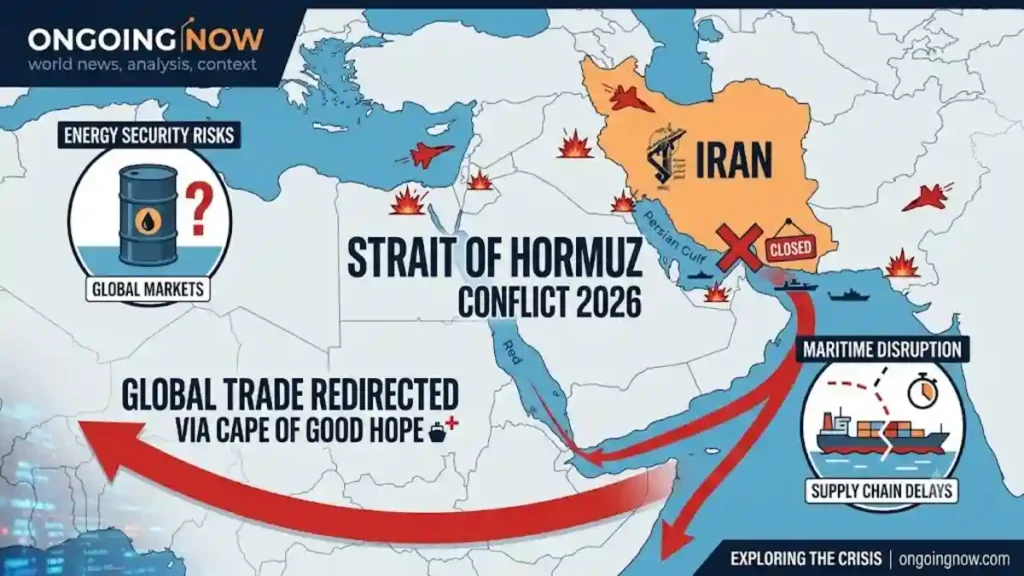
The Strait of Hormuz, a critical artery for global oil supplies, has seen shipping come to a virtual standstill. Iranian retaliatory strikes on neighboring countries—including Bahrain, Kuwait, and the UAE—have targeted both military assets and civilian airports, leading to widespread flight cancellations and increased insurance premiums for maritime trade.
Voices from the Region
“We and our children will sacrifice our lives for the revolution,” stated Hassan Fathollahi, a 54-year-old resident of Tehran, during a public gathering. His sentiment reflects a segment of the population that remains committed to the current leadership despite the mounting pressure. Conversely, many opposition activists view the current instability as the “single greatest chance” for political change, as highlighted by the trending of #MIGA on social media platforms.
Broader Geopolitical Context
The conflict has drawn in multiple international actors, transforming a regional dispute into a global security concern. NATO has bolstered its missile defense posture in response to Iranian ballistic missile launches, while the International Atomic Energy Agency (IAEA) continues to express concern over its inability to verify the status of Iran’s nuclear facilities.
The Middle East peace negotiations 2026 have effectively been sidelined by the military campaign. Traditional mediators, such as Qatar and Oman, find themselves in an increasingly difficult position as Iranian counter-strikes hit targets within their borders or near their territorial waters.
Challenges and Comparative Analysis
The current strategy faces significant logistical and political hurdles. While the U.S. and Israel have successfully degraded much of Iran’s air defense and naval capabilities, the prospect of a ground invasion—a possibility Foreign Minister Abbas Araghchi says Iran is prepared for—remains a point of intense debate in Washington.
Historical Comparison: The 1991 Gulf War
Like the 1991 conflict, the current campaign relies heavily on air superiority and the degradation of command-and-control systems. However, unlike 1991, the current objective includes a more explicit push for domestic regime change, which historically carries a higher risk of prolonged instability and asymmetric warfare.
What the Data Shows
Verified metrics from the first week of the conflict indicate a high operational tempo:
Naval Attrition: At least 9 major Iranian naval vessels confirmed destroyed by U.S. forces.
Missile Interceptions: Patriot and THAAD batteries in Israel and neighboring states have intercepted over 150 incoming projectiles.
Economic Impact: The Iranian rial has reached a historic low, further fueling domestic unrest that predated the military strikes.
Analysis of Military Reserves
While President Trump maintains that munitions supplies are “unlimited,” independent reports from the Wall Street Journal suggest that the pace of consumption for SM-3 interceptors and Tomahawk missiles is placing a strain on long-term reserves. This discrepancy highlights a central tension in the administration’s “forever war” rhetoric versus the reality of high-intensity modern conflict.
As the conflict enters its second week, the international community remains focused on whether the “unconditional surrender” demand will lead to a decisive breakthrough or a protracted regional war.
Stay sharp with Ongoing Now!
Source and Data Limitations: This report is based on verified news dispatches from the first week of March 2026, including official statements from the White House, the House of Commons Library, and accredited international news agencies (AP, Reuters, Middle East Eye). Data regarding Iranian casualties and internal regime stability is subject to reporting delays due to internet blackouts and restricted access to conflict zones. Claims regarding the “death of the Supreme Leader” are cited as reported by multiple sources but remain subject to official verification from Tehran. Information regarding U.S. munitions levels reflects both official administration claims and conflicting independent analytical reports. This article excludes speculative social media rumors not corroborated by at least two independent journalistic entities.