How NCAA JUCO Transfer Rules Dictate College Football Eligibility Benchmarks
How transfer credit evaluation mechanics, GPA benchmarks, and NCAA progress-toward-degree rules impact two-year athlete mobility.
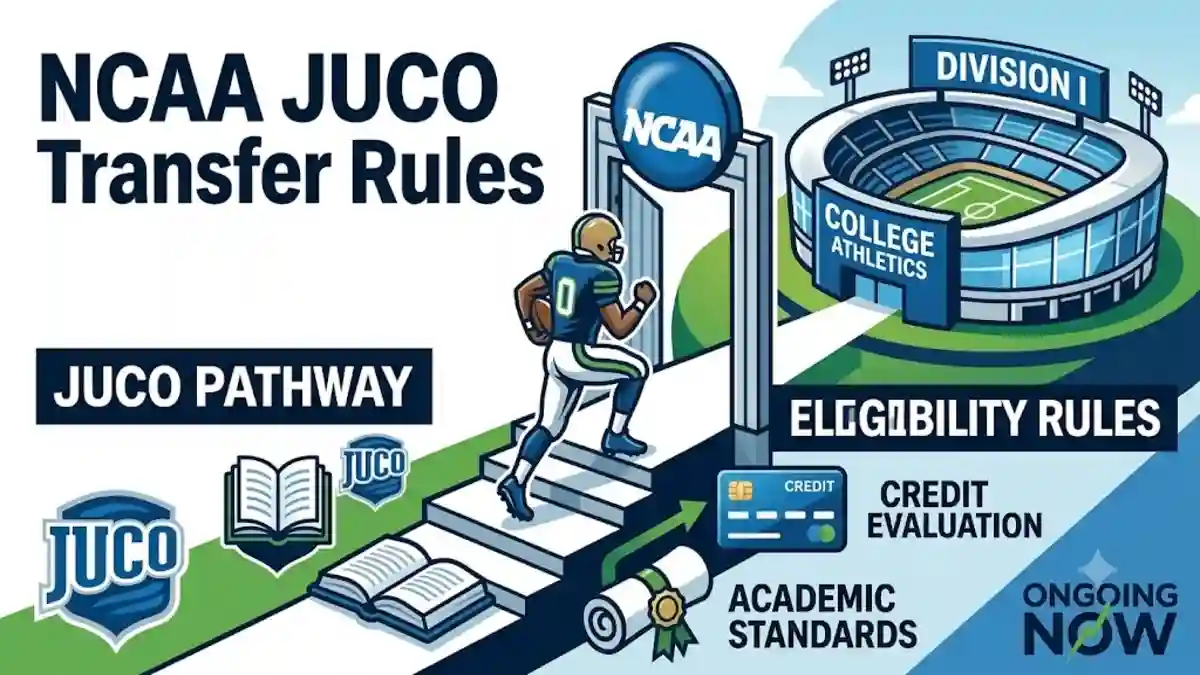
Understanding JUCO to NCAA Division I transfer credit requirements is essential for student-athletes seeking path mobility from two-year colleges to top-tier university athletics. For thousands of prospects across the National Junior College Athletic Association (NJCAA), navigating the interplay between academic credit evaluations, core course mandates, and NCAA Eligibility Center benchmarks dictates whether a transfer results in immediate competition or sidelined academic residence.
The pathway from junior college athletics to Division I sports represents one of the most highly regulated academic pipelines in American higher education. Student-athletes must meet precise credit thresholds, complete mandatory general education distributions, and maintain transferable Grade Point Averages (GPAs) calculated exclusively by the receiving university’s admissions registrar. This analytical breakdown examines the structural mechanics of 2-to-4 transfers, institutional compliance standards, and the academic progress metrics governing transfer eligibility.
Academic Qualifier Status Dictates Two-Year Transfer Benchmarks
The primary determinant of transfer complexity is an athlete’s academic status upon initial graduation from high school. The National Collegiate Athletic Association (NCAA) categorizes incoming junior college transfers into two distinct tracks: initial qualifiers and non-qualifiers.
Qualifier Requirements
Student-athletes who satisfied NCAA Division I initial-eligibility standards in high school (including core-course distributions, GPA requirements, and standardized test metrics) face a streamlined academic standard at the junior college level:
Full-Time Attendance: Minimum of one full-time semester or two full-time quarters in residence at the junior college.
Credit Accumulation: Completion of an average of 12 transferable credit hours for each full-time term attended.
GPA Floor: Maintenance of a minimum cumulative 2.500 transferable GPA.
Non-Qualifier Requirements
For student-athletes who did not meet initial high school requirements, NCAA Division I guidelines mandate a more rigorous two-year academic regimen designed to establish college-level academic readiness prior to transfer:
Associate Degree: Graduation from the junior college with an Associate Degree. At least 25 percent of the degree’s credit hours must be earned directly at the awarding two-year institution.
Term Residency: Completion of at least three full-time semesters or four full-time quarters of enrollment at the two-year college.
Total Transferable Units: A minimum of 48 transferable semester hours or 72 transferable quarter hours.
Core Distribution Mandate: Specific transferable course completion with passing grades:
English: 6 semester or 8 quarter credit hours.
Mathematics: 3 semester or 4 quarter credit hours.
Natural or Physical Science: 3 semester or 4 quarter credit hours.
GPA Threshold: A minimum cumulative transferable GPA of 2.500.
Credit Evaluation Mechanics and Progress-Toward-Degree Rules
A critical point of friction for transferring student-athletes involves the distinction between earned credits at a junior college and transferable credits accepted by a Division I admissions department. The NCAA Eligibility Center does not evaluate or grant transfer credits directly; rather, eligibility relies entirely on whether the target four-year institution accepts each credit toward its own degree programs.
+-----------------------------------------------------------------------------------+
|                        NCAA DIVISION I TRANSFER ELIGIBILITY                       |
+-----------------------------------------------------------------------------------+
|  High School Status   | Minimum Terms | Min. Transferable Hours | Min. Transfer GPA |
+-----------------------+---------------+-------------------------+-------------------+
| Academic Qualifier    | 1 Semester    | 12 per full-time term   | 2.500 GPA         |
| Academic Non-Qualifier| 3 Semesters   | 48 total + Associate Deg| 2.500 GPA         |
+-----------------------------------------------------------------------------------+
Physical Education Credit Limits
NCAA bylaws impose strict limits on physical education activity courses. No more than two credit hours of physical education activity courses can be applied toward the minimum transferable credit hour requirement, unless the student-athlete is enrolled in a physical education or kinesiology degree program.
The Term-Before-Transfer Requirement
To maintain academic continuity, student-athletes must earn at least 6 transferable semester hours (or 6 quarter hours) during their final full-time term of enrollment at the junior college immediately preceding the transfer.
Division I Progress-Toward-Degree (PTD) Benchmarks
Once enrolled at a Division I university, transfer student-athletes must meet NCAA Progress-Toward-Degree rules to retain athletic eligibility year-over-year:
By Year 3 (5th Semester): Completion of 40% of specific degree requirements.
By Year 4 (7th Semester): Completion of 60% of specific degree requirements.
By Year 5 (9th Semester): Completion of 80% of specific degree requirements.
Academic Advising and Institutional Support Networks
To prevent academic credit loss, major junior college athletic programs employ specialized academic advisors to monitor transfer pathways. Institutions like the New Mexico Military Institute (NMMI) operate structured athletic academic advising programs within dedicated learning centers to ensure student-athletes align their coursework directly with NCAA, NJCAA, and NAIA standards.
“Advisors work directly with student-athletes to track progress toward graduation, monitor eligibility clocks, and establish explicit credit transfer articulation with four-year compliance offices,” notes documentation from the NMMI Penrod Toles Learning Center.
Academic tracking programs focus heavily on verifying that remedial courses—often taken during initial junior college placement—are paired with college-level general education subjects to prevent shortfalls in total transferable credits.
The Academic Progress Rate (APR) and Institutional Incentives
Division I institutions are held accountable for student-athlete academic retention through the NCAA Academic Progress Rate (APR). The APR measures term-by-term academic eligibility and institutional retention, awarding points for each scholarship athlete who remains academically eligible and stays enrolled.
+-----------------------------------------------------------------------------------+
|                      ACADEMIC PROGRESS RATE (APR) METRICS                         |
+-----------------------------------------------------------------------------------+
| Metric                 | Standard Requirement                                     |
+------------------------+----------------------------------------------------------+
| Eligibility Point      | Earned per term if athlete meets minimum GPA/credit rules|
| Retention Point        | Earned per term if athlete re-enrolls at the university  |
| Minimum Team Threshold | 930 multi-year score (out of 1000) to avoid penalties    |
| Transfer GPA Buffer    | 2.600 GPA waives retention point loss upon transfer      |
+-----------------------------------------------------------------------------------+
Because an incoming junior college transfer directly impacts a program’s multi-year APR score, Division I coaching staffs increasingly prioritize transfers with GPAs exceeding 2.600 to safeguard against potential penalties, such as practice reductions or post-season bans.
Policy Evolution and Legal Precedents Impacting Junior College Eligibility
The regulatory landscape surrounding junior college transfer eligibility has experienced significant shifts due to federal litigation and administrative policy updates.
Historically, the NCAA enforced a five-year clock within which student-athletes could complete four seasons of competition. However, legal challenges regarding how junior college participation counts toward Division I eligibility timelines have prompted policy revisions. In response to judicial rulings, the NCAA Division I Board of Directors approved specific eligibility waivers and transitional rules for student-athletes competing at non-NCAA institutions—including junior colleges—to harmonize transfer rules with evolving name, image, and likeness (NIL) environments and transfer portal mechanics.
These administrative updates underscore the necessity for transferring athletes to maintain continuous coordination between NJCAA athletic directors, NCAA eligibility staff, and receiving university registrar departments.
Stay sharp with Ongoing Now!
Source and Data Limitations: Information compiled from published guidelines by the National Collegiate Athletic Association (NCAA Eligibility Center), National Junior College Athletic Association (NJCAA) regulatory bylaws, the NCAA Division I Manual, and institutional academic advising documentation from the New Mexico Military Institute (NMMI). This analysis reflects general governance structures; individual course transferability remains subject to the institutional autonomy of receiving university registrars. Unverified eligibility projections and speculative transfer portal claims were excluded.