How the Massive Valiant Shield 2026 SINKEX Drill Redefines Maritime Deterrence
International joint forces coordinate high-precision multi-domain strikes in the Western Pacific to secure vital oceanic corridors.
The execution of the valiant shield 2026 sinkex highlights a profound shift in the overarching indo pacific maritime strategy. Conducted alongside a wider array of us navy guam military exercises, this complex philippine sea naval exercise brought together pacific command joint forces to strengthen maritime deterrence western pacific. This year’s multi nation field training exercise incorporated advanced us japan joint military drills, demonstrating how modern us allied naval exercises rely on joint force multi domain operations to secure vital oceanic corridors.
The defense ministries of the United States, Japan, Australia, Canada, and New Zealand confirmed coordinated participation in the 11th iteration of these drills. Admiral Steve Koehler, commander of the U.S. Pacific Fleet, noted that the integrated operations demonstrate an enduring commitment to maintaining stability across the regional commons. The event serves as a critical test of collective readiness in a highly contested geography.
High-Precision Strikes in the Western Pacific
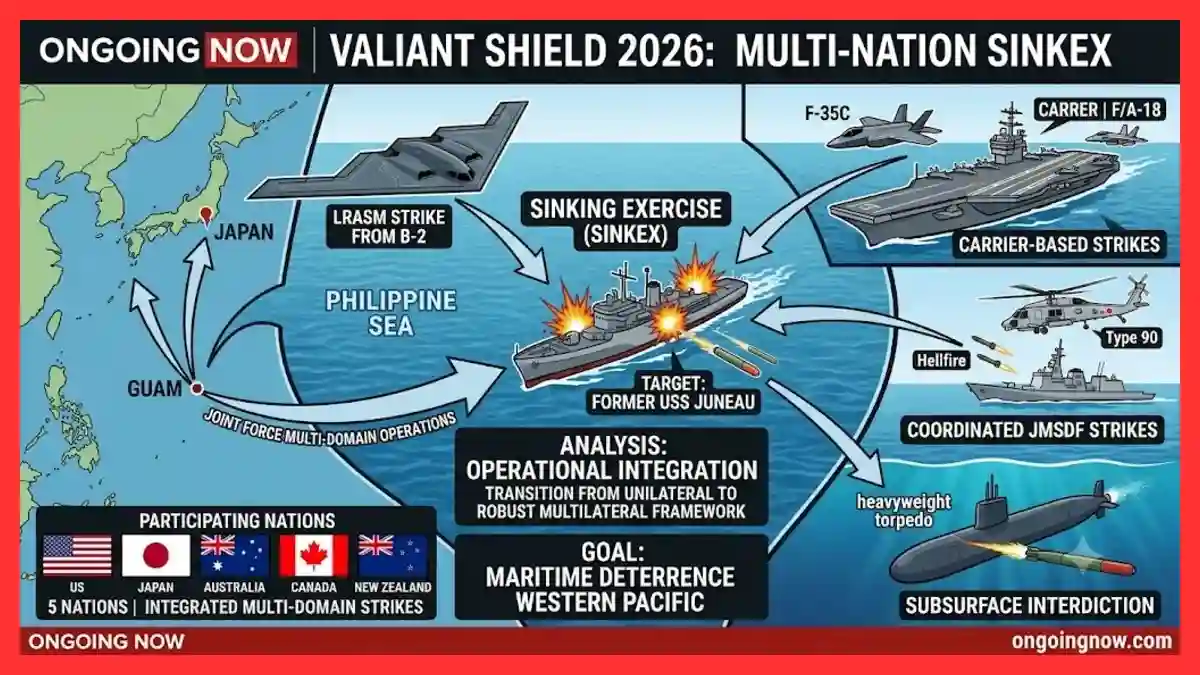
The live-fire sinking exercise occurred more than 200 nautical miles off the coast of Guam within the Mariana Islands Range Complex. The primary target was the thoroughly cleaned and decommissioned Austin-class amphibious transport dock, the former USS Juneau (LPD-10). Coordinated air, surface, and subsurface assets engaged the target vessel over several hours, systematically testing the lethality of modern ordnance.
Initial phases of the engagement involved fixed-wing assets launched from both terrestrial baselines and carrier decks. F-35C Lightning II stealth fighters and F/A-18 Super Hornets from Carrier Air Wing 5 executed precise runs, simulating complex anti-ship cruise missile profiles. These platforms operated in close coordination with land-based long-range strike platforms to saturate the target’s simulated defensive perimeter.
A prominent milestone during the live-fire sequence was the deployment of an AGM-158C Long Range Anti-Ship Missile (LRASM) by a U.S. Air Force B-2 Spirit stealth bomber assigned to the 509th Bomb Wing. Operating out of Andersen Air Force Base in Guam, the strategic platform demonstrated the seamless blending of strategic air assets into tactical maritime strike operations.
Strategic Significance of the Valiant Shield 2026 SINKEX
Analysis: Operational Integration
The transition of Valiant Shield from a historically unilateral U.S. exercise to a robust multilateral framework represents a deliberate evolution in regional architecture. By integrating international partners directly into highly sensitive live-fire events like a SINKEX, participant nations move past basic messaging and enter the realm of deep tactical interoperability.
The multi-domain environment tested during the exercise required real-time sensor-to-shooter data links spanning thousands of miles. Space, cyber, and electronic warfare commands worked in tandem to shield communications networks while ensuring targeting telemetry remained accurate. This high level of cross-combatant command cooperation is essential for managing dense information environments during major maritime contingencies.
Rear Adm. Eric Anduze, commander of Carrier Strike Group 5 and Task Force 70, highlighted the value of the exercise following the event. “This SINKEX provided an outstanding opportunity for our joint team to integrate capabilities across domains, honing the lethal precision and coordination essential for high-end maritime operations in the Pacific theater,” Anduze stated in an official release.
Operational Scope: Units and Assets Engaged
The backbone of the naval surface contingent rested upon the Nimitz-class aircraft carrier USS George Washington (CVN-73) and its accompanying strike group. Key escort vessels included the Ticonderoga-class guided-missile cruiser USS Robert Smalls (CG-62) and Arleigh Burke-class destroyers USS Benfold (DDG-65) and USS Shoup (DDG-86). The Virginia-class fast-attack submarine USS Minnesota (SSN-783) provided subsurface security and surveillance during the opening phases of the drill.
International contributions provided a substantial footprint during the maritime maneuvers. The Japan Maritime Self-Defense Force (JMSDF) deployed the large-deck helicopter destroyer JS Kaga (DDH-184), the destroyer JS Fuyuzuki (DD-118), and the Taigei-class submarine JS Jingei (SS-515). Australia contributed a P-8A Poseidon maritime patrol aircraft alongside embedded staff officers situated within command elements across the region.
| Participating Country | Core Maritime Assets Deployed | Primary Multi-Domain Mission Role |
| United States | USS George Washington CSG, B-2 Spirit Bombers, F-35C Squadrons | Command and Control, Strategic Long-Range Anti-Ship Strike |
| Japan | JS Kaga, JS Fuyuzuki, JS Jingei Submarine, SH-60 Helicopters | Subsurface Interdiction, Coordinated Tactical Missile Strike |
| Australia | P-8A Poseidon, Embedded Command Staff | Airborne Intelligence, Surveillance, and Reconnaissance (ISR) |
| Canada | Specialized Liaison and Operational Personnel | Multi-National Joint Force Logistics Integration |
| New Zealand | Tactical Command and Support Elements | Air-Land Space Integration and Communications Security |
Caveat: This asset tracking table represents publicly acknowledged naval and air deployments for the specific SINKEX phase and does not detail undisclosed subsurface or cyber-defense units.
The final phases of the ship targeting displayed exceptional cross-national tactical sequencing. A JMSDF SH-60 helicopter launched an AGM-114 Hellfire missile against the superstructure, followed closely by a Type 90 anti-ship missile fired from a Japanese surface combatant. The definitive blow that sent the former USS Juneau to the ocean floor was delivered via a heavyweight torpedo launched by a JMSDF submarine, demonstrating unified multi-axis capabilities.
Environmental Compliance and Maritime Safety Protocols
Large-scale live-fire exercises require rigorous environmental and structural screening processes long before any weapons are cleared for launch. The former USS Juneau underwent a strict cleaning regimen conducted over multiple months to fulfill international treaties and domestic safety criteria. Workers completely removed polychlorinated biphenyls (PCBs), residual petroleum products, mercury-containing materials, and heavy storage fluids.
The cleaning process was executed in strict accordance with the guidelines established by the United States Environmental Protection Agency (EPA) under the Marine Protection, Research, and Sanctuaries Act. Sinking locations are chosen specifically to ensure that the remains rest at a depth of at least 6,000 feet and no closer than 50 nautical miles from the nearest land mass. These precautions prevent localized marine disruptions and protect coastal ecosystems from contamination.
Furthermore, the operational zones within the Mariana Islands Range Complex were thoroughly surveyed using advanced acoustic monitoring and aerial reconnaissance. Teams verified that no marine mammals, sea turtles, or commercial fishing vessels were within the hazard sectors prior to authorizing live weapons deployment. This rigorous safety process reflects a commitment to minimizing environmental footprints during essential readiness training.
Comparative Analysis: Evolution from Unilateral to Multilateral Operations
To understand the scale of the current framework, observers point to the historical baseline of the Valiant Shield series, which commenced as a strictly U.S.-only training event in 2006. Early iterations focused primarily on fixing structural friction points between the U.S. Navy, Marine Corps, and Air Force. The expansion to incorporate regional partners represents a major strategic shift in how the Western Pacific defense framework operates.
When compared to other major regional drills, such as the biennial Rim of the Pacific (RIMPAC) exercise, Valiant Shield maintains a more concentrated, high-intensity operational focus. While RIMPAC gathers dozens of nations for broad-spectrum maritime security and humanitarian operations, Valiant Shield focuses explicitly on high-end combat integration, advanced multi-domain weaponry, and direct coordination across distinct combatant commands, including U.S. Space Command and U.S. Transportation Command.
The inclusion of cutting-edge land-based elements further differentiates the 2026 iteration. The temporary deployment of the Typhon missile system and High Mobility Artillery Rocket Systems (HIMARS) to Japan’s Kanoya Air Base illustrates the focus on distributed lethality. Land forces are no longer confined to territorial defense; they are actively training to project power into the maritime domain, creating complex challenges for potential adversaries.
Shifting Dynamics in Regional Maritime Alliances
The geopolitical landscape of the Indo-Pacific has pushed regional militaries toward closer, more visible alignments. For many years, joint training was restricted to basic formation sailing, search-and-rescue communication drills, or ceremonial port visits. The execution of a multi-nation SINKEX demonstrates that participating nations are building a cohesive, standardized network capable of unified operations.
Parallel to these maneuvers, other nations are expanding their regional diplomatic and security footprints. For example, the Indian Navy recently deepened its regional engagement with a port call at Ho Chi Minh City, Vietnam, by the vessels INS Udaygiri and INS Kavaratti. These activities emphasize a growing web of overlapping maritime partnerships that collectively reinforce the established legal order governing international waters.
The emphasis throughout these exercises remains firmly on maintaining an open, accessible maritime domain. By testing advanced tactical concepts in plain view, participating nations demonstrate the logistical and technical capacity to sustain long-range operations. This visible readiness forms the foundation of modern maritime stabilization strategies in deep-water environments.
Measured Outcomes and Long-Term Technical Effects
The data gathered during the sinking of the target vessel provides engineers and planners with invaluable insights that simulation software cannot accurately duplicate. Sensors monitored the weapon blast impacts, structural degradation, and hydrodynamic collapse of the hull as it descended. This technical feedback directly informs the development of next-generation defensive systems and damage-control methodologies for active fleets.
Additionally, the exercise successfully validated the deployment of automated data-routing systems designed to maintain network connectivity under active electronic jamming. By utilizing distributed nodes across space, airborne relays, and surface vessels, the joint force proved that real-time tracking can survive inside a compromised digital environment. The technical success of these systems marks a clear advancement in modern fleet command architecture.
Ultimately, the collaborative exercise serves as a practical demonstration of integrated deterrence. The ability to coordinate a multi-national strike group, manage complex environmental safety protocols, and execute precise live-fire tasks confirms a shared operational standard. These unified actions ensure the maritime corridors of the Western Pacific remain stable, predictable, and open to international commerce.
Stay sharp with Ongoing Now!
Source and Data Limitations: This geopolitical analytical explainer is compiled using official public statements and operational media releases from the U.S. Pacific Fleet, the Japan Maritime Self-Defense Force, the U.S. Department of War, and regional port authorities up to July 1, 2026. Data limitations include the exclusion of classified tactical frequencies, electronic warfare parameters, and exact submarine tracking data. Information regarding specific ordnance yields and telemetry performance remains restricted for national security reasons. All environmental compliance references reflect published records from the U.S. Environmental Protection Agency and standard maritime safety frameworks. Due to the fluid nature of international naval movements, long-term asset positioning may shift from the parameters recorded during the active exercise window spanning June 22 to July 1, 2026.