How Campaign Finance Regulations and Signature Rules Reshape Independent Races
Navigating complex federal election commission standards, contribution limits, and petition rules for nonpartisan congressional bids.
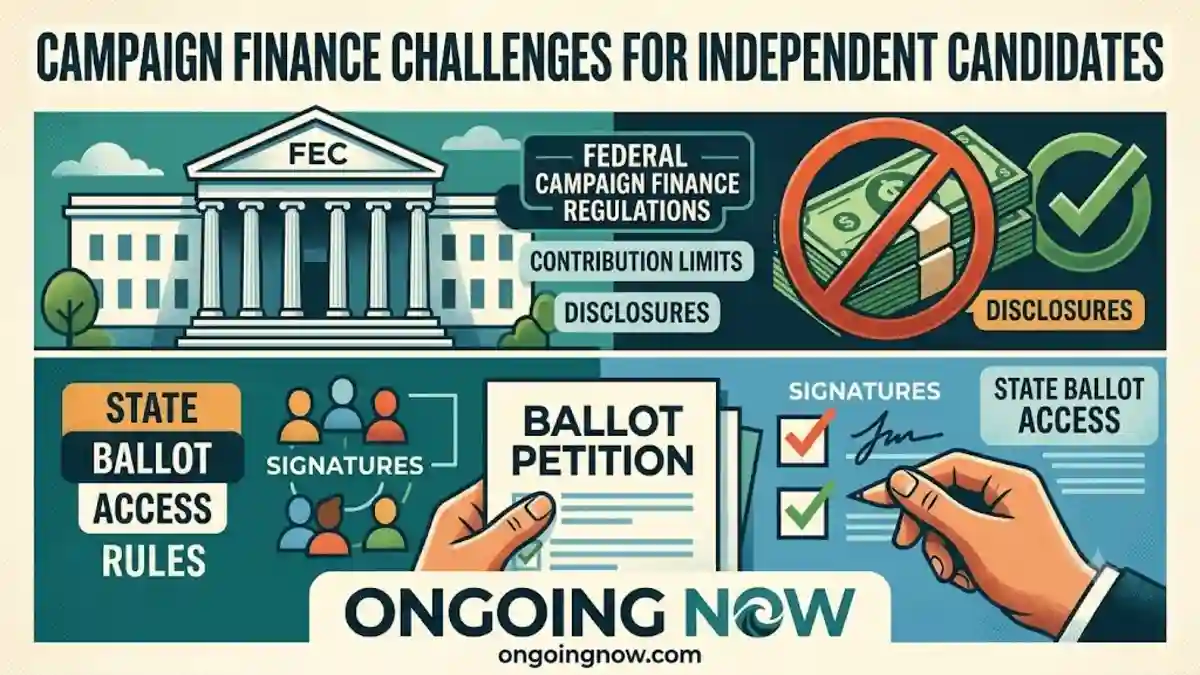
Running as an independent for congress requires navigating a dense web of statutory deadlines, administrative hurdles, and strict financial disclosures. While candidate selection within major political parties is governed by primary elections, nonpartisan candidates face a distinct structural path to secure a spot on the general election ballot. This process demands strict compliance with both state-level election codes and federal campaign finance regulations enforced by the Federal Election Commission. Across all 50 states, independent congressional candidates must execute precise petition drives, manage specialized political action committee compliance, and adhere to federal election campaign finance contribution limits. Understanding these regulatory frameworks is vital for analyzing how nonpartisan election requirements shape ballot access, campaign strategy, and broader democratic participation across the United States.
+----------------------------------------------------------------------------------------------------+
|                      FEDERAL VS. STATE INDEPENDENT CANDIDATE REQUIREMENTS                          |
+------------------------------------+---------------------------------------------------------------+
| Regulatory Area                    | Governing Body & Compliance Mechanism                         |
+------------------------------------+---------------------------------------------------------------+
| Ballot Access Petition Rules       | State Secretarial of State / Board of Elections               |
| Campaign Contribution Limits       | Federal Election Commission (52 U.S.C. § 30116)               |
| Financial Disclosure Reports       | Federal Election Commission (Form 3 & Form 3P)                |
| PAC & Super PAC Rules              | Federal Election Commission (11 CFR Part 100-116)             |
| Personal Financial Disclosures     | U.S. House / Senate Ethics Committees                         |
+------------------------------------+---------------------------------------------------------------+
Navigating State Ballot Access Petition Rules for Nonpartisan Candidates
The fundamental hurdle when running as an independent for congress begins at the state level. Unlike major party nominees who automatically secure ballot placement upon winning a primary, independent candidates must collect thousands of verified voter signatures. Under state ballot access petition rules, signature thresholds vary significantly. States like California and Texas require specific percentages of registered voters or previous election turnouts, whereas other jurisdictions set flat numeric quotas. Furthermore, petition circulation windows are frequently constrained to narrow timeframes, sometimes coinciding with active major-party primary campaigns.
+----------------------------------------------------------------------------------------------------+
|                         BALLOT ACCESS PETITION REQUIREMENTS BY SAMPLE STATE                        |
+-------------------+------------------------------------+-------------------------------------------+
| State             | Signature Threshold Requirement    | Filing Deadline Window                    |
+-------------------+------------------------------------+-------------------------------------------+
| California        | 1% to 3% of registered district    | Mid-March to early August                 |
|                   | voters                             |                                           |
| Texas             | 500 signatures or 1% of last       | May following primary runoff              |
|                   | gubernatorial vote                 |                                           |
| New York          | 3,500 signatures or 5% of enrolled | Early May signature deadline              |
|                   | voters                             |                                           |
| Florida           | 1% of active registered voters in  | Late April to noon in mid-June            |
|                   | district                           |                                           |
+-------------------+------------------------------------+-------------------------------------------+
Administrative challenges to petition sheets represent a frequent pressure point in nonpartisan ballot access. Opposing campaigns and state election officials regularly audit submitted signature books for technical flaws, such as mismatched voter addresses, out-of-district signers, or improper notary certifications. In its seminal 1971 decision, Jenness v. Fortson (403 U.S. 431), the Supreme Court of the United States upheld state authority to require independent candidates to demonstrate a “significant modicum of support” before placing their names on the ballot, establishing that differential rules between party-affiliated and nonpartisan candidates do not automatically violate the Equal Protection Clause of the Fourteenth Amendment.
Federal Campaign Finance Regulations and the FEC Framework
Once a candidate raises or spends more than $5,000 in support of a congressional campaign, federal election candidate disclosures become mandatory. Under the Federal Election Campaign Act (FECA), administered by the Federal Election Commission, independent candidates must register a principal campaign committee using FEC Form 1 within 10 days of reaching the $5,000 threshold. From that point forward, all financial transactions—contributions, expenditures, loans, and debts—must be tracked meticulously and reported on regular quarterly disclosure filings.
FEC campaign finance regulations apply equally to major party, third-party, and independent candidates. However, independent campaigns often operate without the institutional compliance infrastructure provided by established political parties. Candidates must record the full name, mailing address, occupation, and employer for every individual who contributes more than $200 in an election cycle. Failure to accurately maintain these records or meet statutory filing deadlines can result in administrative fines levied by the FEC’s Alternative Dispute Resolution program or formal audit enforcement actions.
Campaign Finance Contribution Limits and Financial Compliance
Fundraising when running as an independent for congress is governed strictly by statutory campaign finance contribution limits. Under 52 U.S.C. § 30116, individual contributors are subject to hard caps on the amount they may donate directly to a candidate’s committee per election. Because the primary and general elections are treated as separate legal contests under federal law, independent candidates can raise funds up to the statutory limit for both the primary (if applicable under state nonpartisan blanket system rules) and general elections.
+----------------------------------------------------------------------------------------------------+
|                       FEDERAL CONTRIBUTION LIMITS FOR CONGRESSIONAL CAMPAIGNS                      |
+------------------------------------+----------------------------------+----------------------------+
| Contributor Type                   | Recipient                        | Limit per Election         |
+------------------------------------+----------------------------------+----------------------------+
| Individual Donor                   | Candidate Committee              | $3,300*                    |
| Multicandidate PAC                 | Candidate Committee              | $5,000                     |
| Non-Multicandidate PAC             | Candidate Committee              | $3,300*                    |
| State/Local Party Committee        | Candidate Committee              | $5,000 (combined)          |
| National Party Committee           | Candidate Committee (House)      | $5,000                     |
+------------------------------------+----------------------------------+----------------------------+
*Note: Figures reflect indexing for inflation during federal election cycles under 52 U.S.C. § 30116.*
Independent candidates are legally permitted to contribute or loan unlimited personal funds to their own campaigns, as established by the Supreme Court in Buckley v. Valeo (424 U.S. 1, 1976). However, if an independent candidate receives loans from financial institutions or third parties, those transactions must follow strict commercial terms to avoid being reclassified as illegal campaign contributions. Additionally, federal election commission pac rules govern how independent campaigns interact with political action committees to ensure that direct contributions remain within statutory bounds.
Federal Election Commission PAC Rules and Independent Campaigns
Navigating political action committee compliance is a central component of federal campaign management. Traditional PACs, structured under 11 CFR Part 100, may contribute up to $5,000 per election directly to an independent congressional candidate’s committee if they qualify as a multicandidate committee. However, independent candidates often face unique dynamic realities when interacting with political action committee structures, particularly Independent Expenditure-Only Political Committees, commonly known as Super PACs.
Super PACs and 501(c)(4) social welfare organizations may raise and spend unlimited funds from corporations, labor unions, and individuals to advocate for or against candidates. Under federal election commission pac rules, the legal threshold dividing permissible independent advocacy from illegal campaign contributions is the strict rule against coordination. Under 11 CFR § 109.21, a communication is deemed a prohibited in-kind contribution if it is made at the request, suggestion, or with the material involvement of the candidate or their authorized agents. Consequently, independent campaigns must establish clear internal compliance protocols to ensure zero communication or strategic alignment with outside expenditure groups.
Human and Societal Impact of Nonpartisan Election Requirements
The intersection of state petition rules and federal campaign regulations deeply influences local communities, campaign volunteers, and the electorate. For grass-roots independent campaigns, complying with nonpartisan election requirements frequently necessitates shifting vital resources away from voter outreach and policy discussions toward legal defense and signature gathering operations. Community organizers and field workers must undergo extensive training to ensure every petition signee is a properly registered voter within the specific congressional district boundaries.
“The right of individuals to associate for the advancement of political beliefs, and the right of qualified voters, regardless of their political persuasion, to cast their votes effectively are two of our most precious freedoms.” — Justice Hugo Black, writing for the Supreme Court in Williams v. Rhodes (393 U.S. 23, 1968)
From a voter’s perspective, stringent ballot access laws shape the variety of ideological and policy choices presented on election day. Supporters argue that robust petition requirements prevent voter confusion by screening out frivolous candidacies and ensuring that only candidates with measurable community support appear on the official ballot. Conversely, critics and nonpartisan advocacy organizations contend that excessive signature thresholds and rigid administrative hurdles insulate major political parties from competition, reducing overall voter engagement and suppressing nonpartisan political expression.
Analysis: Structural Hurdles for Nonpartisan Candidates
+----------------------------------------------------------------------------------------------------+
|                       OPERATIONAL AND LEGAL COMPARISON OF CAMPAIGN TYPES                           |
+----------------------------------+--------------------------------+--------------------------------+
| Campaign Operation Dimension     | Major Party Nominee            | Independent Candidate          |
+----------------------------------+--------------------------------+--------------------------------+
| Primary Election Obligation      | Must compete in official party | Varies by state; often bypasses|
|                                  | primary election               | primary to signature drive     |
| Ballot Signature Burden          | Nominal or automatically filed | High; typically thousands of   |
|                                  | via party primary victory      | verified voter signatures      |
| Party Legal & Compliance Support  | Provided by national and state | Self-funded or managed by      |
|                                  | party committees               | retained election attorneys    |
| Automated Donor Lists            | Access to party databases      | Must build donor base from     |
|                                  | (e.g., ActBlue, WinRed)        | ground level independently     |
+----------------------------------+--------------------------------+--------------------------------+
An examination of political action committee compliance data and state filing registries reveals that running as an independent for congress presents distinct operational challenges compared to major-party efforts. Major-party nominees benefit from established national voter databases, shared legal infrastructure, and institutional fundraising networks. Independent campaigns, by contrast, must construct their administrative, legal, and compliance frameworks entirely from scratch.
This structural disparity is particularly pronounced in financial disclosure and reporting compliance. While major-party candidates rely on experienced party treasurers to handle federal election candidate disclosures, independent candidates often hire private compliance firms or rely on volunteer treasurers. Errors in managing campaign finance contribution limits or reporting schedules can result in severe financial penalties, creating an additional administrative barrier for nonpartisan candidates attempting to challenge established political structures.
Comparative Perspective: Historical Legal Precedents and Reform Movements
The legal framework governing independent congressional candidacies has evolved through decades of jurisprudence and statutory changes. Landmark rulings by the Supreme Court have continually balanced the constitutional rights of candidates and voters under the First and Fourteenth Amendments against state interests in maintaining orderly elections.
+----------------------------------------------------------------------------------------------------+
|                         KEY SUPREME COURT PRECEDENTS ON BALLOT ACCESS                              |
+--------------------------+------+------------------------------------------------------------------+
| Case Title               | Year | Core Judicial Holding                                            |
+--------------------------+------+------------------------------------------------------------------+
| Williams v. Rhodes       | 1968 | Struck down Ohio laws making it virtually impossible for third   |
|                          |      | parties or independents to gain ballot access.                   |
| Jenness v. Fortson       | 1971 | Upheld Georgia law requiring 5% petition signature threshold for |
|                          |      | independent candidates.                                          |
| Storer v. Brown          | 1974 | Validated state "sore loser" laws prohibiting defeated party     |
|                          |      | primary candidates from running as independents in general.      |
| Anderson v. Celebrezze   | 1983 | Invalidated early filing deadlines that unfairly burden          |
|                          |      | independent presidential and congressional candidates.           |
+--------------------------+------+------------------------------------------------------------------+
In Anderson v. Celebrezze (460 U.S. 780, 1983), the Supreme Court established a balancing test that federal courts continue to apply when evaluating state ballot access petition rules. The Court ruled that judges must weigh the character and magnitude of the asserted injury to constitutional rights against the precise interests advanced by the state. This legal standard remains the primary mechanism by which independent candidates challenge restrictive state election laws today.
In recent years, legislative reform efforts in several states have sought to alter ballot access and election mechanisms. Nonpartisan blanket primaries—such as those adopted in Washington, California, and Alaska—allow all candidates, regardless of party affiliation, to run on a single primary ballot, with the top vote-getters advancing to the general election. Proponents argue these systems equalize the playing field for independents, while opponents maintain that without dedicated nonpartisan ballot lines, independent candidates face heightened electoral barriers.
As campaign finance rules and ballot regulations continue to adapt to new legislative and judicial developments, candidates running as an independent for congress must maintain absolute adherence to both state petition guidelines and federal disclosure rules to ensure their campaigns remain viable, compliant, and visible to voters nationwide.
Stay sharp with Ongoing Now!
—
Source and Data Limitations: This analysis relies on official government records, statutory documentation, and codified legal standards available as of early 2026. Core legal and regulatory frameworks analyzed include the Federal Election Campaign Act (FECA), Title 52 of the United States Code (52 U.S.C. § 30116), Title 11 of the Code of Federal Regulations (11 CFR Parts 100-116), and published enforcement guidance from the Federal Election Commission (FEC). State-level signature thresholds and filing windows are drawn from official publications by state Secretaries of State and State Boards of Elections. Legal precedents referenced are derived directly from published decisions of the Supreme Court of the United States. Excluded from this report are unverified news media speculations regarding ongoing campaign filings, non-peer-reviewed political polling data, and predictive election projections. All financial thresholds reflect statutory rates indexed for inflation in federal election guidance.