Securing the fleet: How military beard regulation changes reshape duty rules
The Department of Defense enforces strict timelines for medical shaving exemptions and reviews religious accommodations.
The Department of Defense has initiated a sweeping restructuring of its service appearance protocols, standardizing rules for facial hair across all branches. Driven by a directive from the Office of the Secretary of Defense, the military departments are implementing strict enforcement timelines for medical shaving exemptions while systematically reevaluating long-standing religious accommodations. These administrative updates mark a clear shift toward uniform appearance standards, establishing finite parameters for personnel utilizing medical waivers and shifting final approval authority directly to unit commanders.
Institutional Overhaul of Service Appearance Protocols
The modern framework governing appearance standards across the Armed Forces has undergone its most significant revision in years. Guided by a Department of Defense (DoD) instruction facial hair rules memorandum issued by the Office of the Secretary of Defense, the military services are transitioning away from open-ended exemptions. Under the directive, the foundational standard of the U.S. military remains strictly clean-shaven, with individual exemptions treated as temporary deviations rather than permanent accommodations.
The policy shift stems from a directive by Secretary of Defense Pete Hegseth, whose rapid force-wide review of military standards aimed to reinforce operational uniformity and what the Pentagon terms the “warrior ethos.” The pete hegseth grooming standards memo established clear boundaries for both medical and religious facial hair authorizations. It mandated that all military departments enforce concrete treatment timelines, medical tracking, and commander-driven accountability measures to limit the prevalence of long-term shaving exemptions.
Strict Limits Placed on Medical Exemptions
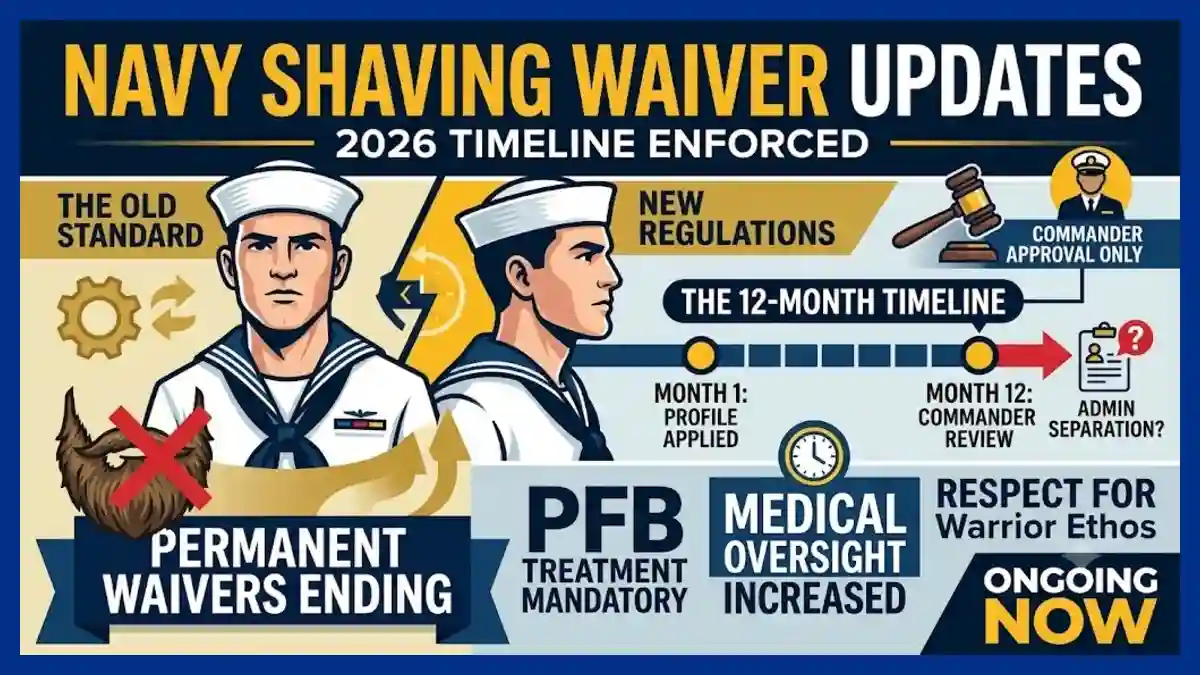
A central component of the updated framework is the total elimination of permanent medical shaving profiles. Historically, service members diagnosed with chronic skin conditions—most notably pseudofolliculitis barbae (PFB), a condition where tightly curled facial hair curves back into the skin, causing painful inflammation and razor bumps—could receive indefinite waivers. The new military razor bumps policy change fundamentally alters this approach by treating PFB as a treatable medical condition with an active recovery pathway rather than a permanent status.
Under the revised DoD directive, military medical officers no longer hold the authority to grant final exemptions. Instead, primary care managers and medical providers are restricted to providing a written clinical recommendation. The final approval authority for all medical shaving waivers rests solely with the unit commander. Furthermore, any approved medical waiver must be paired with an active, documented medical treatment plan, which may include topical medications, specialized shaving hygiene education, or referrals for laser hair removal.
The 12-Month Separation Timeline
The structural core of the military beard regulation changes revolves around a strict, cumulative timeline for service members on medical profiles. The Department of Defense has set a definitive limit on how long a service member can remain non-compliant with standard grooming rules due to a medical condition before administrative action is triggered.
| Branch Implementation | Transition Deadline | Individual Profile Limit | Maximum Cumulative Duration |
| Department of the Navy | Immediate Enforcement | 6 Months | 12 Consecutive Months |
| Department of the Air Force | January 31, 2026 | 6 Months | 12 Months within a 24-Month Period |
| Department of the Army | Immediate Enforcement | Phase-based (Max 90 Days) | 12 Months Total |
As detailed in the navy medical shaving waiver timeline, individuals who are unable to return to standard daily grooming after receiving 12 consecutive months of prescribed medical treatment will face formal review. If a service member requires a shaving waiver beyond this 12-month window, the unit commander is directed to initiate a navy administrative separation grooming review. This process evaluates the member’s long-term fitness for continued naval service, recognizing that an inability to maintain the standard baseline appearance, or an inability to safely deploy due to respirator fit limitations, may warrant an administrative discharge.
Systematic Reevaluation of Religious Accommodations
Separate from the medical waiver tracking, the U.S. Navy and the U.S. Army have launched comprehensive, system-wide redeterminations of all approved and pending religious accommodations (RAs) for facial hair. The navy shaving waiver updates 2026 guidelines require all active and reserve sailors holding a religious exemption to resubmit their formal requests for commander and chaplain review.
This reevaluation process introduces a rigid administrative chain. Sailors are given a window of 10 business days from notice to formally declare their intent to resubmit an accommodation request. Once submitted, the local command has 30 days to process the file, which must include a fresh evaluation by a military chaplain to assess the sincerity of the requestor’s religious belief.
The institutional justification for this rigorous review is driven by a balancing test. As outlined in the Navy’s administrative message issued under the authority of Vice Admiral Jeffrey J. Czerewko, Chief of Naval Personnel:
“Commanding officers must objectively weigh the fundamental value of accommodating religious practices against the compelling, life-or-death interest of maintaining an absolute protective posture and ensuring the operational viability of our fleet.”
Impact on Service Members and Operational Readiness
The operational reality driving the secdef beard policy implementation is the critical requirement for a secure seal on emergency breathing equipment, such as the Oxygen Breathing Apparatus (OBA), gas masks, and damage-control respirators. The Pentagon maintains that any facial hair along the sealing surface of a respirator compromises the protective barrier against chemical, biological, radiological, or nuclear (CBRN) agents, as well as toxic smoke during shipboard firefighting.
The societal and human impact of these changes falls disproportionately on specific demographics within the military population. Pseudofolliculitis barbae heavily affects African American service members and individuals with coarse, curly facial hair. For these troops, the transition away from long-term waivers means navigating intensive medical protocols, laser treatments, or facing potential administrative separation if their skin cannot tolerate standard shaving routines. Concurrently, service members adhering to faiths that mandate uncut facial hair—including Sikhism, Islam, and certain minority Christian and Orthodox traditions—face heightened administrative scrutiny to defend the sincerity of their practices under the new 90-day Pentagon review guidelines.
Historical Context of Military Grooming Rules
The debate surrounding facial hair in the United States military reflects shifting institutional priorities across different eras. Beards were widely accepted and culturally prevalent throughout the American Civil War and the late 19th century. The requirement for a clean-shaven force was institutionalized during World War I, driven specifically by the invention of chemical warfare and the absolute necessity of achieving an airtight seal on early rubber gas masks.
A notable departure occurred in 1970 when Admiral Elmo Zumwalt, the Chief of Naval Operations, modernized Navy grooming standards to improve retention and morale during the Vietnam War era. Zumwalt authorized neatly trimmed beards and longer hair across the fleet. However, this policy was completely rescinded in 1984 by the Department of the Navy, which cited the emergence of advanced, rapid-donning breathing gear and fleet uniformity as primary justifications. The 2026 regulations reinforce the post-1984 orthodox view, aligning all service branches under a centralized, time-limited exemption framework.
Stay sharp with Ongoing Now!
Source and Data Limitations: This policy analysis is based directly on official Department of Defense records, including the Secretarial Memorandum for Senior Pentagon Leadership on Grooming Standards for Facial Hair dated September 15, 2025; Department of the Air Force Guidance Memorandum 2025-03; U.S. Navy administrative messages issued by the Chief of Naval Personnel in June 2026; and official service uniform regulations (BUPERSINST 1000.22/AR 670-1). The data reflects institutional policy parameters and administrative timelines active as of July 2026. This analysis excludes anonymous commentary from digital forums, unverified legal challenges, and political speculation regarding future legislative revisions by Congress.