Astronomers pinpoint the strawberry moon 2026 date and time for low-arc peak
Global astronomy tracking networks establish the strawberry moon 2026 date and time details for optimal June illumination windows
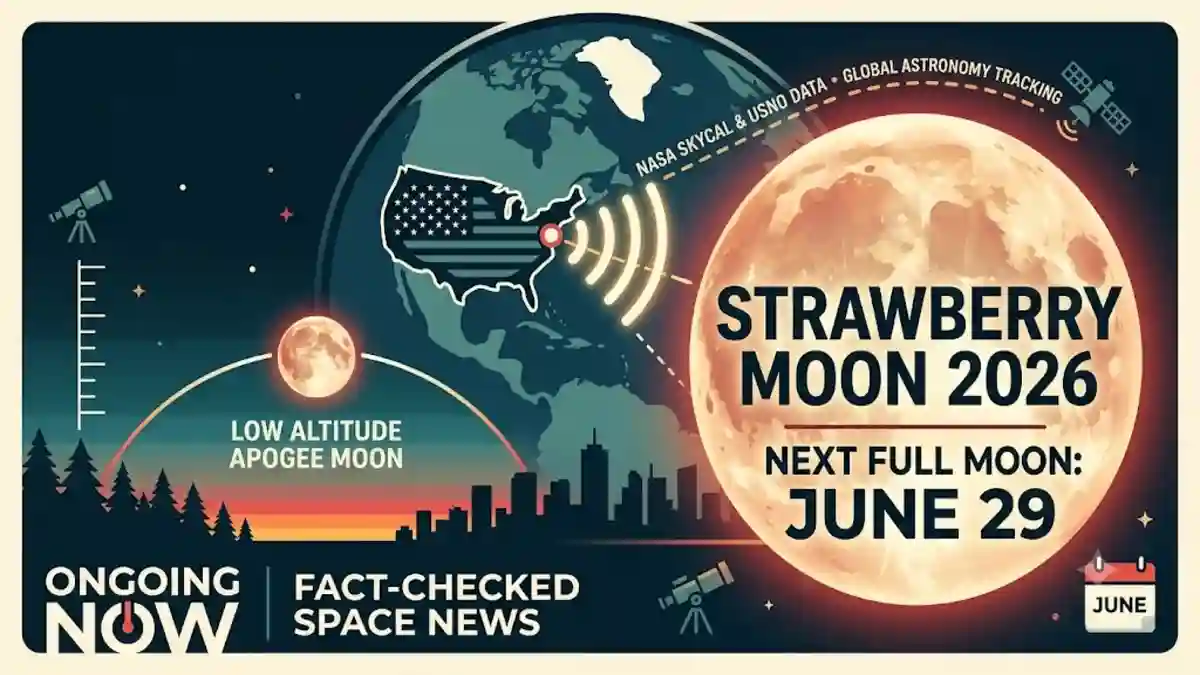
The upcoming lunar cycle will culminate in the first major astronomical event of the summer as data validates the official strawberry moon 2026 date and time. The next full moon june 2026 will reach exact opposition on Monday, June 29, 2026, serving as a key observation target for global astronomical networks. Understanding exactly when is the strawberry moon 2026 enables researchers and casual observers to maximize visibility during its distinct low-altitude transit across the sky. The strawberry moon peak time us bst shows that the event will favor evening observers in the Western Hemisphere and early morning skywatchers in Europe.
Orbital Geometry and the June Full Moon Exact Illumination Time
Calculations provided by the United States Naval Observatory (USNO) and NASA’s SkyCal system establish the june full moon exact illumination time at 23:57 Coordinated Universal Time (UTC) on June 29, 2026. This precise instant occurs when the Moon sits exactly 180 degrees opposite the Sun in ecliptic longitude.
Because the lunar orbit is slightly elliptical, the exact timing of 100% illumination is a singular mathematical moment, though the lunar disk will appear visually full to the unaided eye for roughly three consecutive days surrounding the peak.
       [Sun] ----------------------> [Earth] ----------------------> [Full Moon]
                                                                  (100% Illumination)
                                                                   June 29, 23:57 UTC
This particular lunation follows just eight days after the June solstice, which occurred on June 21, 2026. This close seasonal proximity alters the meridian altitude of the Moon. Because the Sun reaches its highest point of the year in the Northern Hemisphere during the solstice, the full Moon—positioned opposite the Sun—occupies its lowest position relative to the horizon for the entire calendar year.
Global Viewing Windows: Peak Time and Time Zones
The global visibility of this event depends heavily on local geographic coordinates. According to data verified by the Royal Greenwich Observatory and international tracking metrics, the strawberry moon peak time us bst translates to the following localized coordinates:
British Summer Time (BST): 12:57 a.m. on Tuesday, June 30, 2026
Eastern Daylight Time (EDT): 7:57 p.m. on Monday, June 29, 2026
Central Daylight Time (CDT): 6:57 p.m. on Monday, June 29, 2026
Mountain Daylight Time (MDT): 5:57 p.m. on Monday, June 29, 2026
Pacific Daylight Time (PDT): 4:57 p.m. on Monday, June 29, 2026
For observers in the United States, the peak of illumination occurs either shortly before or right at local moonrise, offering optimal alignment for sunset photography. Conversely, observers across the United Kingdom and Western Europe will experience the true astronomical peak after midnight, when the Moon has reached its maximum, albeit low, southern altitude.
Comparative Data: The 2026 Lunar Calendar
The June event represents the sixth full moon of the calendar year. In contrast to the seasonal variations seen in previous years, the full moon calendar 2026 space tracking data indicates that this event constitutes a “micromoon”—occurring near apogee, the point in the Moon’s orbit farthest from Earth—rather than a supermoon.
| Calendar Date (2026) | Traditional Lunar Name | Peak Time (UTC) | Relative Orbital Position |
| January 3 | Wolf Moon | 10:02 | Intermediate |
| February 1 | Snow Moon | 22:09 | Intermediate |
| March 3 | Worm Moon | 11:37 | Perigee (Supermoon) |
| April 1 | Pink Moon | 02:11 | Intermediate |
| May 1 | Flower Moon | 17:23 | Intermediate |
| May 31 | Blue Moon (Seasonal) | 08:45 | Intermediate |
| June 29 | Strawberry Moon | 23:57 | Apogee (Micromoon) |
| July 29 | Buck Moon | 14:35 | Intermediate |
The distance between the Earth and the Moon during this June event will span approximately 405,000 kilometers. As a result, the apparent angular diameter of the lunar disk will be roughly 14% smaller and 30% dimmer than a perigee full moon, making it a subtle target for high-resolution imaging.
Atmospheric Scattering and Horizontal Visual Phenomena
A persistent point of confusion among casual observers is the color of the June full moon. Despite its historical name, which originates from Native American Algonquin traditions tracking the ripening of wild strawberries, the Moon does not inherently change its physical properties or composition.
Instead, the low trajectory across the Northern Hemisphere sky induces a distinct optical phenomenon known as Rayleigh scattering. Because the Moon remains close to the southern horizon, its reflected light must pass through a significantly thicker cross-section of the Earth’s atmosphere than when it transits overhead.
“The atmospheric path length for a celestial object near the horizon is up to ten times greater than at the zenith. This dense column of air scatters shorter wavelengths of light, such as blue and violet, while allowing longer wavelengths—red and orange—to pass through to the observer’s eye.” — National Oceanic and Atmospheric Administration (NOAA) Optics Division Report
Consequently, skywatchers situated at mid-northern latitudes will observe a deeply amber or golden hue during the majority of the night on June 29. This low altitude also activates the “moon illusion,” a psychological optical trick where the brain perceives the moon to be substantially larger when viewed alongside terrestrial foreground objects like trees or buildings.
Space Telescope Viewing Times and Ground Observation
Advanced tracking coordinates published via the astronomy calendar june 2026 moonrise indices indicate that the Moon will reside within the constellation Sagittarius during its peak phase. For deep-space research facilities, full moon phases generally present an obstacle. The high level of ambient sky brightness caused by moonlight interferes with ground-based imaging of faint nebulae, galaxies, and distant exoplanets.
However, specific space telescope viewing times strawberry moon schedules indicate that orbital observatories—such as the Hubble Space Telescope and the James Webb Space Telescope—are unaffected by atmospheric scattering or local sky brightness. These space-based platforms continue their targeted deep-field observations because they operate high above the Earth’s atmosphere.
For ground-based amateur astronomers, the night of June 29 is ideal for studying high-contrast lunar geography along the limb, though the lack of shadows during a full moon makes craters less defined than during a quarter phase.
Scientific Analysis: Why This Matters to Planetary Science
Understanding Albedo and Regolith Behavior
From a purely scientific perspective, the exact moment of a full moon allows planetary scientists to measure the lunar opposition effect. This phenomenon involves a sharp brightening of the lunar surface when the illumination source (the Sun) comes directly behind the observer (the Earth).
By studying how the lunar regolith—the layer of loose, rocky dust covering the bedrock—reflects light at this specific angle, scientists can refine mathematical models detailing the porosity and grain-size distribution of the Moon’s surface material.
Baseline Data for Artemis Mission Operations
Furthermore, continuous tracking of lunar orbital anomalies remains critical for ongoing space exploration initiatives. NASA’s Artemis program, alongside robotic missions planned by the European Space Agency (ESA) and the Indian Space Research Organisation (ISRO), relies on highly precise orbital telemetry.
The gravitational pull of the Sun, Earth, and major planets subtly perturbs the Moon’s trajectory over time. Regular observations during maximum elongation and syzygy (alignment) help validate the trajectory models used for automated spacecraft docking maneuvers in lunar orbit.
Human and Societal Connections to Lunar Tracking
The preservation of astronomical calendars serves a practical purpose beyond historical curiosity. For centuries, civil and agricultural societies aligned their infrastructure with the cycles of the moon. The modern preservation of these naming conventions connects contemporary orbital mechanics with historical human records.
In addition to agricultural tracking, precise knowledge of moonrise and lunar phases supports maritime navigation and search-and-rescue operations by predicting spring tides. These exceptionally high and low tides occur during full and new moons when the gravitational forces of the Sun and Moon pull together.
The June 2026 event provides an accessible entry point for public scientific literacy. By cross-referencing precise astronomical data with direct physical observations, educators can demonstrate real-world applications of gravitational physics, geometry, and atmospheric science to the public.
Stay sharp with Ongoing Now!
Source and Data Limitations: All astronomical coordinate systems, orbital path trajectories, and time zone calculations within this analysis are derived from official telemetry models provided by NASA’s Jet Propulsion Laboratory (JPL) Horizons system, the United States Naval Observatory (USNO), and the international Full Moon phase logs for 2026. Traditional naming conventions are cited from the Smithsonian Institution’s historical archives. The atmospheric scattering descriptions rely on peer-reviewed physical principles established by the National Oceanic and Atmospheric Administration (NOAA). This report deliberately excludes all speculative astrological interpretations, unverified claims regarding weather disruptions, and non-scientific anomalies not documented by recognized planetary science agencies.