How New Orbital Debris Management Rules Force Starlink Satellite Burns
Regulatory filings detail how the SpaceX megaconstellation orbital debris management plan utilizes atmospheric entry to mitigate long-term space clutter.
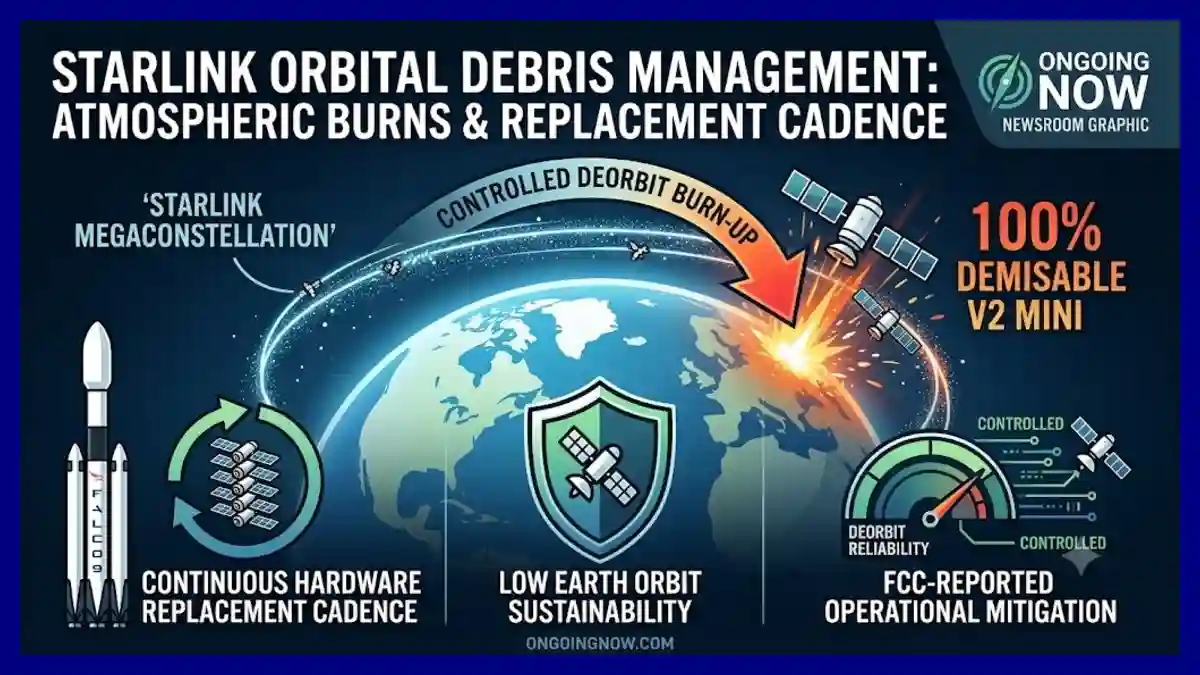
Space Exploration Technologies Corp satellite disposal protocols dictate that all Starlink units maintain a controlled end-of-life sequence to prevent the accumulation of low Earth orbit trackable debris. According to recent Starlink satellite deorbit report FCC filings, the Starlink constellation satellite lifespan typically spans five to seven years, after which active propulsive measures guide the spacecraft down. A critical aspect of this architecture is the Starlink V2 Mini orbital lifecycle, which depends on the SpaceX Falcon 9 constellation replacement cadence to swap aging infrastructure with modernized hardware. By leveraging an automated, low Earth orbit satellite re entry reliability framework, the operator ensures that each SpaceX controlled deorbit satellite burn up event minimizes ground-casualty risks while keeping crucial orbital planes clear for international space operations.
The Operational Framework of SpaceX Megaconstellation Orbital Debris Management
The Federal Communications Commission (FCC) and the Federal Aviation Administration (FAA) maintain strict regulatory oversight regarding the disposal of commercial hardware in low Earth orbit (LEO). As the density of active and inactive tracking objects increases, SpaceX megaconstellation orbital debris management has shifted from a secondary logistical concern to a primary operational imperative. The company relies on a high-cadence deployment and retirement schedule to prevent the accumulation of non-functional hardware in highly sought-after orbital bands.
According to regulatory documentation submitted to the FCC, the management strategy dictates that any satellite experiencing a critical subsystem failure or approaching its nominal retirement date must be actively lowered. This proactive mitigation prevents the creation of dead, uncommunicative satellites that pose collision risks to other active constellations, crewed spacecraft, and international research platforms like the International Space Station (ISS).
SpaceX uses automated collision-avoidance algorithms across its entire fleet to track space debris and adjust satellite trajectories in real-time. By integrating data from the U.S. Space Force’s 18th Space Defense Squadron, the automated system executes thruster burns to avoid closely passing objects, minimizing the likelihood of accidental fragmentations that populate orbits with dangerous kinetic debris.
Technical Specifications of the Starlink V2 Mini Orbital Lifecycle
The introduction of the Starlink V2 Mini design marked a major shift in how the corporation manages satellite lifespans and hardware degradation. These larger, heavier platforms possess significantly higher data capacities than their V1.5 predecessors, requiring advanced propulsion systems to handle orbital maneuvering and subsequent decommissioning. The Starlink V2 Mini orbital lifecycle is structured around a highly efficient Argon-fueled Hall-effect thruster network, providing the thrust necessary for altitude maintenance and controlled descent phases.
+------------------------------------+---------------------------------------+
| Parameter                          | Specification / Target Value          |
+------------------------------------+---------------------------------------+
| Nominal Operational Altitude       | 525 km to 535 km                      |
| Primary Propulsion Propellant      | Argon (Hall-effect thrusters)         |
| Design Demisability Rating         | 100% (Fully demisable in atmosphere)  |
| Active Deorbit Duration            | Less than 6 months (Targeted)         |
| Passive Decay Safe-Guard           | 1 to 5 years (If propulsion fails)    |
+------------------------------------+---------------------------------------+
Note: Demisability metrics are based on internal SpaceX aerospace engineering models submitted during the FCC licensing phase and are subject to varying upper-atmospheric density conditions.
The operational phase of the V2 Mini architecture is heavily monitored via continuous telemetry links. If a satellite exhibits power fluctuations, battery degradation, or attitude-control anomalies that threaten its long-term reliability, the mission control team initiates an early retirement sequence. This structured approach prevents the spacecraft from becoming non-responsive at its operational altitude, preserving the integrity of the surrounding orbital environment.
Analysis of Starlink Satellite Deorbit Report FCC Filings
An examination of recent Starlink satellite deorbit report FCC filings reveals the exact statistical performance of the operator’s disposal operations. The data shows that while the vast majority of retired units complete their propulsive descents successfully, a minor percentage experience anomalies that force a reliance on passive atmospheric drag.
“The overarching goal of the constellation’s disposal architecture is to achieve a 100% successful controlled deorbit rate, minimizing the time any non-functional spacecraft spends in a high-density orbit.” — SpaceX Regulatory Compliance Report to the FCC
The filings indicate that the company has improved its propulsive termination algorithms to lower the per-satellite disposal timeline. When a satellite is flagged for deorbiting, it lowers its perigee into the denser layers of the atmosphere, using its remaining Argon propellant to accelerate the process. This rapid lowering curtails the window in which an aging satellite could potentially collide with another object during its descent phase.
Evaluating Low Earth Orbit Satellite Re Entry Reliability
The metric of low Earth orbit satellite re entry reliability is vital for maintaining the safety of both space assets and populations on the ground. SpaceX designs its newer generations of satellites to be completely demisable, meaning that all components—including structural chassis, solar arrays, and internal electronics—are engineered to vaporize completely during atmospheric friction events.
Phase 1: Mission Termination -> Phase 2: Perigee Lowering (< 300 km) -> Phase 3: Atmospheric Capture -> Phase 4: Full Demisability Burn
Earlier satellite designs across the aerospace industry frequently utilized components containing dense materials like titanium or stainless steel, which could survive re-entry and strike the Earth’s surface. To counter this hazard, Space Exploration Technologies Corp satellite disposal protocols mandate the use of aluminum and other low-melting-point alloys. This material selection ensures that when a spacecraft enters the high-temperature environment of the upper atmosphere, structural failure occurs uniformly, leading to complete disintegration.
The Falcon 9 Constellation Replacement Cadence and Lifecycle Dynamics
The long-term sustainability of large-scale orbital architectures depends heavily on launch vehicle capacity. The SpaceX falcon 9 constellation replacement cadence allows the operator to swap older, less efficient satellites with updated models without reducing overall network capacity. This high-frequency launch schedule ensures that old hardware can be continuously cycled out of orbit as it nears the end of its projected Starlink constellation satellite lifespan.
By launching up to dozens of missions annually dedicated to constellation replenishment, the manufacturing and deployment pipeline operates as a continuous loop. When a new batch of satellites achieves operational status, an equivalent number of older units can be systematically commanded to begin their descent. This balancing act prevents the total number of active payloads from exceeding managed limits while keeping the orbital footprint tightly optimized.
Why This Matters: Long-Term Sustainability of the Space Environment
The implementation of robust SpaceX megaconstellation orbital debris management practices sets a critical precedent for the commercial space sector. With multiple international entities and sovereign states planning their own large LEO networks, tracking and managing dead hardware is vital to preventing the Kessler syndrome—a theoretical scenario where the density of objects in LEO is high enough that a single collision initiates a cascade of subsequent impacts.
Active Mitigation (Propulsive Deorbit) ---> Lowers Orbital Collision Cross-Section
Passive Neglect (Dead Satellites)       ---> Increases Long-Term Fragment Risk
By demonstrating that thousands of mass-produced satellites can be managed, tracked, and safely disposed of at scale, the space industry establishes clear benchmarks for future exploration and commercialization. Maintaining clean orbital pathways ensures that deep-space missions, astronomical observation platforms, and essential communications infrastructure can operate without facing an elevated threat environment from unmanaged space junk.
Stay sharp with Ongoing Now!
Source and Data Limitations: This report is compiled from official public filings submitted by Space Exploration Technologies Corp to the Federal Communications Commission (FCC) and operational tracking data provided by the U.S. Space Force’s 18th Space Defense Squadron. All technical specifications regarding satellite demisability, orbital lifespans, and propulsion systems are derived from authorized manufacturer statements and regulatory approvals. This article omits speculative claims regarding unverified satellite failure rates, non-peer-reviewed orbital collision models, and hypothetical future launch manifests not confirmed by the FAA or relevant international space agencies.