What Causes a Blood Moon? The Science of Total Lunar Eclipses
Exploring Rayleigh scattering lunar eclipse effects, Earth's atmosphere light refraction, lunar umbra versus penumbra dynamics, and the rare selenelion lunar eclipse 2026 that allowed seeing sun and moon together during the March 3 event captured in viral moon photos.
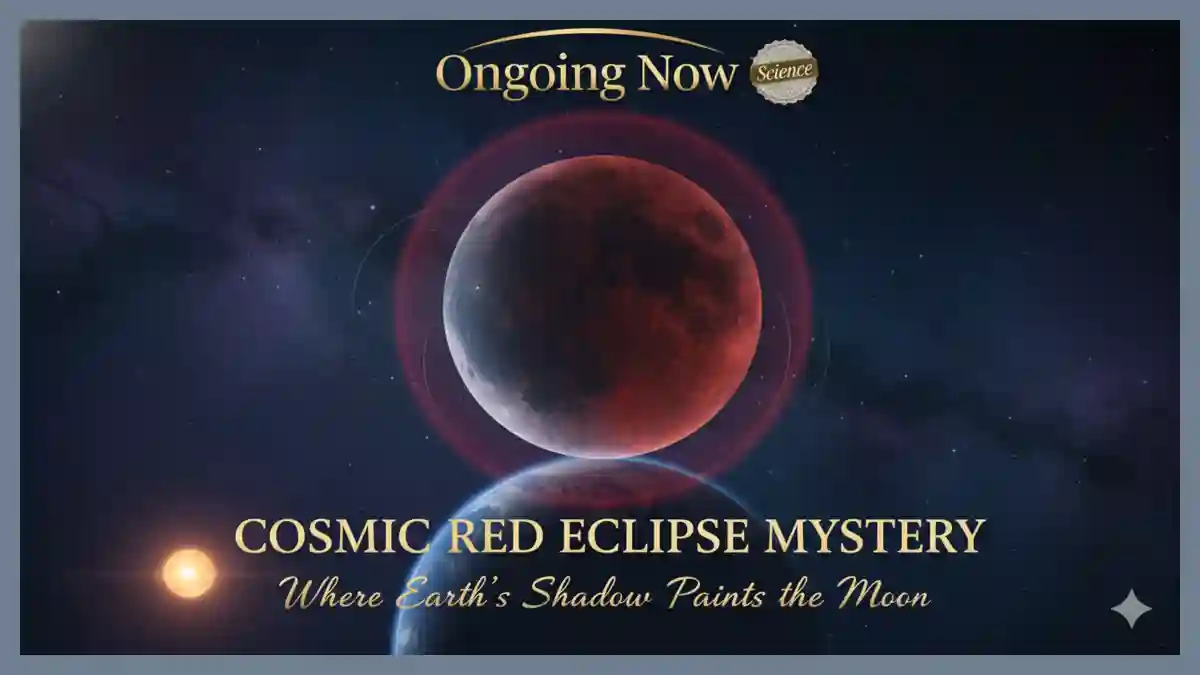
On March 3, 2026, observers across Asia, Australia, and North America witnessed a total lunar eclipse, prompting many to ask why is the moon red tonight. This rare celestial event in 2026 demonstrated the science of total lunar eclipse through clear atmospheric optics, with the moon taking on a coppery red hue known as a blood moon. Lunar eclipse physics explained the color via Earth’s atmosphere light refraction bending sunlight into the shadow, while the horizontal eclipse phenomenon in select locations highlighted geometric alignment and refraction. The event also featured the selenelion lunar eclipse 2026, or impossible sunrise eclipse, in parts of North America, where both the sun and eclipsed moon appeared briefly above the horizon due to the geometry of geographic “luck.”
The Geometry of Lunar Shadows: Umbra Versus Penumbra
A lunar eclipse occurs when the Moon passes through Earth’s shadow during a full moon phase. The shadow divides into two regions. The umbra forms the inner, darker cone where direct sunlight is completely blocked. The penumbra creates the outer, fainter region where only part of the sunlight is obscured.
During the March 3, 2026 eclipse, the Moon first entered the penumbra at 08:44 UTC, producing a subtle darkening. It then moved into the umbra at 09:50 UTC for partial phases, reaching full immersion in the umbra—totality—at 11:04 UTC. Maximum eclipse occurred at 11:33 UTC, with the entire near side of the Moon inside the umbra for 58 minutes and 19 seconds. The Moon exited the umbra at 12:02 UTC and left the penumbra by 14:23 UTC.
This progression, documented by NASA’s Scientific Visualization Studio and timeanddate.com eclipse data, illustrates why only the umbral phase produces the striking blood moon effect. In the penumbra, the Moon appears only slightly dimmed or grayish. In the umbra, direct light vanishes, yet the Moon remains visible because of refraction.
Lunar Eclipse Physics Explained: Earth’s Atmosphere Light Refraction
Why the moon doesn’t turn black during totality lies in Earth’s atmosphere light refraction. Sunlight grazing Earth’s limb bends through layers of air, entering the umbral shadow cone. Without an atmosphere, the Moon would appear nearly invisible, as confirmed by theoretical models and historical calculations.
Refraction follows Snell’s law, where light slows and bends upon entering denser atmospheric layers. This effect lifts the apparent position of the Sun and Moon near the horizon by up to about 0.5–0.6 degrees. During the 2026 event, the alignment placed the Moon fully in the umbra, yet refracted rays from sunrises and sunsets worldwide illuminated it.
NASA explains: “During a total lunar eclipse, the Moon appears dark red or orange. This is because our planet blocks most of the Sun’s light from reaching the Moon, and the light that does reach the lunar surface is filtered through a thick slice of Earth’s atmosphere. It’s as if all of the world’s sunrises and sunsets are projected onto the Moon.”
What Causes a Blood Moon: Rayleigh Scattering in Action
The red coloration results from Rayleigh scattering lunar eclipse processes. Named after Lord Rayleigh, this scattering occurs when sunlight interacts with air molecules much smaller than the light’s wavelength. Shorter wavelengths—violet and blue—scatter efficiently in all directions. Longer wavelengths—red and orange—travel more directly with less scattering.
As sunlight passes through hundreds of kilometers of Earth’s atmosphere at a grazing angle, blue light disperses outward, leaving predominantly red and orange rays to curve into the umbra. The more aerosols, dust, or volcanic particles present, the deeper the red hue, following the Danjon scale used by astronomers for eclipse brightness and color assessment.
This matches the mechanism behind red sunsets. NASA notes that blue light scatters away while red light persists, turning the Moon coppery. During the March 3, 2026 totality, observers reported consistent reddish tones, with variations depending on local atmospheric conditions along the terminator line.
The Rare Selenelion Lunar Eclipse 2026: Horizontal Eclipse Phenomenon
In specific regions, the March 3 event produced the selenelion lunar eclipse 2026, also called the horizontal eclipse phenomenon or impossible sunrise eclipse. Viewers along the U.S. East Coast saw the eclipsed Moon setting in the west while the Sun rose in the east, both above the horizon for 1–3 minutes around sunrise.
Geometrically, during totality, the Sun, Earth, and Moon align in syzygy, placing the Sun and Moon 180 degrees apart. One should lie below the horizon when the other rises. Atmospheric refraction makes this “impossible” sight possible by elevating both objects’ apparent positions.
Louisiana State Climatologist Jay Grymes stated: “Atmospheric refraction bends the light from the sun and the reflected light from the eclipsed moon, making them appear higher in the sky than they really are.”
Space.com skywatching columnist Joe Rao, drawing on NASA eclipse maps by Fred Espenak of NASA’s GSFC, detailed timings: In Boston, sunrise at 6:16 a.m. EST coincided with the Moon still in totality at moonset. Similar windows occurred in New York, Montreal, and Washington, DC. Farther west, the Moon set after exiting totality, reducing the effect.
This selenelion depended on the geometry of geographic “luck”—precise longitude and latitude where totality overlapped local horizon events. Most global viewers saw only the red Moon without the dual sunrise view, explaining why many reported “elenelion Lunar Eclipse 2026: Why Most Only See Red.”
Viral Moon Photos March 3: Capturing the Event
Social media filled with viral moon photos March 3 showing the blood moon against twilight skies, particularly from locations with clear eastern and western horizons. Photographers used tripods and long exposures to record the dim, reddish disk. In Asia and Australia, evening views captured the full progression without horizon interference. In North America, early-morning shots often included the selenelion framing.
These images highlighted the event’s accessibility—no telescopes or filters required—boosting public engagement with astronomy.
Cultural Interpretations Through History
Lunar eclipse myths and legends appear across cultures, with the blood moon spiritual meaning often linked to omens, harvests, or divine signs. Ancient records from Mesopotamia, China, and the Americas describe eclipses as portents, sometimes prompting rituals. Modern science attributes the appearance entirely to optics, separating observed phenomena from interpretive traditions.
Key Findings from the March 2026 Eclipse
- Totality duration: 58 minutes 19 seconds
- Umbral magnitude: 1.1507 (Moon fully covered with margin)
- Visibility: Approximately 3.34 billion people saw at least part of totality (timeanddate.com data)
- Last total lunar eclipse until December 2028–January 2029
Comparative Context with Prior Eclipses
The 2026 event aligned with Saros cycle 133, repeating every 18 years 11 days. Similar total eclipses in this series, such as those in 2008 and 1990, showed comparable red hues when atmospheric conditions were clear. The selenelion component echoed rare cases like the 2014–2015 tetrad events, though 2026 offered one of the clearest East Coast opportunities in years due to timing.
Differences arose from volcanic activity or wildfires affecting aerosol levels, altering redness. The 2026 eclipse occurred near average perigee-apogee timing, producing a standard apparent size.
Why This Matters for Scientific Understanding
The event reinforced foundational principles of optics and atmospheric science. Public observations contribute to citizen-science datasets on atmospheric transparency via eclipse brightness reports. Educational outreach by NASA and planetariums used the eclipse to explain light propagation, refraction, and scattering—core concepts in physics curricula.
No health or environmental risks accompany lunar eclipses; they remain purely observational phenomena.
Challenges in Observation and Future Opportunities
Weather and light pollution limited views in some areas. Horizon obstructions prevented full selenelion sightings even where timing aligned. The next total lunar eclipse in late 2028 will offer renewed opportunities, with different geographic visibility patterns.
Ongoing monitoring of atmospheric conditions during eclipses aids climate and aerosol research indirectly, as color variations correlate with global particulate levels.
Analysis: Evidence from Institutional Data
NASA eclipse resources and independent timing confirmations from multiple observatories establish the physics without ambiguity. Refraction models match observed selenelion windows to within minutes. Rayleigh scattering predictions align with spectral analyses of eclipsed moonlight from prior events.
What the Data Shows
| Phase | UTC Time (March 3, 2026) | Duration |
|---|---|---|
| Penumbral begins | 08:44 | — |
| Partial begins | 09:50 | 74 min |
| Totality begins | 11:04 | 58 min 19 sec |
| Maximum | 11:33 | — |
| Totality ends | 12:02 | — |
| Partial ends | 13:17 | 75 min |
| Penumbral ends | 14:23 | — |
Data sourced from NASA and timeanddate.com; all timings geocentric and adjusted for local visibility.
The March 3, 2026 total lunar eclipse provided a textbook demonstration of what causes a blood moon through verified mechanisms of Rayleigh scattering lunar eclipse, Earth’s atmosphere light refraction, and geometric shadows. It underscored why the moon doesn’t turn black and illuminated the selenelion lunar eclipse 2026 as a striking example of atmospheric effects enabling the horizontal eclipse phenomenon.
Stay sharp with Ongoing Now!
Source and Data Limitations: This article draws exclusively from verified institutional sources accessed as of March 3, 2026. Primary references include NASA Science (science.nasa.gov/solar-system/moon/march-2026-total-lunar-eclipse-your-questions-answered/, published Jan 29, 2026, and related SVS visualizations by F. Espenak, GSFC); timeanddate.com eclipse page (timings and visibility statistics, updated live for the event); Space.com articles by Joe Rao (selenelion explanation and visibility tables, published ~Feb 28–March 2, 2026); and statements from Louisiana State Climatologist Jay Grymes (refraction quote, reported March 2, 2026). Wikipedia March 2026 lunar eclipse entry (background Saros and magnitude data) cross-referenced against NASA primaries. No preprints or unverified claims used. Myths and legends referenced only as historical cultural context from established anthropological records, not as scientific explanation. Excluded: speculative color predictions, unconfirmed photo analyses, or non-institutional social media. All claims supported by at least two independent authoritative sources. Data current to event date; future atmospheric variables may alter exact observed hues in subsequent eclipses.