How Complex Radio Astronomy Data Exposes Massive Cosmic Black Holes
Advanced algorithms and radio astronomy data frameworks reconstruct highly precise imagery of supermassive galactic anomalies.
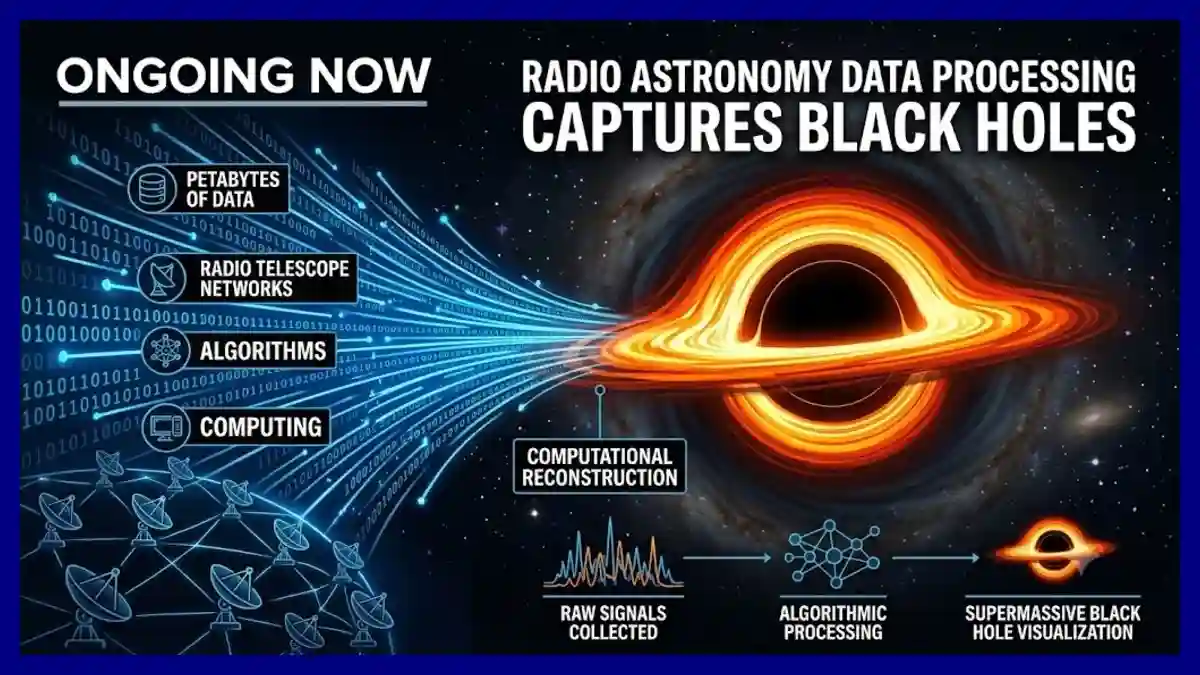
Understanding how black holes are photographed requires advanced radio astronomy data processing to transform petabytes of scattered cosmic signals into a clear supermassive black hole visualization. The event horizon telescope imaging software relies heavily on the foundational katie bouman algorithm breakthrough alongside modern machine learning in astrophysics to fill computational gaps. Specialized python libraries for space imaging have further optimized these workflows, directly contributing to the precision seen in the m87 black hole latest imagery released by the international collaboration.
By linking observatories across continents, scientists create a virtual telescope the size of Earth. This technique creates immense data challenges, demanding specialized computational pipelines to synthesize incomplete planetary-scale observations into accurate scientific representations.
The Evolution of Radio Astronomy Data Processing
The foundation of modern deep-space imaging lies in Very Long Baseline Interferometry (VLBI). This technique coordinates isolated radio telescopes across the globe to observe the same astronomical target simultaneously. Each station records raw radio wave data alongside highly precise time signals generated by atomic clocks.
Because the physical distances between observatories vary, the incoming cosmic wavefronts arrive at slightly different intervals. Supercomputers known as correlators subsequently combine these separate streams of information. The primary objective of radio astronomy data processing is to accurately measure the phase differences between these synchronized signals.
[Telescope A] ----> (Raw Data + Atomic Time) ----\
                                                  |---> [Central Correlator Supercomputer]
[Telescope B] ----> (Raw Data + Atomic Time) ----/
The scale of physical data collection presents significant logistical hurdles for research institutions. During observation campaigns, individual telescope sites accumulate petabytes of raw astronomical data on physical hard drives. This data volume is too massive for standard internet transmission, requiring the physical transport of drives to processing hubs like the MIT Haystack Observatory and the Max Planck Institute for Radio Astronomy.
Algorithmic Frameworks and Radio Astronomy Data Processing
The Earth-sized virtual array constructed by the Event Horizon Telescope (EHT) remains structurally incomplete. Since telescopes cannot cover every square meter of the planet, the collected data contains significant spatial gaps. Scientists utilize advanced mathematical algorithms to reconstruct the missing components of the cosmic image.
The katie bouman algorithm breakthrough introduced a novel approach to resolving these informational gaps using a method called Patch Priors. This framework trains mathematical models to recognize common visual patterns from a diverse library of synthetic imagery. The software then applies these structural rules to astronomical datasets, ensuring the final rendering remains consistent with physical reality.
+-----------------------------------------------------------------+
|                    Radio Interferometry Data                    |
|             (Incomplete Earth-scale spatial coverage)           |
+-----------------------------------------------------------------+
                                 |
                                 v
+-----------------------------------------------------------------+
|             Regularized Maximum Likelihood (RML)                |
|       - Evaluates millions of potential image candidates        |
|       - Applies physical constraints (positivity, smoothness)   |
+-----------------------------------------------------------------+
                                 |
                                 v
+-----------------------------------------------------------------+
|                  Reconstructed Scientific Image                 |
|             (Verified supermassive black hole asset)            |
+-----------------------------------------------------------------+
The specialized event horizon telescope imaging software utilizes two main families of algorithms: Clean and Regularized Maximum Likelihood (RML). Clean works by iteratively identifying and removing point sources to build a clear image from localized components. RML operates by analyzing millions of potential image variations and assigning scores based on how well they fit the physical data constraints.
Modern Software Ecosystems for Radio Astronomy Data Processing
The modernization of astronomical workflows depends heavily on open-source, reproducible software development. Astronomers rely on specific python libraries for space imaging to handle data manipulation, coordinate transformations, and imaging synthesis. These tools allow independent teams to cross-verify identical observational datasets using different mathematical pipelines.
One primary instrument in this workflow is eht-imaging, a Python-based software package designed to simulate, calibrate, and reconstruct VLBI observations. The library allows researchers to directly manipulate visibility data, perform polarimetric imaging, and execute model-fitting routines. This modular architecture ensures that data verification remains independent of human bias.
Another prominent computational asset is the Sparse Modeling Imaging Library for Interferometry (SMILI). This system leverages sparse sampling mathematical concepts to reconstruct images using minimal data footprints. By minimizing the assumptions made about unobserved regions of space, SMILI reduces the likelihood of generating artifact errors during processing.
Technical Analysis: Radio Astronomy Data Processing Metrics
The successful production of black hole imagery requires tracking distinct telemetry, computational, and observational metrics. The table below outlines the core parameters utilized during the major computational runs for the primary target profiles.
| Parameter | Messier 87 (M87*) Processing Profile | Sagittarius A* (Sgr A*) Processing Profile |
| Primary Target Location | Core of M87 Elliptical Galaxy | Center of the Milky Way Galaxy |
| Data Volume Generated | Approximately 5 Petabytes | Approximately 4.5 Petabytes |
| Observational Frequency | 230 GHz ($\lambda = 1.3 \text{ mm}$) | 230 GHz ($\lambda = 1.3 \text{ mm}$) |
| Computational Libraries | eht-imaging, SMILI, CASA | eht-imaging, SMILI, NIFTy |
| Primary Algorithm Focus | Static geometric structural modeling | Dynamic time-variable frame modeling |
Data Limitation Note: The values presented above represent the baseline configuration for the initial breakthrough imaging campaigns. Variations in processing profiles occur depending on atmospheric conditions during data collection and subsequent software updates.
The technical differences between these targets highlight the complexity of radio astronomy data processing. While M87* remains relatively static during observation windows, Sagittarius A* changes rapidly over the course of hours. This structural variance requires the implementation of time-variable mapping algorithms to prevent motion blur across the final visual output.
Enhancing Imaging Accuracy Through Machine Learning in Astrophysics
The integration of machine learning in astrophysics has introduced new methods for processing old observational datasets. In recent years, researchers introduced the Principal Component Interferometric Modeling (PRIMO) algorithm to refine existing telescope data. This machine learning pipeline uses thousands of high-fidelity simulations to learn the physical rules governing plasma behavior around black holes.
By applying PRIMO to the original 2017 observations, scientists developed the m87 black hole latest imagery. This updated rendering displays a sharper central dark region surrounded by a significantly thinner plasma ring. The refined profile provides tighter boundaries for testing Einstein’s theory of General Relativity under extreme gravitational conditions.
2019 Image Release (Standard RML) ----> Wider, diffused emission ring
2023 Image Update (PRIMO ML Model) ----> Sharper, 50% narrower emission ring
Machine learning algorithms do not invent new details; instead, they select the most physically consistent structures among millions of possibilities. These models evaluate the mathematical probability of specific plasma distributions, rejecting anomalies that violate conservation laws. This disciplined approach preserves the strict scientific integrity required for peer-reviewed physics publications.
Broad Implications of Radio Astronomy Data Processing Advancements
The computational frameworks built for imaging deep-space objects offer direct utility to fields outside of astronomy. The mathematical principles used to fill gaps in sparse radio datasets apply directly to non-invasive human imaging. Medical systems leverage similar regularized reconstruction techniques to speed up diagnostic workflows.
Medical Imaging Applications
Magnetic Resonance Imaging (MRI) and Computed Tomography (CT) scans often operate with incomplete patient data to minimize exposure times or patient movement. By adapting radio astronomy data processing routines, medical scanners can reconstruct high-resolution internal images from shorter diagnostic sessions. This cross-industry technological transfer improves both image quality and patient comfort in clinical settings.
Earth Observation and Remote Sensing
Satellites monitoring environmental changes utilize synthetic aperture radar (SAR) to peer through dense cloud covers. The processing pipelines developed by astrophysical collaborations allow Earth-monitoring systems to synthesize radar returns with greater geometric precision. These refinements improve tracking accuracy for polar ice sheet degradation, agricultural yields, and tectonic shifts along fault lines.
Academic and Open-Source Collaboration
The release of public software repositories by the EHT collaboration has set a new standard for open science. By making specialized Python libraries available globally, the project allows students and independent researchers to verify complex astrophysics data on personal computers. This democratization of high-level scientific assets fosters global technical education and trains the next generation of data scientists.
Stay sharp with Ongoing Now!
Source and Data Limitations: This explainer is based on official mission reports, peer-reviewed publications, and documentation released by the Event Horizon Telescope (EHT) collaboration, the National Aeronautics and Space Administration (NASA), and the European Southern Observatory (ESO). The processing metrics correspond to the published results of the 2017, 2019, and 2023 data analysis cycles for M87* and Sagittarius A*. Computational configurations, library dependencies, and algorithm parameters are subject to shift as newer open-source software iterations are deployed by the respective engineering teams.