Blue Origin New Glenn Launch Window Opens
The New Glenn launch window at Cape Canaveral marks a pivotal shift in heavy lift rocket launches and satellite deployment
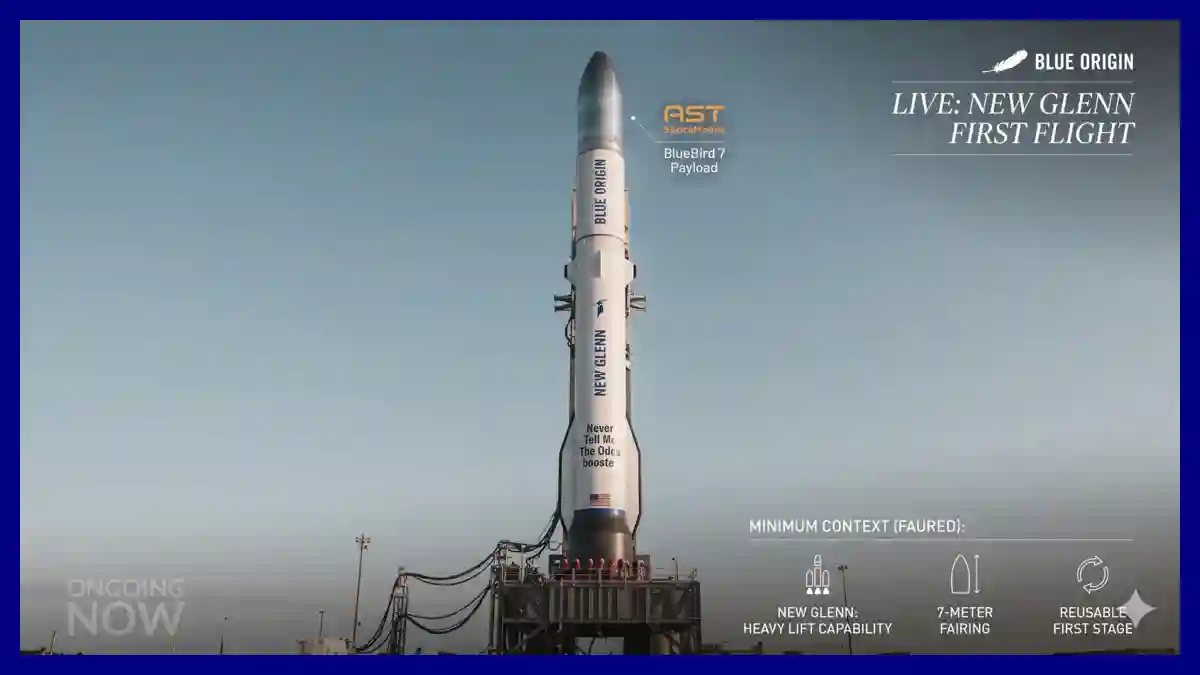
The established New Glenn launch window signifies a transformative phase for the Cape Canaveral launch schedule, as Blue Origin prepares its heavy-lift orbital vehicle for its inaugural flight from Cape Canaveral Space Force Station LC-36. This mission, carrying the AST SpaceMobile BlueBird 7 satellite, integrates critical milestones in booster reuse history and commercial telecommunications. Viewers can observe the proceedings via the Blue Origin live stream, which will document the performance of the first-stage booster, colloquially named Never Tell Me The Odds booster, as it attempts to validate years of engineering development. These heavy lift rocket launches are essential for expanding global internet connectivity and maintaining the competitive edge of the American aerospace sector.
The transition of Launch Complex 36 (LC-36) from a historic Atlas site to a modern multi-user facility underscores the evolving infrastructure requirements of the 21st-century space race. Blue Origin has invested significantly in the site to support the massive scale of the New Glenn vehicle, which stands over 320 feet tall. The integration of the AST SpaceMobile payload further highlights the shift toward deploying large-scale satellite constellations designed to provide direct-to-cell connectivity.
The Engineering Profile of New Glenn
The New Glenn heavy-lift vehicle is powered by seven BE-4 engines at its base, utilizing liquefied natural gas (LNG) and liquid oxygen. This propulsion system is designed to provide 3.85 million pounds of thrust at sea level, placing it in the same class as the world’s most powerful operational rockets. The focus on the New Glenn launch window is not merely about the ascent but also about the recovery of the Never Tell Me The Odds booster.
Unlike many expendable launch systems, New Glenn is designed for a minimum of 25 flights per first stage. This requirement has dictated the architectural choices of the vehicle, from its stainless-steel construction to its aerodynamic control surfaces. The recovery attempt will take place on a landing platform located hundreds of miles downrange in the Atlantic Ocean, a maneuver that remains one of the most technically demanding aspects of modern rocketry.
Cape Canaveral Launch Schedule and Infrastructure
The Cape Canaveral launch schedule is currently experiencing its highest cadence since the dawn of the space age. To accommodate the New Glenn launch window, the Space Force and commercial partners have streamlined range operations to allow for rapid turnarounds between missions. This high-frequency environment is necessary to clear the backlog of commercial and governmental payloads waiting for orbit.
At Cape Canaveral Space Force Station LC-36, the infrastructure includes a massive horizontal integration facility and a bespoke launch mount. The facility is designed to handle the logistical challenges of a rocket with a seven-meter fairing, which offers twice the volume of current five-meter class launch vehicles. This increased volume is a primary draw for companies like AST SpaceMobile, which require significant fairing space for their unfolding satellite arrays.
Satellite Integration: AST SpaceMobile BlueBird 7
The AST SpaceMobile BlueBird 7 represents the next generation of telecommunications infrastructure. Unlike traditional satellites that require specialized ground terminals, the BlueBird series is engineered to communicate directly with standard, unmodified smartphones. This requires an exceptionally large antenna array, which in turn necessitates the high-mass capacity of heavy lift rocket launches.
By launching during the designated New Glenn launch window, AST SpaceMobile aims to demonstrate that its technology can scale to provide continuous global coverage. The success of this deployment is a critical benchmark for the company’s business model, which seeks to eliminate cellular dead zones worldwide. The payload’s size and complexity make it an ideal candidate for the maiden flight of a heavy-lift vehicle.
Technical Specifications: New Glenn vs. Industry Standards
| Feature | New Glenn | Falcon Heavy | Delta IV Heavy (Retired) |
| Height | 98 Meters | 70 Meters | 72 Meters |
| Fairing Diameter | 7 Meters | 5.2 Meters | 5.1 Meters |
| First Stage Engines | 7 x BE-4 | 27 x Merlin 1D | 3 x RS-68A |
| Propellant | LNG / LOX | RP-1 / LOX | LH2 / LOX |
| Reusable Goal | 25+ Flights | 10+ Flights | 0 Flights |
Note: Data based on official manufacturer specifications; actual performance may vary based on mission profile and orbital inclination.
Analysis: The Evolution of Booster Reuse History
The attempt to recover the Never Tell Me The Odds booster is a milestone in booster reuse history. While SpaceX pioneered the landing of orbital-class boosters, Blue Origin’s approach with New Glenn introduces different variables, specifically the use of LNG as a fuel. LNG burns cleaner than the kerosene used in other rockets, theoretically reducing the amount of refurbishment required between flights.
This transition toward “turnkey” reusability is the central goal of the New Glenn program. If the recovery is successful during the New Glenn launch window, it will validate the BE-4 engine’s durability in a flight environment. This has broader implications for the United Launch Alliance (ULA) as well, as the BE-4 also powers their Vulcan Centaur rocket, though that system does not currently utilize booster recovery.
What the Data Shows: Market Demand for Heavy Lift
The demand for heavy lift rocket launches is driven by two primary factors: the deployment of mega-constellations and the return of heavy lunar exploration hardware. Market analysis indicates that the current supply of heavy-lift vehicles is insufficient to meet the projected needs of the late 2020s. New Glenn’s entry into the market provides a much-needed alternative for satellite operators.
The Blue Origin live stream will be closely watched by industry analysts to determine the vehicle’s structural integrity during Max-Q (maximum dynamic pressure). Any data gathered during this phase is vital for the iterative design process. Blue Origin’s philosophy of “Gradatim Ferociter” (Step by Step, Ferociously) suggests that even a partial success in booster recovery will be used to inform the next flight in the Cape Canaveral launch schedule.
Broader Scientific and Economic Implications
The operational status of New Glenn changes the economics of space access. By providing a seven-meter fairing, the rocket allows scientists to design larger, more capable space telescopes and planetary probes that do not require complex folding mechanisms. This reduces the risk of mechanical failure during deployment, a lesson learned from the intricate unfolding of the James Webb Space Telescope.
Furthermore, the increased cadence of heavy lift rocket launches from Cape Canaveral Space Force Station LC-36 stimulates the regional economy. The “Space Coast” has seen a resurgence in manufacturing and specialized labor as companies like Blue Origin, SpaceX, and ULA expand their footprints. This industrial base is the foundation upon which future deep-space exploration missions will be built.
Why This Matters: Global Connectivity and Security
The mission of the AST SpaceMobile BlueBird 7 carries significant societal weight. In many parts of the world, terrestrial cellular infrastructure is non-existent due to geographical or economic barriers. Space-based direct-to-cell technology can bridge this digital divide, providing essential communication services during natural disasters or in remote regions.
From a strategic perspective, the availability of multiple heavy-lift providers ensures “assured access to space.” This is a core tenet of U.S. space policy, preventing a single point of failure from grounding the nation’s orbital capabilities. The New Glenn launch window is therefore not just a corporate milestone, but a matter of national and global infrastructure resilience.
Future Context: Beyond the Initial Launch
Following the inaugural flight, the focus will shift toward increasing the flight rate of New Glenn. Blue Origin has already secured a significant contract with Amazon to launch a portion of its Project Kuiper satellite constellation. These missions will test the limits of the Cape Canaveral launch schedule and the refurbishment speed of the Never Tell Me The Odds booster.
As booster reuse history continues to be written, the lessons learned from New Glenn will likely influence the design of future fully reusable systems. The aerospace industry is moving toward a model where the cost of the rocket is amortized over dozens of missions, similar to commercial aviation. This flight is a foundational step toward that reality.
Evidence-Based Insights on Launch Operations
The complexity of liquid natural gas (LNG) systems introduces unique thermal management challenges during the New Glenn launch window. Engineers must balance the cryogenic temperatures of the fuel with the extreme heat generated by atmospheric reentry. Official mission telemetry will provide the first real-world data on how the BE-4 engines handle these transitions during an orbital mission.
According to official Blue Origin statements, the vehicle’s design incorporates lessons from the New Shepard suborbital program, particularly regarding vertical landing software and landing gear deployment. However, the scale of New Glenn—being significantly larger and faster—presents a different set of aerodynamic stresses. The data collected from the Blue Origin live stream and onboard sensors will be the definitive record of the vehicle’s performance.
Stay sharp with Ongoing Now!
Source and Data Limitations: This report is based on official mission overviews from Blue Origin, AST SpaceMobile, and the U.S. Space Force’s 45th Weather Squadron. Data regarding vehicle specifications (height, thrust, fairing size) is sourced from the Blue Origin New Glenn payload user’s guide. Launch schedule information is subject to change based on weather conditions at Cape Canaveral and technical readiness. References to booster reuse history are based on established industry records as of early 2026. This article excludes speculative rumors regarding future lunar variants of New Glenn or unverified financial projections for AST SpaceMobile. All technical parameters for the BE-4 engine are based on qualification testing data released by the manufacturer.