Artemis II Mission: Orion Spacecraft Enters High Earth Orbit
NASA’s first crewed lunar mission in over 50 years successfully reached orbit on April 1, 2026, as the crew begins critical systems verification.
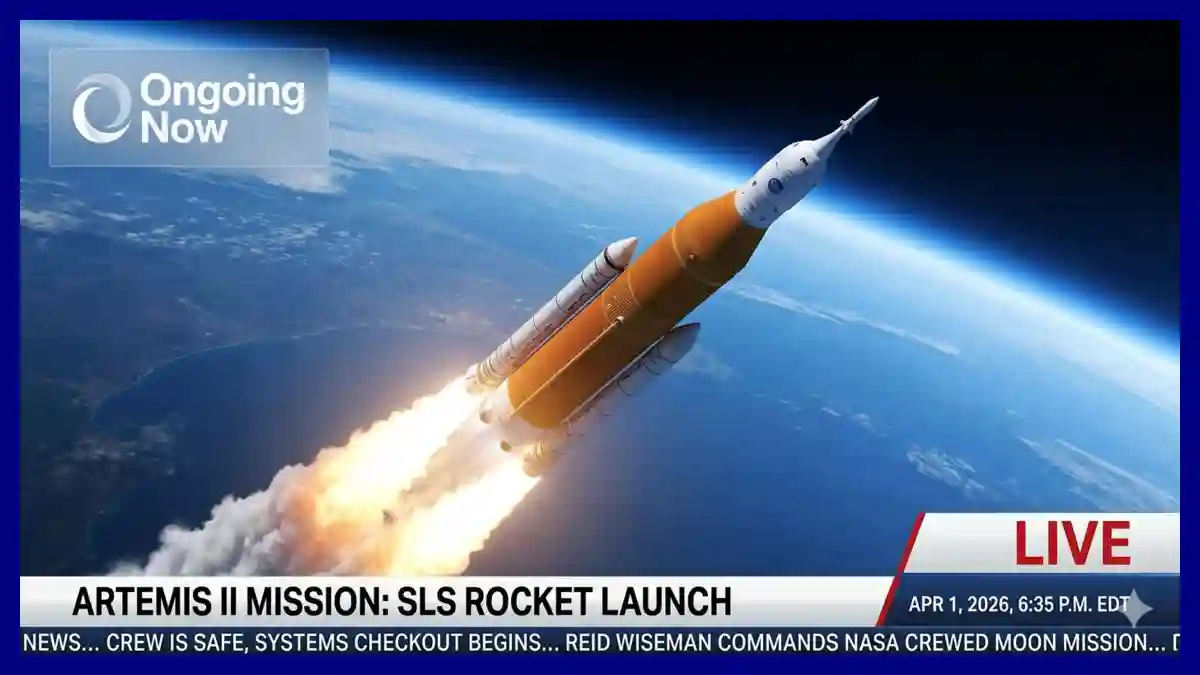
The Artemis II launch successfully commenced on April 1, 2026, marking the first time a crewed Orion spacecraft has departed Earth for the lunar environment since 1972. Following a precise SLS rocket launch, the mission is currently in its initial 24-hour checkout phase in a high Earth orbit. Commander Reid Wiseman, Pilot Victor Glover, and Mission Specialists Christina Koch and Jeremy Hansen are monitoring the Orion spacecraft position and life-support performance before committing to the moon flyby trajectory. This NASA crewed moon mission serves as the definitive flight test for the Space Launch System (SLS) and Orion’s integrated systems under human-operated conditions.
Technical Execution of the SLS Rocket Launch
The Artemis II mission began at 6:35 p.m. EDT from Launch Complex 39B at the Kennedy Space Center. The Space Launch System (SLS) generated 8.8 million pounds of thrust at liftoff, successfully propelling the Orion spacecraft through the period of maximum dynamic pressure.
Following the SLS upper stage separation, the cryogenic propulsion stage—specifically the Interim Cryogenic Propulsion Stage (ICPS)—assumed control to raise the spacecraft’s perigee. This Artemis 2 mission profile utilized the ICPS to place the crew into a highly elliptical Earth orbit. This trajectory allows the crew to remain relatively close to Earth for the first day of the mission, providing a safety window to verify the Environmental Control and Life Support System (ECLSS) before the final translunar injection burn.
Key Mission Milestones: Launch and Ascent
| Phase | Duration / Status | Technical Note |
| SLS Core Stage Burn | ~8 Minutes | Nominal performance; reached initial orbit |
| Solid Rocket Booster Jettison | T+ 2:12 | Successful separation and splashdown |
| ICPS Perigee Raise Burn | T+ 0:50 | Raised orbital low point to 115 miles |
| Solar Array Deployment | T+ 0:18 | All four wings locked; 63-foot wingspan |
Proximity Operations and Manual Piloting Tests
A primary objective for the crew during the first 24 hours is the Orion manual piloting test. After the cryogenic propulsion stage separation, the crew will use the ICPS as a target for NASA proximity operations maneuvers. This exercise is designed to evaluate how the Orion spacecraft handles during close-range flight, a critical skill for the future Artemis III mission when Orion docks in space with the Lunar Gateway or a landing vehicle.
Pilot Victor Glover is tasked with maneuvering the spacecraft near the spent upper stage to test the hand controllers and flight software. These maneuvers provide essential data on the Orion spacecraft technical specs, specifically its translational and rotational response in a vacuum. By performing these tests while still in Earth orbit, NASA ensures that the spacecraft’s manual override capabilities are fully functional before the crew enters the four-day transit to the Moon.
Analysis: The Physics of the Lunar Flyby Trajectory
The lunar flyby physics for Artemis II rely on a hybrid free-return trajectory. This specific orbital path uses the Moon’s gravitational pull to naturally “whip” the spacecraft back toward Earth without requiring a large engine burn for the return trip.
If the Orion Service Module were to experience a propulsion failure after the translunar injection, the spacecraft would still return to Earth’s atmosphere for a safe splashdown. The planned trajectory will take the crew approximately 4,600 miles (7,400 kilometers) above the lunar surface at its closest approach. At its farthest point, the crew will travel nearly 250,000 miles from Earth, surpassing the distance records set during the Apollo era.
Artemis 2 Mission Stages
Launch and Earth Orbit: Initial system checkouts and manual piloting.
Translunar Injection (TLI): A high-energy burn to escape Earth’s gravity.
Outbound Transit: A four-day journey to the lunar vicinity.
Lunar Flyby: Gravitational assist and deep-space data collection.
Return Transit: Four-day return leg following the free-return path.
Re-entry and Splashdown: Heat shield testing and Pacific Ocean recovery.
Crew Readiness and Mission Status
Mission Commander Reid Wiseman reported that the crew is in excellent health and the Orion cabin environment is stable. Mission Specialist Christina Koch is overseeing the science payload and radiation monitoring equipment, while Jeremy Hansen of the Canadian Space Agency (CSA) is coordinating with ground teams on the checkout of the European Service Module (ESM).
The Reid Wiseman mission status update confirmed that the “apogee raise burn” was executed perfectly by the ICPS, placing the spacecraft in an orbit with a high point of roughly 1,600 miles. This elliptical path is necessary to reach the high-speed requirements for the eventual lunar transit. The Artemis 2 landing date is currently projected for April 11, 2026, contingent on the successful completion of the upcoming translunar injection.
Why This Matters: Validating Human Deep Space Capability
The Artemis II mission is more than a flight test; it is a validation of the entire Space Launch System performance envelope for human occupants. Unlike Artemis I, which was uncrewed, this mission must prove that Orion can sustain four humans in the harsh radiation environment of deep space for over a week.
The data gathered during the NASA proximity operations maneuvers and the manual piloting demonstrations will directly influence the final design of the docking interfaces for the Artemis III landing mission. Furthermore, the successful integration of the CSA astronaut Jeremy Hansen underscores the international nature of modern lunar exploration, setting a precedent for global cooperation in the Artemis Accords.
Technical Specifications: Orion and SLS Upper Stage
The Orion spacecraft, manufactured by Lockheed Martin with a service module provided by Airbus, represents the most advanced crewed vehicle ever flown to deep space.
Total Height: 322 feet (SLS + Orion)
Orion Crew Volume: 316 cubic feet (9 cubic meters)
Service Module Thrust: 6,000 pounds (Main Engine)
Max Velocity at Re-entry: 25,000 mph (approx. Mach 32)
“This mission is a unique opportunity to test all of Orion’s life-support, navigation, and other systems in deep space to make sure everything works properly,” stated the Canadian Space Agency during a pre-launch briefing.
The mission continues to be monitored via the NASA live stream today, with the next major milestone—the translunar injection burn—expected within the next 12 hours. This burn will utilize the European Service Module to provide the “outbound push” required to leave Earth’s orbit and begin the transit to the Moon.
Stay sharp with Ongoing Now!
Source and Data Limitations: This report is based on official mission telemetry and press releases from NASA and the Canadian Space Agency (CSA) as of April 2, 2026. Data regarding the Artemis II launch, crew assignments (Wiseman, Glover, Koch, Hansen), and orbital parameters are derived from the NASA Artemis II Reference Guide and live mission updates. Trajectory details and landing dates (April 11, 2026) are subject to real-time adjustments based on spacecraft performance and orbital mechanics. Speculative claims regarding lunar surface activities or future mission dates beyond the official Artemis roadmap have been excluded to maintain factual integrity. Historical comparisons to Apollo-era missions are based on verified NASA archival data.