How the 2026 GMC Sierra EV Price Shift Expands Premium Electric Pickup Trucks
GMC expands the 2026 GMC Sierra EV family with accessible Elevation and rugged AT4 trims, lowering prices.
Structural Changes to General Motors Electric Full-Size Truck Portfolio
The full-size electric truck segment is shifting from low-volume, high-priced introductory editions toward multi-tiered commercial lineups. General Motors is accelerating this market evolution by diversifying its premium electric pickup trucks platform for the 2026 model year. When the luxury-oriented Denali Edition 1 debuted, it carried an initial manufacturer’s suggested retail price near $100,000, which limited its reach to early adopters. For the upcoming model year, the automaker has introduced broader structural choices, introducing more affordable price entries and distinct mechanical configurations designed for varied utility requirements.
The expansion centers on the introduction of two prominent nameplates to the electric truck family: the entry-level Elevation and the off-road-focused AT4. This updated product tier utilizes the corporate Ultium EV architecture, which shares structural underpinnings with the Chevrolet Silverado EV. By decoupling the platform’s heavy-duty powertrain from exclusive top-tier luxury trims, the manufacturer aims to capture a wider demographic of traditional truck buyers who prioritize payload, trailering, and off-road geometry over bespoke interior materials. Consequently, the entry point for the model line drops by more than $35,000, fundamentally altering how these 2026 GMC trucks position themselves against established architectural rivals in the North American market.
Entry-Level Utility Metrics of the Sierra EV Elevation Specs
The foundation of the revised lineup relies on the newly introduced Elevation trim, which lowers the financial barrier to the brand’s electric vehicle technology. The baseline configuration is divided into two distinct engineering variants: the Standard Range and the Extended Range. According to official manufacturer documentation, the Standard Range model establishes a competitive entry point while maintaining a dual-motor electronic four-wheel-drive system. This setup generates 605 horsepower and 605 pound-feet of torque. This mechanical baseline ensures that the most affordable model does not suffer from degraded performance figures typically found in entry-level internal combustion variants.
Upgrading to the Elevation Extended Range configuration alters the electrical architecture, shifting output to a factory-rated 645 horsepower and 765 pound-feet of instant torque. This increase in electrical capacity directly influences the vehicle’s operating utility. Both versions of the Elevation trim are built around a highly functional chassis, utilizing an 18-inch wheel package paired with LT265/70R18 all-season blackwall tires. Inside the cabin, a standard 16.8-inch diagonal center touchscreen acts as the primary interface, supplemented by a standard 11.0-inch driver instrument cluster. This layout provides comprehensive telemetry data without requiring the expensive premium packages found on upper-tier trim levels.
Mechanical Adaptations and GMC CrabWalk Feature Capabilities
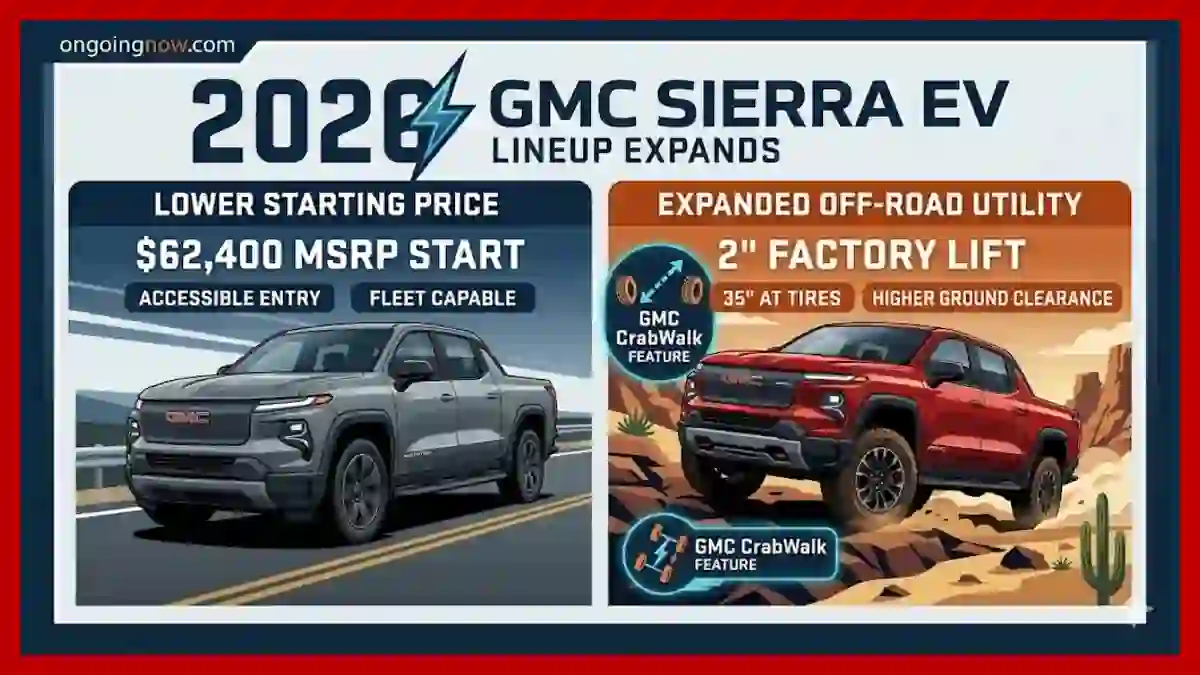
For operators requiring mechanical enhancements for unpaved terrain, the mid-tier option comes in the form of the AT4 trim. This rugged variant modifies the underlying frame geometry to prioritize trail clearance and technical maneuvering over highway aerodynamics. The factory engineering specifications dictate a standard two-inch suspension lift, which elevates the total ground clearance to 10.04 inches compared to the 8.07 inches found on the base Elevation trim. This lifted suspension package alters the off-road physical limits, resulting in a verified approach angle of 32.4 degrees, a departure angle of 25.1 degrees, and a break-over angle of 19.2 degrees. These physical clearances are supported by standard LT285/75R18 all-terrain tires measuring 35 inches in total diameter.
+------------------------------------+-----------------------+-----------------------+
| Physical Metric                    | Elevation Trim        | AT4 Off-Road Trim     |
+------------------------------------+-----------------------+-----------------------+
| Total Ground Clearance             | 8.07 inches           | 10.04 inches          |
| Wheel and Tire Package Size        | 18-inch / All-Season  | 18-inch / 35" AT      |
| Front Approach Angle Limit         | 27.7 degrees          | 32.4 degrees          |
| Rear Departure Angle Limit         | 22.8 degrees          | 25.1 degrees          |
| Standard Steering System Type      | 2-Wheel Steering      | 4-Wheel with CrabWalk |
+------------------------------------+-----------------------+-----------------------+
A core distinction of this off-road chassis is the standard integration of a four-wheel steering system that features the proprietary GMC CrabWalk feature. This electro-mechanical system allows the rear wheels to turn at identical angles to the front wheels during low-speed maneuvers. This synchronization enables the full-size pickup truck to move diagonally across tight paths, bypassing standard turning radii on narrow off-road trails or urban environments. When the four-wheel steering mechanism is active, the turning circle diameter drops to 39.1 feet. This represents a significant reduction from the 44.0-foot turning diameter required by the standard two-wheel-steering Elevation model, improving the truck’s overall maneuverability.
Engineering Analysis of Sierra EV Towing Capacity and Range
Evaluating an electric vehicle’s heavy-duty performance requires analyzing the direct relationship between battery mass, motor efficiency, and thermal limits under load. The 2026 model lineup offers three distinct battery capacities, which are officially categorized as Standard Range, Extended Range, and Max Range configurations. While official EPA certifications are finalized closer to public delivery dates, internal manufacturer projections indicate that the Extended Range variant achieves a 410-mile driving range. The flagship Max Range variant, available on the AT4 and Denali trims, targets an estimated range of up to 478 miles on a full charge. These extended operational ranges are achieved using heavy Nickel Cobalt Manganese traction batteries that support charging speeds up to 350 kilowatts on 800-volt DC fast-charging networks.
+------------------------------------+-----------------------+-----------------------+
| Trim and Battery Configuration     | Max Towing Capacity   | Max Payload Capacity  |
+------------------------------------+-----------------------+-----------------------+
| Elevation Standard Range           | 12,500 pounds         | 2,250 pounds          |
| Elevation Extended Range          | 12,500 pounds         | 2,250 pounds          |
| AT4 Extended Range                 | 12,300 pounds         | 1,950 pounds          |
| AT4 Max Range                      | 12,300 pounds         | 1,950 pounds          |
| Denali Extended Range              | 12,500 pounds         | 2,250 pounds          |
| Denali Max Range                   | 12,500 pounds         | 2,250 pounds          |
+------------------------------------+-----------------------+-----------------------+
When evaluating work metrics, the Sierra EV towing capacity showcases how chassis reinforcements alter real-world utility across trims. The aerodynamic Elevation and luxury Denali configurations achieve a maximum trailering limit of 12,500 pounds, alongside a top payload rating of 2,250 pounds. Conversely, the off-road AT4 trim sacrifices a small fraction of its absolute trailering capacity due to the compliance weights of its taller suspension and heavier all-terrain tire tread. The AT4 drops to a 12,300-pound maximum towing capacity and a 1,950-pound payload ceiling. Driving ranges will contract significantly when pulling heavy trailers near these physical boundaries, an inherent characteristic of contemporary electric truck battery life that fleet operators must factor into route planning.
Financial Context and Segment MSRP Comparison Analysis
The updated pricing structure reflects a targeted effort by General Motors to align its products with current economic realities and federal consumer tax credit thresholds. Initial market offerings for high-end electric trucks focused almost exclusively on premium luxury brackets, which slowed down mass adoption. The revised pricing tiers position the brand to compete directly against premium configurations of the Ford F-150 Lightning and the Rivian R1T. This structural realignment ensures that fleet managers and private buyers can select models based on necessary utility parameters rather than being forced into high-end luxury trim packages.
Comprehensive Manufacturer Suggested Retail Prices
Elevation Standard Range: $62,400 MSRP (Total with $2,095 Destination Freight Charge: $64,495)
Elevation Extended Range: $70,600 MSRP (Total with $2,095 Destination Freight Charge: $72,695)
AT4 Extended Range: $79,300 MSRP (Total with $2,095 Destination Freight Charge: $81,395)
Denali Standard Range: $69,700 MSRP (Total with $2,095 Destination Freight Charge: $71,795)
AT4 Max Range: $89,600 MSRP (Total with $2,095 Destination Freight Charge: $91,695)
Denali Extended Range: $77,900 MSRP (Total with $2,095 Destination Freight Charge: $79,995)
Denali Max Range: $98,600 MSRP (Total with $2,095 Destination Freight Charge: $100,695)
The base Elevation model’s entry point represents a vital strategic threshold for the vehicle lineup. By keeping the base configuration under the $80,000 regulatory ceiling, specific models can remain eligible for federal clean vehicle tax incentives, depending on individual buyer income verification and local country requirements. This financial adjustment bridges the gap between commercial fleets and consumer markets, shifting the vehicle out of the luxury novelty realm and into mainstream consideration.
Infrastructure Demands and Environmental Impact Realities
The deployment of full-size electric trucks introduces distinct societal and secondary infrastructure questions that differ from those of compact commuter electric vehicles. Because these pickups weigh over 8,000 pounds due to their large Ultium battery packs, they require substantial grid power to recharge. To help mitigate this demand, the manufacturer integrates an available 10.2-kilowatt Energy Transfer Pro off-board power system. This bidirectional charging system converts the vehicle into a mobile energy storage unit, capable of exporting power via 120-volt and 240-volt outlets in the truck bed to run job sites or provide home backup power during electrical grid failures.
From an environmental standpoint, these heavy trucks reduce tailpipe emissions to zero, which helps lower urban particulate matter and greenhouse gas accumulation. However, their large scale means they require more raw materials during production compared to smaller vehicles. The production of high-capacity traction batteries demands substantial mineral resources, including nickel, cobalt, and manganese. Consequently, the long-term environmental benefits of these trucks depend heavily on sourcing minerals ethically and transitioning regional electrical grids to renewable energy sources like wind, solar, and hydro power. Without these clean energy inputs, the environmental benefits of driving an electric truck are partially offset by the emissions produced during manufacturing and grid charging.
Comparative Benchmarking Against Segment Competitors
To accurately assess where this electric truck fits in the broader automotive landscape, it is helpful to contrast its core specifications against direct segment competitors. The table below outlines how the mid-tier, off-road configuration compares with similarly priced premium electric pickup trucks currently available in the North American market.
+------------------------------------+-----------------------+-----------------------+
| Feature / Specification            | GMC Sierra EV AT4     | Ford F-150 Lightning  |
+------------------------------------+-----------------------+-----------------------+
| Base Manufacturer MSRP             | $79,300               | $79,495 (Platinum)    |
| Peak Electric Horsepower           | 625 hp                | 580 hp                |
| Maximum Torque Output              | 775 lb-ft             | 775 lb-ft             |
| Projected Driving Range            | 390 miles             | 300 miles             |
| Maximum Towing Limit               | 12,300 pounds         | 8,500 pounds          |
| Standard DC Fast Charge Cap        | 350 kW                | 150 kW                |
+------------------------------------+-----------------------+-----------------------+
This data demonstrates that the corporate Ultium architecture prioritizes driving range and fast-charging capabilities to better handle heavy-duty towing cycles. While competitor platforms often top out at 150-kilowatt charging rates on 400-volt systems, the 800-volt electrical setup in these trucks cuts down charging times at high-speed public stations. This capability allows operators to add approximately 116 miles of range in 10 minutes under optimal thermal conditions. This competitive charging advantage is crucial for retaining commercial truck operators who cannot accommodate long operational pauses during long-distance towing assignments.
Safety Systems and Regulatory Compliance Frameworks
The 2026 truck lineup comes equipped with advanced active safety suites and driver-assist systems designed to manage the high kinetic energy of heavy vehicles. Standard driver assistance features include front and rear collision mitigation, blind-spot monitoring, rear pedestrian alerts, and automated emergency braking. Higher trim levels feature General Motors’ Super Cruise hands-free driving technology, which includes a dedicated three-year subscription plan. This system operates across mapped divided highways throughout North America and includes specialized trailering software that adjusts braking parameters and sensor ranges to account for the added weight and length of a trailer.
From a regulatory standpoint, these electronic driver assistance features are critical for managing vehicles with a gross vehicle weight rating approaching 10,000 pounds. While formal crash test evaluations from the National Highway Traffic Safety Administration and the Insurance Institute for Highway Safety are completed later in the production cycle, the truck’s structural frame relies on a reinforced lower cradle designed to shield the internal cell chemistry during side impacts. Furthermore, standard pedestrian detection and automatic braking features are tuned to mitigate visibility challenges caused by high front hood lines, ensuring these trucks comply with evolving federal safety standards for large passenger vehicles.
Analysis of Fleet Suitability and Real-World Utility
The expansion of this model family demonstrates that vehicle electrification has evolved beyond high-end showcase trucks and is now entering practical commercial markets. Lowering the base price with the Elevation trim makes these pickups a viable option for corporate fleets and municipal departments aiming to meet sustainability goals without sacrificing payload capacity. However, commercial operations require careful consideration of local charging infrastructure. While the truck’s 350-kilowatt charging capability performs efficiently under ideal conditions, real-world charging speeds can vary based on grid congestion, station reliability, and ambient temperatures, which can impact daily fleet scheduling.
Furthermore, cold weather environments present a known physical challenge to electric truck battery life, often reducing overall driving range when operating under freezing conditions. For buyers selecting the AT4 or Denali trims for towing heavy loads, planning routes around high-speed charging hubs is critical, as pulling maximum loads can reduce an electric truck’s standard range by half. Consequently, while these trucks deliver impressive horsepower and towing metrics on paper, their real-world utility depends heavily on local infrastructure development and route planning.
Stay sharp with Ongoing Now!
—
Source and Data Limitations: All technical metrics, retail prices, and equipment availability are sourced from official General Motors media announcements, GMC brand specification manuals, and corporate configuration sheets published between March 2025 and May 2026. Real-world driving ranges and charging times are manufacturer estimates; final EPA-certified testing numbers for specific 2026 model year trims remain pending. Comparative vehicle data is drawn from published manufacturer specification sheets for the Ford F-150 Lightning. Unverified internet rumors regarding mid-cycle battery chemistry changes or future performance variants were excluded from this analysis to preserve strict factual accuracy.