Tesla Cybertruck 48V System Reveals How Efficiency Dominates
Technical analysis of the 48 volt car architecture, steer-by-wire technical specs, and Tesla ethernet backbone in the Cybertruck.
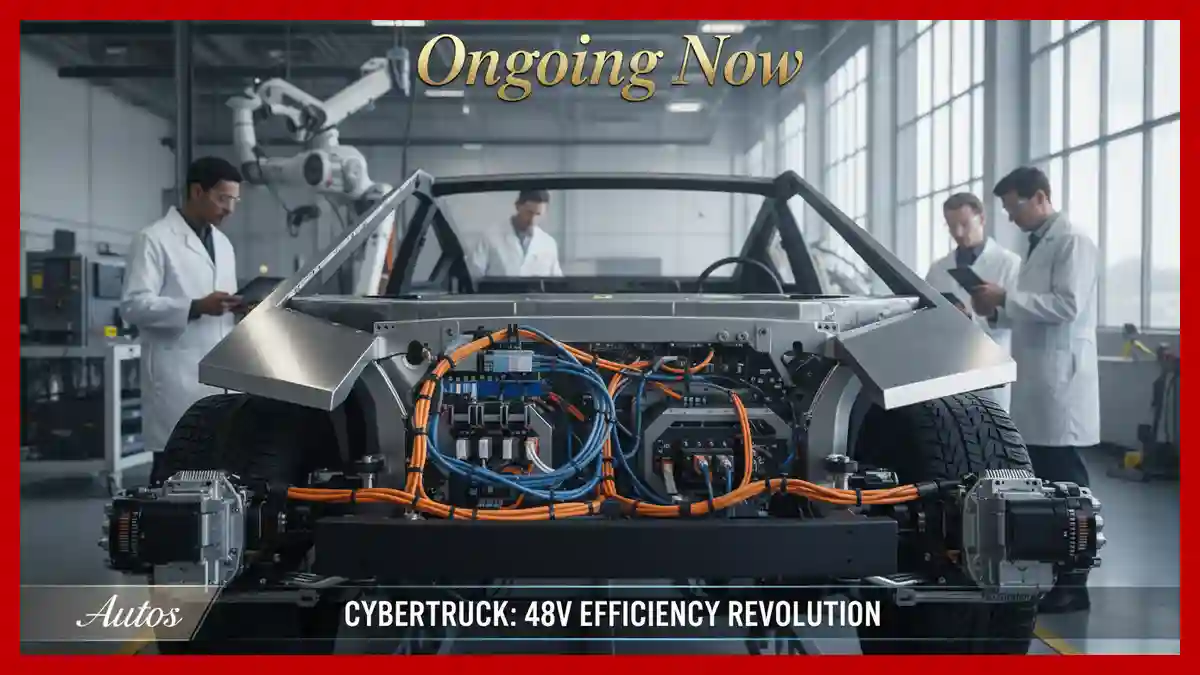
The Tesla Cybertruck introduces a fundamental shift in automotive electrical design, replacing the industry-standard 12V architecture with a comprehensive Tesla 48V system. This transition, paired with a steer-by-wire system and a high-speed Tesla ethernet backbone, represents a significant departure from traditional vehicle manufacturing. As of the Q1 2026 reporting period, official Tesla Q1 delivery data shows the company produced 408,386 vehicles, with “Other Models”—including the Cybertruck—accounting for 16,130 deliveries. Beyond consumer demand, technical innovations like the lithium-ion low voltage battery and a drastically reduced Cybertruck wiring harness weight define the vehicle’s engineering profile. This report examines the 48 volt car architecture, EV efficiency engineering, and verified Cybertruck delivery figures 2026, while addressing SpaceX internal fleet orders and broader EV market context.
The Engineering Logic of 48 Volt Car Architecture
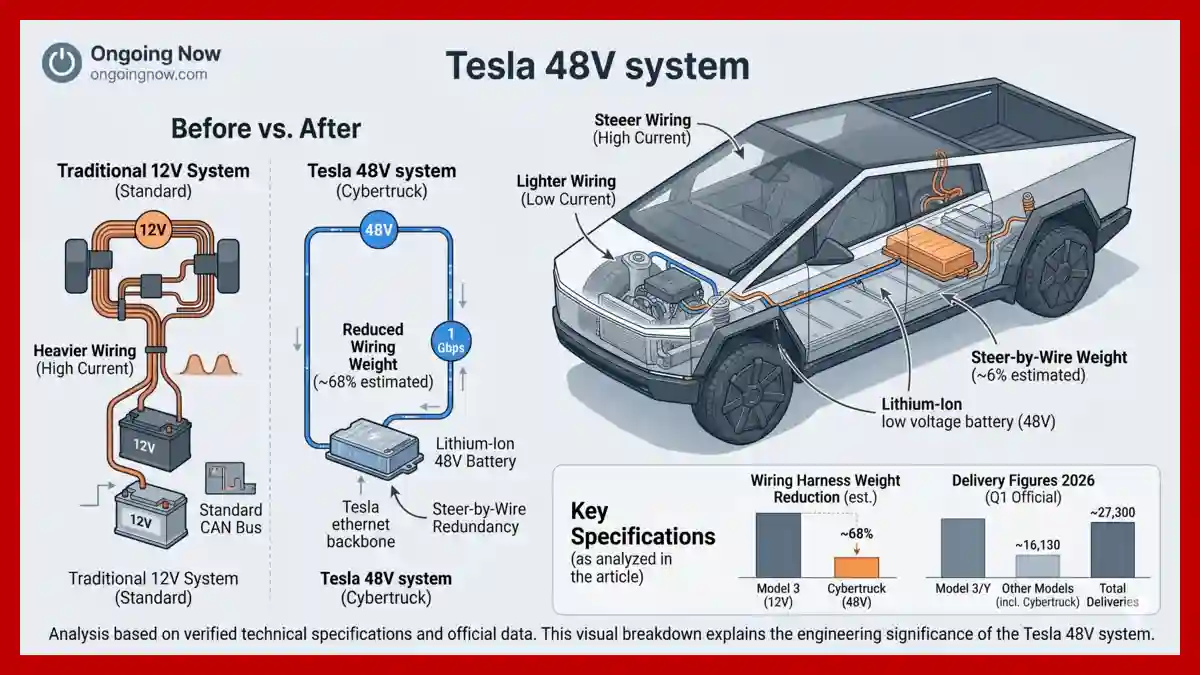
The automotive industry has utilized 12V electrical systems for decades, but modern power demands have pushed this standard to its physical limits. By implementing a 48 volt car architecture, the Cybertruck addresses the inverse relationship between voltage and current. According to basic electrical principles, doubling the voltage allows for a fourfold reduction in current to deliver the same power.
This shift is critical for EV efficiency engineering. High-current 12V systems require thick, heavy copper wiring to minimize heat loss and voltage drop. By moving to 48V, Tesla has reduced the Cybertruck wiring harness weight by an estimated 68% compared to previous models like the Model 3. The reduction from approximately 490 wires to just 155 is made possible by the higher voltage and the integration of a decentralized “Etherloop” communication system.
Steer-by-Wire Technical Specs and Redundancy
The Cybertruck is the first mass-produced passenger vehicle to utilize a full steer-by-wire system with no mechanical link between the steering wheel and the tires. This system relies entirely on the 48V low voltage battery and electronic actuators to translate driver input into wheel movement.
Key Steer-by-Wire Components:
Steering Wheel Module: Uses sensors to detect driver torque and haptic actuators to provide artificial road feedback.
Road Wheel Actuators: Dual-redundant motors (primary and secondary) manage front-wheel direction.
Redundancy Protocols: The system utilizes triple-redundant position sensors and a two-out-of-three voting mechanism to detect and isolate faults.
Traditional steering columns typically allow for 1,080 degrees of rotation. The Cybertruck’s electronic system adjusts the steering ratio based on vehicle speed, allowing full lock-to-lock turns with as little as 200 degrees of rotation. This improves maneuverability at low speeds while maintaining stability on highways.
Tesla Ethernet Backbone and Data Infrastructure
Complementing the 48 volt car architecture is the Tesla ethernet backbone, often referred to internally as the “Etherloop.” Unlike traditional Controller Area Network (CAN) bus systems that operate at low kilobit speeds, this gigabit ethernet loop connects all high-speed controllers across the vehicle.
The Tesla technical innovations in data transit allow for millisecond-scale latency across 368 endpoints. This high-speed loop also handles bi-directional audio data, facilitating both the sound system and active road noise cancellation. By utilizing a ring topology, the system provides an inherent level of fault tolerance; if one section of the loop is compromised, data can be rerouted in the opposite direction to maintain vehicle functionality.
Lithium-Ion Low Voltage Battery Specifications
Standard internal combustion and many electric vehicles rely on lead-acid batteries for low-voltage tasks. The Cybertruck utilizes a dedicated lithium-ion low voltage battery designed to match the 48V architecture.
Technical Comparison: 48V vs 12V Low Voltage
| Feature | 12V System (Standard) | Tesla 48V System (Cybertruck) |
| Battery Chemistry | Lead-Acid or Li-ion (12V) | Lithium-Ion (48V) |
| Wiring Mass | High (Thicker gauge) | Low (Thinner gauge) |
| Communication | CAN Bus (Slow) | Gigabit Ethernet (Fast) |
| Current (at 1kW) | ~83 Amps | ~21 Amps |
| Heat Loss | Significant at high loads | Minimized |
The Cybertruck electrical diagram indicates that all blue-coded connectors and blue-taped wires denote 48V lines. This higher voltage powers the windows, infotainment, and critical safety systems, such as the steering actuators, with greater efficiency and less heat generation.
Analysis: Market Context and Delivery Data
The Tesla Q1 delivery report released in April 2026 confirmed that total deliveries reached 358,023 units globally. While the Model 3 and Model Y remain the primary volume drivers, the “Other Models” category—which encompasses S, X, and Cybertruck—showed 16,130 deliveries.
Independent analysis of Cybertruck delivery figures 2026 suggests that production at Gigafactory Texas has stabilized, though lead times for the Dual Motor AWD variant have shifted into late 2026. This shift is reportedly due to high sustained Cybertruck public demand rather than supply chain disruptions. Official pricing for the entry-level variants has transitioned out of the “introductory” phase, with the Dual Motor AWD model starting at $59,990 before federal or state incentives.
SpaceX Internal Fleet Orders and Corporate Integration
An unusual but verified factor in recent sales figures is the role of SpaceX internal fleet orders. Regulatory filings and Bloomberg data indicate that SpaceX purchased 1,279 Cybertrucks in late 2025. This accounted for nearly 19% of total Cybertruck registrations in that specific quarter.
These vehicles are primarily utilized at SpaceX’s Starbase and Texas facilities to replace older internal combustion work trucks. While some have suggested this indicates EV market manipulation rumors, industry analysts view it as a logical consolidation of resources between Elon Musk’s companies. The deployment provides Tesla with large-scale, real-world durability data in harsh industrial environments, which is being used to refine future software and hardware iterations.
Human and Societal Impact
The move toward 48 volt car architecture has implications beyond weight reduction. For the consumer, it simplifies the vehicle’s physical complexity, potentially reducing long-term maintenance issues related to sprawling wiring harnesses. For the industry, Tesla’s decision to share its 48V design documentation with other manufacturers could accelerate a broader shift in the automotive supply chain, lowering costs for high-voltage components across the board.
From an environmental standpoint, the reduction in copper usage—achieved through the Cybertruck wiring harness weight decrease—minimizes the material footprint of each vehicle. As the EV market matures, these technical efficiencies will be critical in making sustainable mobility more resource-efficient.
Evidence-Based Automotive Insights
The Cybertruck’s electrical and mechanical systems are not merely incremental upgrades; they are a re-engineering of the vehicle platform. The combination of steer-by-wire and an 800V high-voltage powertrain (for the drive units) positions the truck as a laboratory for future Tesla models.
Data from the Tesla Q1 2026 Financial Results indicates that capital expenditures continue to focus on scaling 4680 cell production. These “Cybercells” (Gen 2 4680s) provide approximately 10% higher energy density than their predecessors. This energy density is vital for maintaining the estimated 320–340 mile range of the heavy, stainless-steel-clad vehicle.
Stay sharp with Ongoing Now!
Source and Data Limitations: This report is based on Tesla’s official Q1 2026 Production and Delivery report (published April 2, 2026), Tesla Cybertruck Owner’s Manual (version 2024.x), and verified technical analysis from Hardware FYI and BatteryDesign.net. Delivery data for SpaceX fleet orders was cross-referenced with Bloomberg and InsideEVs reports from April 2026. Technical specs for the 48V system and wiring weight were sourced from Tesla executive briefings (December 2023) and subsequent independent engineering teardowns. Claims regarding “market manipulation” were investigated and found to be speculative; current data only supports verified inter-company sales as part of fleet modernization