How Regulations and Physics Dictate the Fastest IndyCar Pit Stop Times on Track
The mechanics of an IndyCar pit stop depend on a precise balance of pneumatic power, component engineering, and regulatory boundaries. While media attention focus often highlights human speed, physics and mechanical constraints establish the baseline limits of pit lane execution.
Technical Architecture of the Modern Single-Nut Hub
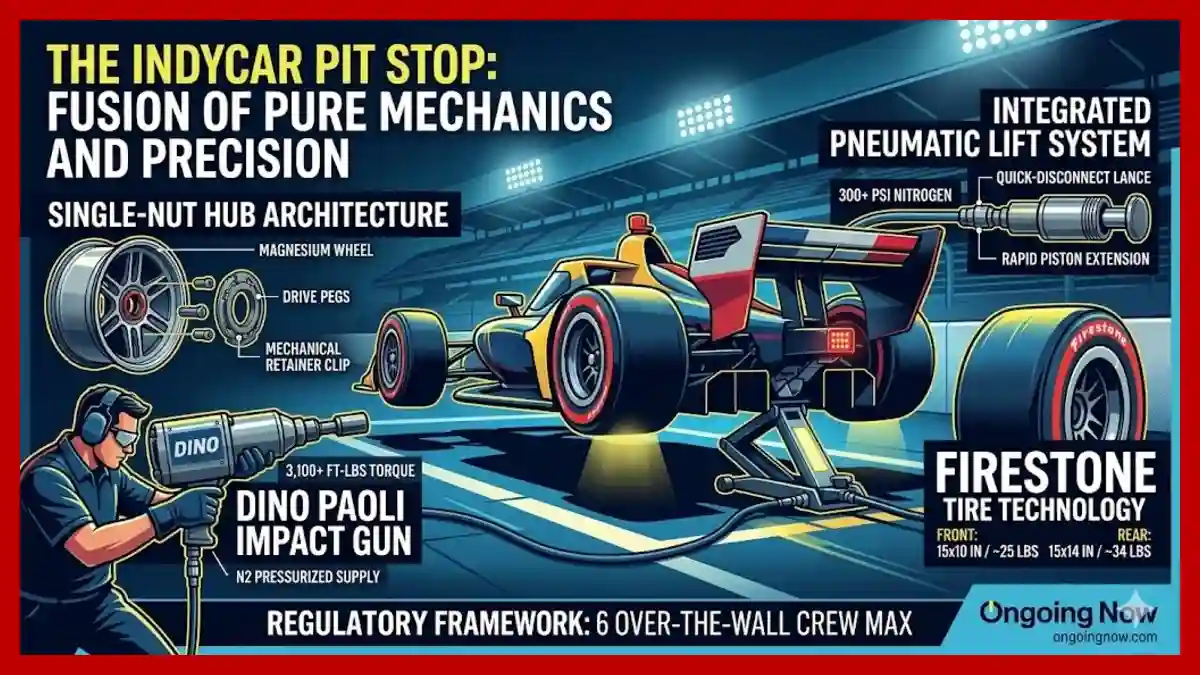
The speed of an IndyCar wheel change relies on a center-lock hub design optimized for high-speed mechanical disassembly. Unlike standard production vehicles that utilize four to five separate lug nuts, open-wheel racing cars employ a single, self-locking center nut to secure the wheel assembly to the drive pegs.
+-----------------------------------------------------------------+
|                    INDYCAR CENTER-LOCK HUB                      |
+-----------------------------------------------------------------+
|                                                                 |
|     [Cone Face] ----> [Drive Pegs] ----> [Retention Clips]     |
|          |                 |                    |               |
|    Aligns wheel      Transfers high      Prevents unthreading   |
|    under tension      torque loads       if tension drops       |
|                                                                 |
+-----------------------------------------------------------------+
The hub assembly incorporates a series of hardened steel drive pins or pegs that project outward from the brake rotor hat. These pegs mate directly with corresponding recesses machined into the back face of the Firestone racing wheel. This physical separation of the centering mechanism from the torque-transfer mechanism ensures that the wheel nut only bears the clamping force, while the pins absorb the rotational forces generated under braking and acceleration.
To guarantee that wheels cannot back off if torque drops, the hub uses mechanical retention mechanisms. These internal safety clips or spring-loaded detents remain depressed when the pneumatic gun socket is engaged but snap outward to lock the nut in place once the tool is removed. The threads themselves are directional: right-hand threads are fitted to the left side of the chassis, and left-hand threads are used on the right side. This application of inertial tightening ensures that the forward rotation of the wheels naturally tends to tighten the nut rather than loosen it.
Pneumatic Systems and Pneumatic Impact Tool Parameters
The tools responsible for breaking loose and securing these single wheel nuts operate under strict pneumatic constraints. IndyCar teams utilize standard specialized air impact wrenches, primarily manufactured by builders like Dino Paoli, which are engineered to deliver high torque outputs within milliseconds of trigger engagement.
| Parameter | Specification / Value |
| Tool Manufacturer/Model | Dino Paoli Hurricane / DP6000 Series |
| Maximum Reverse Torque | 3,100 to 3,172 ft-lbs ($4,200 \text{ to } 4,300 \text{ Nm}$) |
| Free Speed Rotation | 14,500 to 15,000 RPM @ 25 bar |
| Operating Gas / Medium | Compressed Nitrogen or Clean Compressed Air |
| Maximum Regulated Pressure | 25 bar ($362.6 \text{ psi}$) |
| Tool Mass (Carbon Cover) | 8.15 lbs ($3.70 \text{ kg}$) |
The maximum reverse torque rating of these tools ranges between 3,100 ft-lbs and 3,172 ft-lbs, operating at fluid pressures up to 25 bar. This immense force is required to overcome the static friction of a heated wheel nut that has undergone severe heat soak from the adjacent carbon brake assemblies. The forward fastening torque is carefully regulated via downstream pressure valves to ensure it achieves a precise clamping force, typically calibrated between 400 ft-lbs and 500 ft-lbs depending on the circuit topology and wheel load calculations.
To supply the necessary flow rate to drive these air motors to free speeds of 15,000 RPM, teams deploy heavy-duty overhead booms feeding flexible lines with a minimal interior bore of 10 mm. The gas medium used is typically compressed nitrogen rather than standard atmospheric air. Nitrogen provides a completely dry, predictable moisture profile, preventing internal tool corrosion and eliminating the risk of pressure fluctuations caused by moisture expanding when exposed to the high ambient temperatures of the pit box environment.
Firestone Tire Performance and Mass Profiles
Minimizing tire change time requires optimizing the physical dimensions and weight of the tire and wheel assemblies. Firestone produces specific slick and treaded rain specifications for IndyCar competition, with the physical mass differing substantially between front and rear axles to accommodate the rear-biased weight distribution of the Dallara IR-12 chassis.
Front Wheel Assembly Mass: Approximately 13.5 lbs ($6.12 \text{ kg}$) for the bare magnesium rim, totaling roughly 24 to 26 lbs once fitted with a dry-weather slick tire.
Rear Wheel Assembly Mass: Minimum bare rim weight of 14.7 lbs ($6.67 \text{ kg}$), scaling to 32 to 35 lbs when fully inflated with dry nitrogen.
Front Rim Dimensions: 15 inches in diameter by 10 inches in width.
Rear Rim Dimensions: 15 inches in diameter by 14 inches in width.
Optimal Operating Temperature: Optimal Operating Temperature: 180°F to 220°F (82°C to 104°C), achieved via rolling friction on track as tire warmers are prohibited by rule.
The physical size of the rear assembly presents a distinct packaging challenge during a pit stop. A tire changer must lift, rotate, and align a 35-pound assembly onto the hub drive pegs while clearing the rear wing assembly and bodywork. Because the air jacks elevate the car by only a few inches to maintain stability, the vertical clearance between the bottom of the tire carcass and the pavement is often less than two inches.
Any misalignment during the mounting phase can damage the aluminum hub threads or deform the drive pegs. If the wheel does not seat completely flush against the brake hat face, the pneumatic gun will apply its torque across an angled gap. This results in an incomplete torque readout, leaving the wheel insufficiently clamped and forcing an immediate secondary stop to replace the damaged hardware.
The Mechanical Execution of the Integrated Air Jack System
Every stationary pit service requires the deployment of an on-board pneumatic lift system embedded directly within the car’s carbon-fiber monocoque structure. This system eliminates the need for manual floor jacks, reducing mechanical lag before a tire change can begin.
+-----------------------------------------------------------------+
|                   PNEUMATIC LIFT SEQUENCE                       |
+-----------------------------------------------------------------+
|                                                                 |
|   1. Nitrogen Lance engaged at rear receptacle                  |
|   2. High-pressure gas fills internal cylinder                  |
|   3. Main piston rod stroke extends downward                    |
|   4. Car lifts 2-3 inches; mechanical vent valve locks system    |
|   5. Lance release vents pressure; chassis drops via gravity     |
|                                                                 |
+-----------------------------------------------------------------+
The car features a quick-disconnect nozzle receptacle located at the base of the rear engine cover hoop. As the car halts in its assigned box, the air-jack technician inserts a pressurized lance connected to a high-pressure pit bottle regulated at approximately 300 to 400 psi. The gas enters a single vertical pneumatic cylinder mounted near the car’s center of gravity.
This pressure forces an internal piston rod downward through the floor of the underwing. The stroke extends a metallic footprint into contact with the pavement, lifting the entire 1,600-pound vehicle two to three inches clear of the track surface in less than 0.3 seconds.
The system remains pressurized until the tire changes are completed. Once the tire changers signal completion, the technician pulls a release ring on the lance or operates a mechanical vent valve, venting the internal gas volume directly to the atmosphere. The car drops instantly via gravity, allowing the driver to engage the clutch and launch from the box.
Regulatory Framework Governing Pit Lane Activities
Safety and competitive parity in IndyCar pit lanes are strictly governed by the NTT IndyCar Series Rulebook. These regulations impose clear operational boundaries that prevent teams from optimizing solely for speed at the expense of crew safety.
Personnel Limits: A maximum of six over-the-wall crew members are permitted to service the vehicle during a live pit stop under green or yellow flag conditions.
Specific Allocation: Typical crew layouts comprise four tire changers (one per wheel), one fueler operating the deadman-valve hose, and one air-jack operator.
Mandatory Safety Apparel: All over-the-wall personnel must wear fire-resistant suits, gloves, shoes, and balaclavas meeting SFI 3.2A/5 or FIA 8856-2000 specifications, alongside full-face helmets.
Pit Lane Speed Limits: Strictly enforced via timing loops and on-board wheel-speed sensors, generally set at 50 mph (80.5 km/h) or 60 mph (96.5 km/h) depending on the pit lane geometry of the specific circuit.
The six-person limit alters the mechanics of an IndyCar stop compared to other formats like Formula 1, where upwards of twenty mechanics are deployed. In IndyCar, each tire changer must perform the entire removal, placement, and tightening sequence independently. They must use one hand to operate the heavy wheel gun while using their other arm and torso to handle the mass of the wheel assembly.
Furthermore, fuel replenishment occurs simultaneously with the tire change. The fueler attaches a heavy, 2-inch diameter fuel hose that flows specialized E85 fuel into the cell under gravity or regulated pressure. A secondary vent hose must be monitored to ensure fuel vapors do not accumulate near hot brake components, introducing severe penalties for any spilled fuel or premature releases before the hoses are decoupled.
Financial Realities and Labor Metrics of Pit Crew Personnel
Unlike specialized technicians in some European racing series, the individuals completing these rapid pit stops are generally full-time mechanics, fabricators, or engineers based within the team’s race shop. Their trackside pit duties represent a specialized extension of their primary mechanical roles.
| Job Classification | Median Annual Salary | Primary Shop Responsibility |
| Motorsport Engineer | $107,956 | Data analysis, vehicle dynamics, simulation |
| IndyCar Mechanic | $52,283 | Powertrain teardowns, suspension assembly, chassis prep |
| Motorsports Technician | $46,952 | Component fabrication, composite repair, electrical routing |
| Pit Crew Member (Avg. Baseline) | $44,261 | General shop labor, logistics, trackside support |
The financial compensation structure reflects this dual-role reality. Data compiled from national labor tracking systems indicates that the average baseline salary for personnel carrying out pit crew duties sits at $44,261 annually, translating to an hourly equivalent of roughly $21.28. However, highly skilled shop mechanics who double as front-tier tire changers for premier organizations command higher earnings, often pairing their base mechanical salary ($52,283 median) with performance-based bonuses tied to championship points or high-profile event finishes.
At the apex of the engineering hierarchy, formal motorsport engineers earn a median salary of $107,956. While these engineers infrequently step over the wall to change tires due to their critical analytical roles on the pit box, they are directly responsible for the data logging, telemetry analysis, and mechanical adjustments that define the window of the stop itself. The physical crew members undergo rigorous conditioning regimens, including target weight training and reflex synchronization drills, to protect against soft-tissue injuries caused by lifting heavy tire assemblies under explosive physical acceleration.
Analytical Review of Competitive Complications: Carb Day 2026 Case Study
The intersection of mechanical precision and physical environment was demonstrated during the running of the annual Oscar Mayer Indy 500 Pit Stop Challenge on Carb Day. This exhibition brackets the field’s top crews in a single-elimination tournament to compete for a share of a $150,000 prize purse. The 2026 event illustrated how small component variations disrupt well-rehearsed mechanical workflows.
+-----------------------------------------------------------------+
|              2026 CARB DAY PIT CHALLENGE HIGHLIGHTS             |
+-----------------------------------------------------------------+
|                                                                 |
|   Palou (Ganassi) vs. Hunter-Reay (McLaren)                     |
|   --> Right-rear wheel nut fumble eliminates Ganassi.           |
|                                                                 |
|   Newgarden (Penske) vs. Dixon (Ganassi)                        |
|   --> Penske executes clean stop; eliminates remaining Ganassi. |
|                                                                 |
|   O'Ward (McLaren) vs. Power (Andretti)                         |
|   --> Power stalls engine during launch phase; McLaren advances.|
|                                                                 |
+-----------------------------------------------------------------+
The opening bracket round matched reigning Indianapolis 500 pole-sitter Alex Palou’s No. 10 Chip Ganassi Racing crew against the No. 31 Arrow McLaren squad of Ryan Hunter-Reay. Palou secured a slight initial advantage on the entry drag to the box. However, the Chip Ganassi Racing crew suffered an uncharacteristic mechanical fumble on the right-rear wheel nut engagement, delaying the tool’s impact cycle and allowing the Arrow McLaren crew to advance to the quarter-finals.
Subsequent pairings reinforced the high penalty for operational errors. The defending event winners, Josef Newgarden and the No. 2 Team Penske crew, faced Scott Dixon’s No. 9 Ganassi crew. The Penske mechanics executed a clean synchronization sequence, eliminating the second major Ganassi entry from the tournament.
In a later matchup between Pato O’Ward and Will Power—making his first appearance for Andretti Global after moving from Penske—the stop was decided by a driver execution error. Power stalled his engine during the high-torque launch phase as the air jacks dropped, gifting Arrow McLaren an easy advancement.
The competition was ultimately cut short by weather conditions. As Dennis Hauger’s Dale Coyne Racing crew prepared to face Mick Schumacher’s Rahal Letterman Lanigan group, increasing rainfall began coating the concrete pit lane.
Because IndyCar vehicles run slick tires during this challenge, cold rubber interacting with a wet, low-friction concrete surface introduced an immediate risk of traction loss during the high-speed entry and launch phases. To protect the over-the-wall crew members from out-of-control vehicles sliding into the service boxes, IndyCar technical official Kevin Blanch cancelled the remainder of the competition, preserving the assets and safety of the teams ahead of the main event.
Source and Data Limitations
The analysis presented in this report relies strictly on official regulatory data, manufacturer technical catalogs, and trackside event filings verified through May 2026. Technical specifications regarding hub architecture and engine boost boundaries are derived from the official NTT IndyCar Series Rulebook and mechanical releases from Dallara Automobili and Honda Performance Development.
Pneumatic tool metrics, including maximum torque values and rotational velocities, are verified using the official product specifications for the Dino Paoli Hurricane and DP6000 series impact tools. Financial labor figures and salary distribution curves are sourced from mid-2026 national occupational data registries, including localized breakdowns from ZipRecruiter.
The analytical details concerning the Carb Day Pit Stop Challenge are drawn from official trackside reports and timing logs issued by Indianapolis Motor Speedway media communications on May 22, 2026. This article deliberately omits any unverified live-stop timing numbers or speculative predictions concerning team operational budgets that are not part of the public regulatory record.
Stay sharp with Ongoing Now!