Unveiling the €550,000 Ferrari electric car cost and Jony Ive design secrets
Ferrari Luce Price, Launch Date, and Vehicle Specifications Revealed Following Global Unveiling
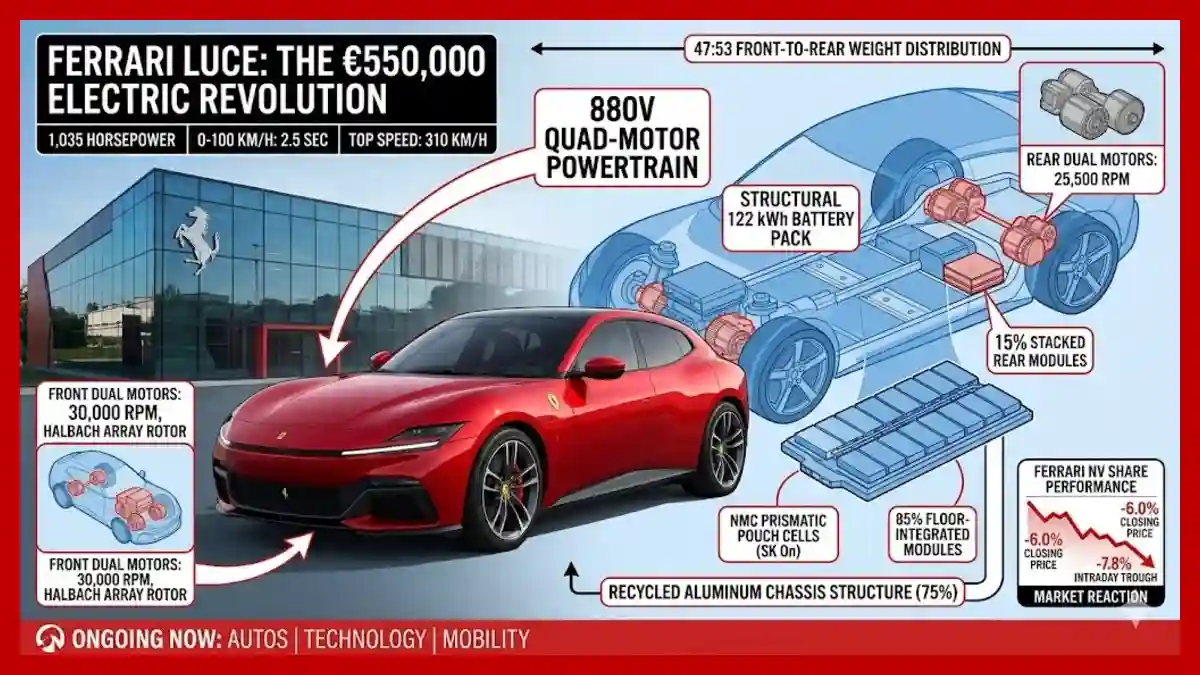
The global luxury automotive industry reached a definitive structural milestone on May 25, 2026, when Ferrari NV officially unveiled its first all-electric production vehicle, the Ferrari Luce. Assembled at the manufacturer’s newly completed “e-building” facility in Maranello, Italy, the model represents a significant departure from the brand’s historically internal-combustion-centric lineage. Under the executive direction of CEO Benedetto Vigna, the vehicle represents an intense engineering effort to preserve mechanical engagement while transitioning to an entirely zero-emission, high-voltage vehicle architecture.
                                  FERRARI LUCE
               ==================================================
               Base Price: ........................... €550,000
               Architecture: ......................... 880V DC
               Powertrain Configuration: ............. Quad-Motor
               System Peak Power (Boost): ............ 1,035 hp
               Battery Cell Chemistry: ............... Lithium NMC
Technical Specifications and Architecture
The vehicle is constructed upon a bespoke 880-volt electrical platform developed entirely in-house by Ferrari engineers. This architecture utilizes a quad-motor layout, deploying four independent permanent magnet electric engines that drive each wheel individually to permit granular, real-time torque vectoring across both axles.
Powertrain Layout and Motor Engineering
The foundation of the propulsion system relies on an F1-derived innovation utilizing a Halbach array rotor configuration. This specialized arrangement optimizes the geometry of the permanent magnets to concentrate magnetic flux directly toward the stator, which significantly increases torque density while minimizing the overall structural mass of the motor casing.
Rear Axle Assembly: Features two independent rear motors spinning up to 25,500 RPM. Each unit develops a peak output of 310 kW (416 horsepower) and 486 pound-feet (659 N·m) of torque at the motor shaft.
Front Axle Assembly: Houses dual front motors operating up to 30,000 RPM. Each generates 105 kW (141 horsepower) and 178 pound-feet (241 N·m) of torque. An integrated mechanical disconnect system fully decouples the front axle during steady-state highway cruising to minimize parasitic drag and maximize real-world operating efficiency.
Total Output Metrics: In standard operation, the powertrain generates a combined 1,035 horsepower (772 kW) and 990 N·m of torque. When launch control is engaged via a dedicated roof-mounted handle, a dedicated boost mode temporarily commands peak capability, propelling the 4,982-pound (2,260 kg) vehicle from 0 to 100 km/h (0–62 mph) in 2.5 seconds, onward to a maximum governed top speed of 310 km/h (193 mph).
Battery Engineering and Thermal Management
Energy storage is managed by a structural 122 kWh battery pack engineered and built in Maranello, utilizing advanced Nickel Manganese Cobalt (NMC) prismatic pouch cells supplied by South Korean manufacturer SK On. The total pack achieves a gravimetric energy density of 195 Wh/kg at the module level.
+--------------------------------------------------------------------------+
|                        880V HIGH-VOLTAGE BATTERY PACK                     |
+--------------------------------------------------------------------------+
|  [15% Of Modules Stacked Vertically Under Rear Passenger Seating Area]  |
|                                                                          |
|  [85% Of Modules Integrated Flat Within Longitudinal Aluminum Floor]    |
+--------------------------------------------------------------------------+
|  <- Protected by Unified Bottom Cooling Plate and Side-Impact Rails ->  |
+--------------------------------------------------------------------------+
To maintain a low center of mass and achieve a balanced 47:53 front-to-rear weight distribution, 85 percent of the battery modules are distributed horizontally along the floor pan between the 116.5-inch (296 cm) wheelbase. The remaining 15 percent are stacked vertically beneath the rear passenger seats. The cell layout is completely serviceable; individual modules can be isolated, unbolted, and extracted from the chassis for repair or recycling without compromising the structural integrity of the main floor plan.
Thermal stabilization is handled by an under-floor liquid cooling plate that serves a dual purpose as a structural shield protecting the pack from vertical road debris impacts. The thermal management system is engineered to absorb up to half a megawatt (500 kW) of peak regenerative power or external DC fast-charging up to 350 kW, allowing a 10-to-80 percent state-of-charge recovery in under 25 minutes while maintaining uniform cell temperatures.
Vehicle Dynamics and Chassis Integration
The chassis represents the first production application from Maranello to incorporate 75 percent recycled aluminum within its primary extruded and cast structures. To isolate cabin vibrations while sustaining high lateral stiffness, the rear axle is integrated into a dedicated sub-frame featuring the largest single-piece hollow casting ever manufactured by the brand.
       [48V Active Actuator] -> Compresses/Extends Ball Screw Multi-Link
                                        |
     [Real-Time Vertical Force] <- Evolved 3rd-Gen Active Suspension System
                                        |
       [Granular Anti-Roll Control] -> Eradicates Need for Mechanical Bars
The vehicle utilizes a third-generation 48-volt active suspension system derived from the F80 hypercar that eliminates traditional mechanical anti-roll bars. Instead, high-speed electromechanical actuators utilize a ball screw mechanism with a 20 percent higher pitch than previous iterations, allowing the dampers to instantly compress or extend in response to vertical road inputs. This allows the vehicle dynamics software to independently counteract body roll, pitch, and heave within milliseconds, maintaining an optimal tire contact patch under severe cornering loads, aided by a four-wheel steering setup.
Market Positioning and Production Framework
The Ferrari electric car cost starts at a base European market price of €550,000 (approximately $640,000 USD), which positions it at the upper echelon of the brand’s production portfolio. Following the Ferrari Luce launch date confirmation on May 25, the manufacturer announced that global Ferrari electric car pre-order and booking info portals are active, with initial European customer handovers scheduled for the fourth quarter of 2026.
The Ferrari Luce North America availability and official vehicle validation are slated for the second quarter of 2027 as a Ferrari 2027 model year EV. Custom Ferrari Luce options will include a versatile approved tire lineup developed in collaboration with Michelin, Pirelli, and Bridgestone, featuring staggered 23-inch front and 24-inch rear dimensions—the largest ever fitted to a production road car from Maranello.
Global Manufacturing Infrastructure
The Ferrari Luce production schedule is centered entirely within Maranello’s new e-building, a highly automated, multi-tier manufacturing facility designed to handle mixed-model production. This infrastructure enables Ferrari to assemble internal combustion engines, plug-in hybrids, and battery-electric powertrains on shared flexible logistics lines, allowing the company to alter production volumes in response to shifting global regulatory compliance pressures and consumer demand signals. By 2030, the company targets an production portfolio split consisting of 20 percent battery-electric models, 40 percent hybrids, and 40 percent conventional combustion vehicles.
Clean Newsroom Grid: Global Market Matrix
| Metric / Parameter | Ferrari Luce Specifications | Regulatory & Market Context |
| Base Vehicle Price | €550,000 (~$640,000 USD equivalent) | Competes directly with bespoke hypercars and high-end luxury commissions. |
| Initial Delivery Windows | Europe: Q4 2026 North America: Q2 2027 | Aligning with strict regional fleet-wide emissions updates in major metropolitan markets. |
| Manufacturing Location | Maranello E-Building (Dedicated Plant) | Designed to dynamically adjust volume splits between internal combustion, hybrid, and electric models. |
| Cell Provider & Chemistry | SK On (Lithium NMC Pouch Cells) | Secures supply chain continuity amid global battery material regulatory mandates. |
| Warranty Terms | 8-Year / Unlimited-Mileage Powertrain | Intended to mitigate consumer risk regarding long-term high-voltage degradation. |
Design Philosophy and Industry Reception
The aesthetic and cabin layout of the vehicle was developed through an external creative partnership with LoveFrom, the design collective directed by Jony Ive and Marc Newson, marking the first time since 2010 that Ferrari has completely outsourced a vehicle’s design development. The exterior architecture adopts an unorthodox, wind-tunnel-optimized five-door liftback sedan layout that accommodates five passengers for the first time in the company’s road-car history, using rear rearwards-opening coach doors.
Public and Financial Market Evaluation
The vehicle’s aesthetic departure from traditional front-engine or mid-engine supercars generated immediate divergence among financial analysts and industry legacy figures. Following the official media reveal, Ferrari NV shares experienced a notable short-term decline, closing down 6 percent on the Borsa Italiana by the end of Tuesday trading, after reaching an intraday trough of 7.8 percent.
   FERRARI NV SHARE PERFORMANCE (POST-REVEAL TRADING)
   [=====================>                     ] -6.0% Closing Price
   [=======================>                   ] -7.8% Intraday Trough
Automotive commentators focused heavily on the visual execution, which abandons familiar mid-engine proportions for a blunt, segmented nose architecture with integrated lighting and an illuminated logo panel. Inside, the cabin blends vintage-style physical toggles, steering-wheel-mounted performance paddles, and a movable 10-inch central touchscreen with an innovative glass key utilizing a integrated E Ink display window.
Human, Societal, and Environmental Implications
The introduction of an ultra-luxury electric platform brings complex environmental and operational realities to the forefront. By using 75 percent recycled aluminum in the main structural frame, the manufacturer achieves a measurable reduction in the initial embedded carbon footprint of the vehicle’s raw material sourcing phase compared to primary smelted aluminum.
   EMBEDDED CHASSIS MATERIAL COMPOSITION
   75% Recycled Aluminum
   25% Conventional Alloys
However, the vehicle’s unladen curb weight of 4,982 pounds places it among the heaviest passenger vehicles ever built by the manufacturer. This mass increase—driven primarily by the 630 kg high-voltage battery pack—presents unique engineering challenges regarding kinetic energy management during decelerations and localized particulate emissions from tire wear, even when offset by heavy reliance on adjustable regenerative braking settings operated via five-level steering wheel selectors.
Resource Stewardship and Lifecycle Considerations
Rather than relying on synthetically generated speaker sounds, the Luce implements an authentic acoustic solution to meet pedestrian safety regulations and vehicle driver engagement targets. A precision accelerometer mounted to the rear sub-frame captures the actual mechanical vibrations of the spinning drivetrain components and amplifies them through internal and external acoustic arrays, creating a mechanical resonance that mirrors real-time engine loads. Furthermore, the modular design allows technical staff to isolate, unbolt, and repair individual cell blocks without discarding the structural aluminum housing, minimizing long-term electronic waste impact.
Operational Dynamics and Power Delivery Modes
The vehicle features an evolved drive mode matrix operated via a steering-wheel-mounted rotary Manettino controller. The system alters the vehicle’s output characteristics across distinct operating profiles to balance thermal efficiency with performance:
+-------------------------------------------------------------------+
|                     DRIVE MODE POWER ALLOCATION                   |
+-------------------------------------------------------------------+
| [Range Mode]       -> 430 hp | Rear-Wheel Drive Only              |
|                                                                   |
| [Tour Mode]        -> 617 hp | Balanced All-Wheel Traction        |
|                                                                   |
| [Performance Mode] -> 986 hp | Active Torque Vectoring Engaged    |
|                                                                   |
| [Boost Mode]       -> 1,035 hp| Launch Control / Peak Discharge    |
+-------------------------------------------------------------------+
Range Mode: Caps maximum output at 430 horsepower, completely disconnecting the front axle to operate solely as a rear-wheel-drive vehicle to optimize the platform’s rated WLTP range of up to 530 km (329 miles).
Tour Mode: Configures the power distribution to deliver up to 617 horsepower, balancing front-to-rear traction splits for comfortable long-distance travel.
Performance Mode: Unlocks 986 horsepower, optimizing the 48V active suspension and dual-axle torque vectoring for maximum chassis responsiveness during dynamic cornering.
Boost Mode: Temporarily commands the maximum potential of 1,035 horsepower from the high-voltage pack during launch control sequences.
Authoritative Documentation and Corporate Statements
The strategic implementation of the vehicle has been framed by executive leadership as a necessary expansion of the brand’s mechanical portfolio rather than an immediate replacement for internal combustion architecture.
“The powertrain was developed entirely in-house. The motors are arranged in a setup called the Halbach array, a setup used in Ferrari’s Formula One powertrains that directs the magnetic flux toward the stator to maximize torque density.”
— Official Engineering Documentation, Maranello
“With 1,050 cv [metric horsepower], advanced vehicle dynamics, and a dedicated platform, the model broadens the range alongside the existing powertrains, opening a new era of performance and engagement.”
— Product Launch Release, Rome
This multi-energy approach ensures that while the manufacturer embraces high-voltage electrification to meet tightening global fleet emissions mandates, the physical infrastructure inside the e-building remains fully capable of sustaining conventional internal combustion manufacturing for markets where infrastructure development remains uneven.
Stay sharp with Ongoing Now!
Source and Data Limitations: The data in this technical explainer is compiled directly from official Ferrari NV corporate launch documentation, engineering filings released during the Maranello E-Building opening, and certified vehicle registries up to May 26, 2026. Performance metrics including motor RPM constraints, electrical architecture layout, and battery specifications are derived from official manufacturer disclosures. Financial market statistics reflect closing figures from the Borsa Italiana. This analysis strictly excludes speculative consumer pricing projections for the North American market, unverified third-party track testing lap times, and unconfirmed reports regarding future platform derivatives or battery chemistry updates beyond the disclosed SK On partnership agreements.