How the Toyota solid state battery achieves a 10-minute fast charge
An analytical deep dive into official production timelines, sulfide-based electrolyte materials science, and 2026 EV integration.
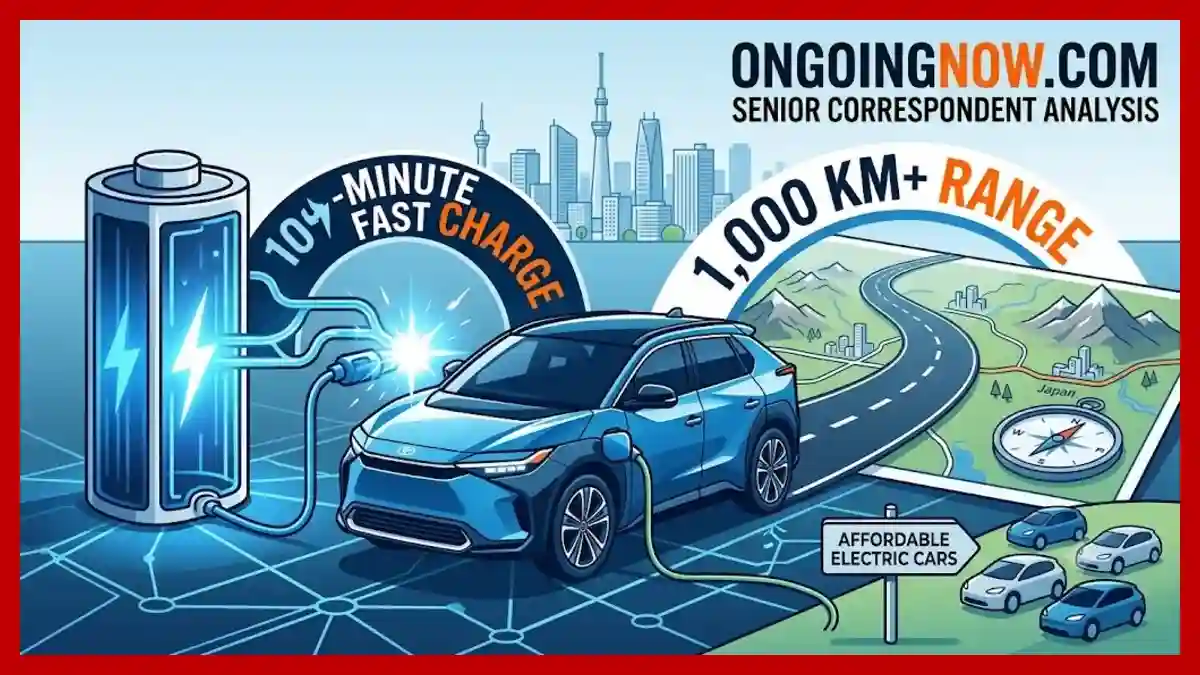
The evaluation of Toyota solid state battery specifications has become a central focus for the automotive sector as the manufacturer transitions toward its 2026 Toyota EV lineup. This next gen EV battery technology aims to drastically improve solid state battery charging speed and maximize Toyota electric vehicle range. While initial deployment will prioritize premium platforms and long range electric SUVs, the development roadmap outlines a long-term shift toward mass-market, affordable solid state electric cars. The official approval of Toyota commercial solid state batteries by Japan’s Ministry of Economy, Trade and Industry (METI) marks a structural shift from laboratory research to validated mass production infrastructure.
This formal certification by METI under Japan’s Economic Security Promotion Act solidifies the regulatory framework supporting this transition. Koji Sato, President and CEO of Toyota Motor Corporation, has emphasized the strategic value of establishing domestic production capabilities for these high-density energy storage systems. The operational roadmap is executed through deep supply chain partnerships with Idemitsu Kosan for sulfide solid electrolytes and Sumitomo Metal Mining for high-durability cathode materials. By integrating these foundational engineering advancements, Toyota plans to address structural limitations inherent in traditional liquid electrolyte cells, notably thermal instability and energy capacity saturation.
The Technical Blueprint of Toyota Solid State Battery Specifications
The core alteration in this battery architecture is the replacement of volatile liquid organic electrolytes with a highly stable sulfide-based solid electrolyte. This materials science transition allows for the integration of a lithium metal anode, which possesses a significantly higher theoretical energy capacity than conventional graphite anodes. According to official manufacturer documentation and certification data, the energy density of these solid-state units scales between $450\text{ to }500\text{ Wh/kg}$. This capacity represents more than double the volume efficiency of standard ternary lithium-ion batteries currently found in mainstream electric passenger vehicles.
+-----------------------------------------------------------+
|               Sulfide-Based Solid Electrolyte             |
|  [ Cathode (+) ] ----> ( Lithium Ions ) ----> [ Anode (-) ]|
|  High-Voltage Material                     Lithium Metal  |
+-----------------------------------------------------------+
| * Eliminates volatile liquid solvents                      |
| * Inhibits dangerous crystalline dendrite growth          |
+-----------------------------------------------------------+
By removing liquid components, the cells are significantly less susceptible to thermal runaway, reducing the requirement for heavy and complex internal cooling assemblies. The solid matrix physically prevents the growth of lithium dendrites—microscopic metallic whiskers that cause internal short circuits and eventual battery degradation. Furthermore, the specialized high-durability cathode material minimizes the structural degradation usually observed during repeated electrochemical cycling. Consequently, laboratory data indicates a capacity retention rate exceeding 90% after 2,000 full charge-discharge cycles, giving the powertrain a projected operational lifespan that matches or exceeds vehicle architecture durability.
Integration Within the 2026 Toyota EV Lineup and Beyond
The image above highlights the incremental strategy being deployed, showing a distinct multi-pathway transition from traditional liquid configurations to advanced solid states. The first commercial implementation of all-solid-state cells is scheduled for the 2027–2028 timeframe, debuting primarily within the Lexus luxury division. Because early-stage production yields face higher component overheads, luxury flagships provide the necessary margin buffer to absorb initial capital expenditures. This phased strategy ensures manufacturing processes mature substantially before the technology transitions down to high-volume consumer segments.
Analysis: Performance Metrics and Solid State Battery Charging Speed
The physical properties of sulfide solid electrolytes drastically lower internal resistance, enabling rapid kinetic movement of lithium ions during high-voltage charging events. Consequently, the certified solid state battery charging speed targets a 10% to 80% state-of-charge replenishment in exactly 10 minutes when connected to compatible high-power DC fast-charging infrastructure. This performance requires integration with an 800-volt electrical architecture capable of sustaining elevated peak currents without generating catastrophic localized thermal strain.
       TYPICAL CHARGING CURVE COMPARISON (10% TO 80% SOC)

Conventional Liquid Li-ion (400V)
[========= 30 Minutes =========]

Toyota Solid-State Battery (800V)
[== 10 Min ==]
To validate these speeds under real-world stresses, engineers have tested prototype packs across extensive environmental envelopes. In low-temperature baselines of $-10^\circ\text{C}$, where standard liquid lithium-ion cells suffer dramatic drop-offs in conductivity and experience plating risks, the solid matrix maintained efficient ion transport. Conversely, during extreme ambient testing at $40^\circ\text{C}$, the system demonstrated a low thermal accumulation signature, eliminating the aggressive step-down charging curves typically used by battery management software to prevent overheating.
What the Data Shows: Toyota Electric Vehicle Range Benchmarks
The combination of elevated volumetric efficiency and reduced structural mass fundamentally shifts expectations for Toyota electric vehicle range capabilities. Initial production iterations are engineered to comfortably exceed 1,000 kilometers of driving range under standardized testing cycles. Subsequent optimization phases, which involve refined aerodynamic profiles and advanced vehicular mass management, aim to push driving ranges beyond 1,200 kilometers on a single charge.
| Battery Tier Category | Cell Chemistry / Architecture | Target Driving Range (WLTP) | Fast Charge Time (10-80%) | Relative Cost Base |
| Current Baseline (bZ4X) | Monopolar Liquid Lithium-Ion | ~500 km | ~30 minutes | 100% (Reference) |
| Performance (2026) | Monopolar Liquid Lithium-Ion | >800 km | ~20 minutes | 20% Reduction |
| Popularisation (2026-27) | Bipolar Lithium Iron Phosphate | >600 km | ~30 minutes | 40% Reduction |
| High-Performance (2028) | Bipolar Liquid Lithium-Ion | >1,000 km | ~20 minutes | 10% Further Drop |
| Solid-State Phase 1 (2027-28) | All-Solid-State Sulfide | >1,000 km | ~10 minutes | Premium Tier |
| Solid-State Phase 2 (TBD) | Advanced All-Solid-State | >1,200 km | Under 10 minutes | Mass-Market Target |
Caveat: Displayed driving range targets are engineering design projections based on internal development protocols and the Worldwide Harmonized Light Vehicles Test Procedure (WLTP). Real-world operational range will fluctuate depending on individual driving habits, vehicle accessory load, specific tire rolling resistance, and real-time topographical changes.
Manufacturing Partnerships and Toyota Commercial Solid State Batteries
Transitioning a complex material synthesis from a sterile laboratory environment to a high-volume factory floor represents a profound industrial challenge. To successfully commercialize Toyota commercial solid state batteries, the automaker has unified its internal engineering resources with specialized domestic industrial giants. The joint venture with chemical leader Idemitsu Kosan focuses explicitly on scaling the manufacturing of high-purity lithium sulfide electrolytes, ensuring stable material properties at high processing speeds.
Shunichi Kito, Representative Director and President of Idemitsu Kosan, detailed the structural integration of the project during an official corporate address:
“Through combination of both companies’ material development technologies, Idemitsu’s material manufacture technologies and Toyota’s battery processing and assembly technologies which is obtained through BEV development, both companies will aim to realize mass production of both solid electrolytes and all-solid-state batteries.”
Concurrently, Toyota has finalized an industrial production agreement with Sumitomo Metal Mining to handle the high-volume refining and synthesis of advanced cathode elements. This partnership secures critical upstream supplies of battery-grade lithium, nickel, and cobalt, insulating the production ecosystem from volatile global commodity markets. By establishing a dedicated 10 gigawatt-hour (GWh) pilot production plant in Japan, Toyota aims to systematically resolve automated stack-alignment tolerances and material contamination risks before embarking on international assembly expansion.
Economic Horizon: Navigating the Path to Affordable Solid State Electric Cars
Initial manufacturing assessments indicate that early-generation solid-state cells will carry a significant cost penalty, positioning early vehicles well above standard market pricing. During the first phase of commercial rollout, production costs are estimated near $\$300\text{ per kWh}$, necessitating their restriction to high-margin luxury sedans and premium long range electric SUVs. The industrialization strategy relies on scaling processing volumes to lower the expensive synthesis costs associated with specialized lithium sulfide components.
To eventually deliver genuinely affordable solid state electric cars, Toyota has outlined a decade-long cost-reduction curve targeting a sub-$\$100\text{ per kWh}$ cell cost by the early 2030s. This economic milestone depends on achieving massive supply-chain scale, automating high-precision stacking mechanisms, and increasing the yields of defect-free cells. By gradually introducing these high-density packs into mid-tier vehicle segments like the Camry or Corolla families, the cost premium is projected to fall below 1.5 times that of conventional liquid batteries.
Broader Mobility and Societal Implications
The widespread commercial adoption of solid-state vehicle powertrains carries significant implications for regional electrical infrastructure and global decarbonization initiatives. A 10-minute charging sequence for a high-capacity battery pack places an intense localized demand on regional electrical grids, requiring substantial implementation of stationary energy buffers. Public charging stations will need to integrate high-output megawatt charging systems (MCS) or localized battery storage vaults to prevent severe peak-demand spikes on community substations.
From an environmental standpoint, the extended operational life of solid-state cells greatly improves the lifetime sustainability metrics of passenger vehicles. Because these robust packs resist cell degradation over decades of regular use, they reduce the immediate demand for raw mineral extraction per vehicle mile traveled. Once a vehicle reaches the end of its road life, the highly stable solid cells can easily transition into secondary grid-storage applications, supporting municipal solar or wind farms before undergoing final hydrometallurgical recycling.
Evidence-Based Automotive Insights
The transition toward solid-state power systems represents a steady, capital-intensive engineering evolution rather than an overnight market disruption. Independent market forecasts indicate that solid-state options will account for roughly 0.1% of global EV sales at introduction, slowly rising to approximately 4% by 2030 as manufacturing yields steadily improve. Automakers who successfully master this difficult manufacturing process will secure an enduring competitive advantage in vehicle efficiency, structural packaging, and real-world utility.
Toyota’s comprehensive, multi-layered approach—balancing near-term liquid lithium-ion optimizations with long-term solid-state investments—mitigates the industrial risks associated with navigating a shifting regulatory landscape. By securing certified government approval and formalizing critical supplier joint ventures, the company has constructed a highly resilient foundation for its next-generation products. As these advanced vehicles gradually transition from low-volume premium flagships to mainstream consumer segments, they will help establish standardized benchmarks for global vehicle efficiency, long-term durability, and highway safety.
Stay sharp with Ongoing Now!
Source and Data Limitations: This technical explainer is compiled using verified corporate disclosures from Toyota Motor Corporation, official joint announcements with Idemitsu Kosan Co., Ltd., and Sumitomo Metal Mining Co., Ltd., alongside regulatory certification data published by Japan’s Ministry of Economy, Trade and Industry (METI) up to July 2026. Performance parameters, including the 1,000+ km range and 10-minute fast-charging capabilities, represent official manufacturer design targets and certified engineering projections rather than independent EPA or WLTP consumer window-sticker verifications. This analysis purposefully excludes viral social media speculation, unverified prototype claims, or speculative pricing models not formally disclosed via manufacturer regulatory filings.