Why Drivers Are Tracking Real-World RAV4 Hybrid Battery Life Profiles
An in-depth data analysis of long-term Toyota traction pack degradation, active maintenance strategies, and secondary market replacement costs.
Technical Overview of Electrified Powertrains
The engineering foundation of the Toyota Motor Corporation hybrid lineup relies on distinct high-voltage configurations designed to balance thermal efficiency and power density. Standard models utilize either a nickel-metal hydride (NiMH) or a compact lithium-ion (Li-ion) pack, typically operating around 244.8 volts. In contrast, the plug-in hybrid electric vehicle (PHEV) variant utilizes a much larger 18.1 kWh lithium-ion traction battery operating at 355.2 volts to manage prolonged electric-only propulsion.
Data from the Federal Highway Administration (FHWA) regarding average annual driving distances indicates that consumer vehicles undergo highly repetitive shallow cycling patterns. The battery management system (BMS) controls these cycles by maintaining the state of charge (SoC) within a strict operational window, usually preventing the cells from exceeding 80% or dropping below 20%. This design paradigm protects internal chemistry from structural stress, directly supporting prolonged operational readiness over multiple years of service.
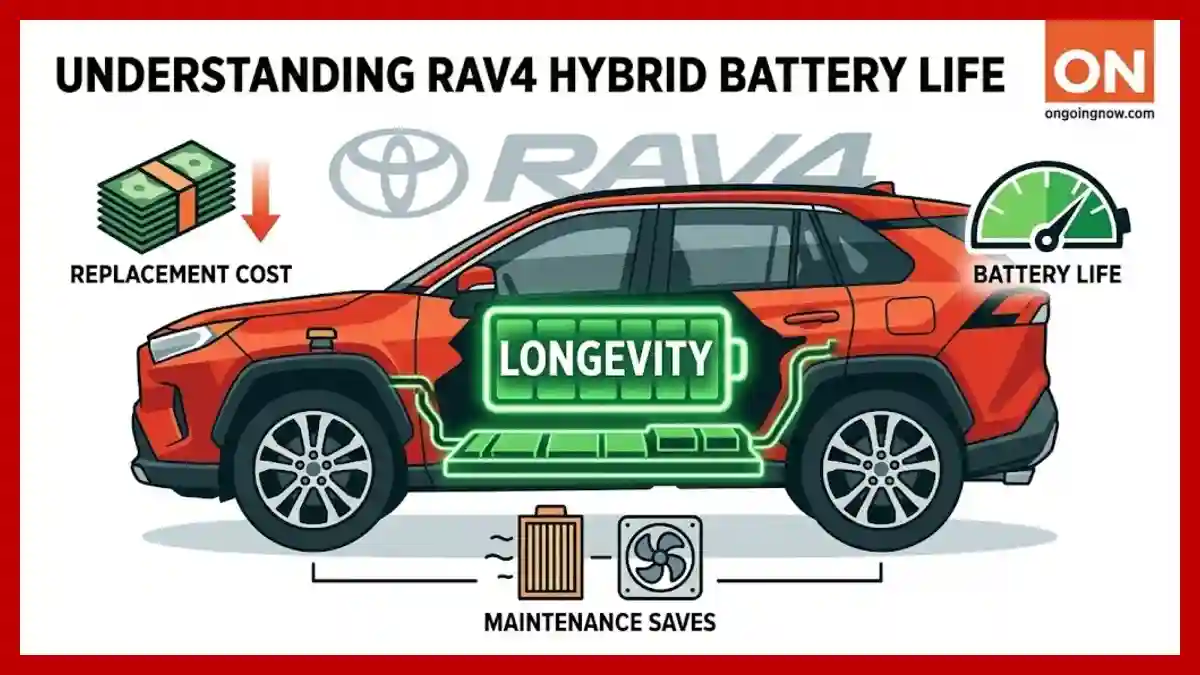
The packaging of these high-voltage packs places them directly beneath the rear passenger seats or along the lower floor pan. This positioning shields the modules from external impacts while optimizing passenger volume and lowering the center of gravity. However, it also requires an active cooling system that draws cabin air through dedicated filters to keep internal temperatures within nominal limits during operation.
Evaluating Long-Term Toyota RAV4 Hybrid Battery Life Performance
Real-world metrics gathered by independent testing firms like iSeeCars and valuation organizations like J.D. Power indicate that standard high-voltage packs frequently reach between 150,000 and 200,000 miles before experiencing critical cell failure. The overall longevity depends heavily on local climate profiles, daily driving duty cycles, and adherence to cooling system maintenance schedules. When cells age normally, the internal resistance rises, leading to marginal decreases in overall thermal efficiency.
+-----------------------------------------------------------+
|               HIGH-VOLTAGE DEGRADATION TIMELINE           |
+-----------------------------------------------------------+
|  0-50k Miles   | Nominal capacity, full efficiency        |
|  50k-100k Mi   | Minor capacity loss (<5%), normal range  |
|  100k-150k Mi  | Gradual internal resistance increases    |
|  150k+ Miles   | Capacity stabilization or cell imbalance |
+-----------------------------------------------------------+
As the high-voltage system encounters higher mileage, subtle plug in hybrid battery lifespan signs become apparent to observant operators. The internal combustion engine (ICE) may engage earlier during moderate acceleration phases, or the vehicle may show a slight reduction in cold-weather regenerative braking capacity. These behaviors represent a calculated software strategy implemented by the powertrain control module to protect aging cells rather than an immediate mechanical failure.
“Our goal is to build batteries that outlast the first lifecycle of the vehicle itself,” noted Gill Pratt, Chief Scientist of Toyota Motor Corporation, during a technical review. This engineering approach focuses on chemical stability over aggressive high-current draw cycles, mitigating the risk of premature terminal degradation. Consequently, catastrophic failures remain statistically rare within the initial decade of road usage.
Financial Analysis of Toyota RAV4 Hybrid Battery Life and Replacement Costs
When a vehicle operates past its factory coverage period, understanding the components of a toyota hybrid repair cost estimator becomes a necessary aspect of long-term ownership. Financial exposures are divided cleanly into two tiers based on the complexity and capacity of the underlying high-voltage architecture. Standard non-plug-in variations carry a lower liability due to their smaller physical footprint and lower cell count.
| Component / Pack Type | Estimated Parts Cost | Estimated Labor Hours | Average Total Expense |
| Standard Hybrid (OEM New) | $3,000 – $4,500 | 2.5 – 4.0 Hours | $3,500 – $5,500 |
| Standard Hybrid (Remanufactured) | $1,500 – $2,500 | 2.5 – 4.0 Hours | $2,000 – $3,500 |
| PHEV Prime Traction Pack (OEM) | $7,500 – $10,000 | 5.0 – 7.5 Hours | $8,500 – $12,000 |
| Auxiliary 12V AGM Battery | $220 – $350 | 0.5 – 1.0 Hours | $270 – $450 |
Caveat: Material costs vary regionally based on active hazardous logistics fees, core deposit return recycling credits, and local certified technician labor rates.
For advanced plug-in variants, the cost to replace rav4 prime traction battery assemblies is substantially higher due to the 18.1 kWh capacity of the lithium-ion cells. This substantial module requires specialized high-voltage lifting equipment and extensive technician training to handle safely. This investment reflects the complex cooling jackets and individual cell monitoring modules integrated directly into the physical structural casing.
The secondary market provides an alternative through the best aftermarket hybrid batteries, which utilize rebuilt or remanufactured modular cells. While these choices reduce the upfront plug in hybrid battery replacement cost by up to 50%, they generally carry shorter warranty durations and can exhibit varied cell-matching precision. True long-term reliability relies on the strict quality control processes used during the rebuilding stage to ensure uniform voltage balancing across all modules.
How Maintenance Strategies Directly Influence Toyota RAV4 Hybrid Battery Life
Proactive preservation steps represent the most accessible method to protect high-voltage components from premature capacity degradation. Incorporating practical hybrid car battery maintenance tips into regular service intervals helps avoid the accumulation of high thermal loads within the individual cell matrices. The most critical, yet frequently overlooked, task involves maintaining the dedicated cabin air intake vent located near the rear seats.
Filter Inspection: Inspect and clean the hybrid cooling fan filter every 10,000 miles to maintain uninhibited airflow.
Debris Removal: Prevent loose clothing, pet hair, or luggage from blocking the rear seat ventilation slots.
Diagnostic Scanning: Request a hybrid health check during routine oil changes to monitor individual block voltage variances.
Thermal Control: Park in shaded environments during extreme summer heatwaves to minimize ambient thermal stress on the cells.
If these paths are ignored, a restricted cooling fan will increase internal cell temperatures under heavy load conditions, accelerating chemical aging. Over time, this degradation can cause a permanent rav4 prime electric driving range decrease as the onboard monitoring computers reduce the operational capacity envelope to protect the hardware. Maintaining consistent airflow through the system allows the thermal management modules to keep cell temperatures within stable operational limits.
“Standardizing factory test parameters ensures that cell balancing remains stable under high thermal stress,” explained Cooper Ericksen, Toyota’s Senior Vice President of Product Growth and Alternative Fuel Vehicles. This highlights why keeping the air delivery paths clear remains central to the long-term health of the high-voltage system. A clean cooling loop ensures the vehicle can manage demanding regenerative charging profiles without overheating the cells.
Manufacturer and Regulatory Structural Protections
To shield subsequent owners from early financial risk, manufacturer coverage frameworks are heavily regulated by regional environmental bodies. New vehicles conform to a standard factory roadmap outlining specific toyota rav4 prime battery warranty years based on original retail registration locations. For vehicles model year 2020 and newer, the factory high-voltage traction component coverage spans 10 years or 150,000 miles, whichever benchmark occurs first.
+-----------------------------------------------------------+
|               FACTORY WARRANTY JURISDICTIONS              |
+-----------------------------------------------------------+
|  Federal EPA States   | 10 Years / 150,000 Miles Coverage |
|  CARB Mandate States  | Enhanced Zero Emission Compliance |
|  Component Inverter   | 8 Years / 100,000 Miles Coverage  |
+-----------------------------------------------------------+
In regions adhering to rules set by the California Air Resources Board (CARB), partial zero-emission vehicle compliance mandates require rigorous monitoring of emissions-related electrical assemblies. Auxiliary electronics, such as the power inverter assemblies and variable converter modules, carry an independent 8-year or 100,000-mile safety net. This legal structure protects consumers from early system failures while ensuring vehicles maintain low tailpipe emissions over time.
For buyers seeking extended security past 100,000 miles, specialized toyota extended warranty hybrid battery coverage can be integrated into comprehensive vehicle service agreements. These platinum and gold service contracts extend powertrain protection metrics, providing financial safety nets for secondary or high-mileage buyers. Reviewing the explicit contractual exclusions is necessary, as normal gradual capacity loss from routine use is typically excluded from mechanical breakdown coverage.
Comparative Market Analysis and Societal Implications
“Long-term durability and resource circularity are central to our electrification roadmap,” stated Akio Toyoda during an environmental strategy briefing. This perspective underlines the broader industrial shifts toward sustainable vehicle manufacturing practices. When high-voltage components reach the end of their primary automotive usefulness, they enter a structured recycling stream designed to reclaim vital rare-earth elements.
+---------------------------------------------------------------+
|                TRACTION BATTERY SECONDARY LIFE                |
+---------------------------------------------------------------+
|  First Life   | Automotive Propulsion (0 - 150k+ Miles)       |
|  Second Life  | Stationary Renewable Grid Storage Support     |
|  Final Life   | Closed-Loop Pyrometallurgical Material Rescue |
+---------------------------------------------------------------+
Spent packs are routinely repurposed into stationary energy storage systems, helping balance commercial solar and wind grids during peak demand hours. Once the modules drop below approximately 70% of their operational capacity, they are processed through authorized pyrometallurgical or hydrometallurgical recycling facilities. This recovery loop allows manufacturers to extract copper, nickel, cobalt, and lithium to supply future battery production lines, minimizing reliance on raw mining operations.
On a consumer level, these predictable lifespan metrics help stabilize vehicle depreciation rates within the secondary vehicle market. Buyers can review transparent historical repair and maintenance data, reducing the uncertainty often associated with older electrified powertrains. This mechanical stability lowers total ownership costs, making efficient transportation options more accessible across various consumer demographics.
Stay sharp with Ongoing Now!
Source and Data Limitations: Technical data, specifications, and warranty configurations detailed in this analysis are compiled directly from official Toyota Motor Corporation service publications, corporate announcements, and product manuals. Longevity statistics, resale valuations, and failure probabilities are derived from independent automotive research tracking indexes published by J.D. Power, iSeeCars, and CarEdge. Regulatory compliance parameters reflect active frameworks established by the Environmental Protection Agency (EPA) and the California Air Resources Board (CARB) as of June 2026. Real-world cost estimates represent market averages computed from national dealership labor metrics and certified independent hybrid component distributor catalogs; individual out-of-pocket pricing varies based on local market labor rates, shop supplies, taxes, and core recycling credits. Gradual, uniform capacity reduction over extended mileage represents a normal chemical characteristic of all lithium-ion and nickel-metal hydride cells and is editorially distinguished from mechanical component failure or factory workmanship defects.