Fallout in Deep Water: How the Persian Gulf Alliance Challenges Maritime Militarization
The enforcement of US naval operations Iranian ports has reshaped trade flows across the Middle East.

Global Corridors Face Unprecedented Security Restructuring
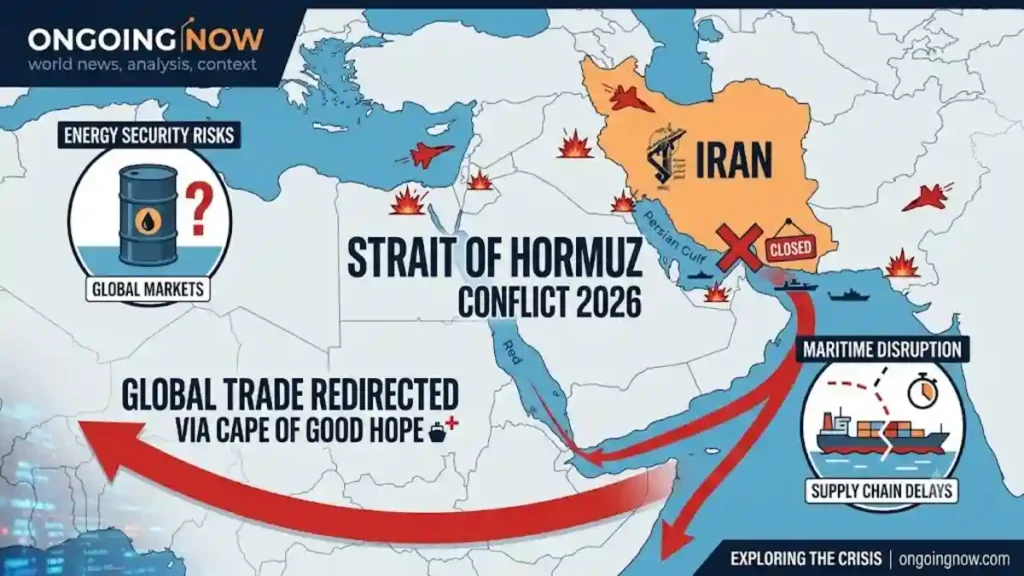
The implementation of restricted commercial access surrounding Iranian coastlines has fundamentally shifted the logistics of the Middle East geopolitical conflict updates. Under the direct operational oversight of United States Central Command (CENTCOM), an impartial maritime enforcement perimeter now governs the movement of vessels entering or departing the region’s shipping infrastructure. This tactical shift directly intersects with international navigation freedom rights, transforming how international commercial fleets navigate the critical sea lanes connecting the western Indian Ocean to global markets.
The ongoing maritime deployment represents a primary component of the current US economic pressure containment strategy against regional non-compliance. By positioning advanced naval assets near major energy distribution hubs, international authorities have placed strict oversight on the movement of commercial shipping lines. This extensive operational presence is designed to monitor and regulate specific regional transit corridors, aiming to limit unauthorized state-directed trade while attempting to minimize broader disruption to the international energy supply chain.
Geopolitical alignments have altered the diplomatic and economic strategies of major international actors. The United States continues to build global maritime corridor security networks to preserve international navigation freedom rights and ensure unhindered energy transport through the Strait of Hormuz. Conversely, foreign powers argue that the persistent deployment of Western fleets undermines local sovereignty and disrupts established bilateral economic trade relationships.
Strategic Shift in the Gulf Shipping Lanes
The current enforcement infrastructure has fundamentally altered how commercial maritime networks operate within the Persian Gulf. International shipping lines have adjusted their transit routes to comply with the stringent maritime enforcement mechanisms established across regional logistics hubs.
[Commercial Fleet Transit] ---> [CENTCOM Verification Perimeter] ---> [Authorized Regional Hubs]
                                             |
                                             v
                             [Diverted/Non-Compliant Vessels]
According to recent data from the United States Department of War, the naval infrastructure supporting this maritime strategy relies heavily on generational investments in procurement and fleet readiness. The operational integration of multi-theater surface combatants ensures a continuous monitoring capability across vital international waterways, directly impacting the operational costs of global shipping consortiums.
Analysis: The Mechanics of Modern Maritime Enforcement
Geopolitical analysts observe that current maritime tracking frameworks represent a highly structured application of the US economic pressure containment strategy. By focusing enforcement capabilities directly on specific regional ports rather than attempting a wider, undifferentiated waterway closure, maritime authorities have maintained the movement of neutral commercial trade while systematically restricting specific state-controlled logistics lines.
This approach minimizes broader collateral disruption to global container networks but introduces significant regulatory compliance burdens for commercial vessels. Maritime insurance syndicates have adjusted risk premiums for vessels operating within the enforcement zone, directly influencing the final cost of commodity distribution across the Middle East.
Focus on Human Impact and Local Maritime Communities
The strategic implementation of naval enforcement parameters has caused immediate economic adjustments for local merchant crews and regional maritime labor forces. Merchant mariners navigating these corridors face elongated transit times due to mandatory verification protocols and safety routing adjustments, extending standard tours of duty.
Extended Transit Durations: Commercial crews report additional wait times in designated holding areas while waiting for clearance from international naval patrols.
Heightened Safety Operations: Civilian shipping companies have instituted advanced safety protocols, increasing the operational workload of onboard engineering and deck departments.
Altered Port Logistics: Local longshoremen and dock workers in dependent regional ports experience highly variable cargo arrival schedules, complicating localized supply chain management.
The regional seafaring community remains focused on maintaining standard humanitarian and commercial supply lines amid changing regulatory landscapes. International maritime organizations continue to monitor crew welfare metrics to ensure that merchant mariners are provided with adequate support and clear communication during scheduled transits through verified monitoring sectors.
Chronology of Regional Maritime Enforcement
The following timeline details the key operational and diplomatic milestones that have defined the modern maritime security infrastructure in the region since the early quarters of 2026.
| Date Period | Strategic Operational Event | Institutional and Global Response |
| January 2026 | US initiates a large-scale naval and air asset buildup in the Middle East region. | International maritime insurance syndicates adjust baseline risk premiums. |
| February 2026 | Strategic policy focus shifts heavily toward high-CPC targeting of illicit supply chains. | Regional trade ministries issue updated compliance guidelines for commercial shipping. |
| April 2026 | CENTCOM establishes an active maritime verification perimeter for Iranian ports. | China officially rejects the expanding American maritime militarization frameworks. |
| May 2026 | White House requests significant defense expansions under the FY27 budget framework. | Arab Gulf states accelerate domestic infrastructure projects to bypass vulnerable lanes. |
Operational Caveat: This chronological data reflects verified public defense announcements and international trade registry filings. Real-time commercial tracking metrics may fluctuate based on voluntary transponder deployment and localized weather constraints within the Persian Gulf.
Diplomatic Positions and International Policy Responses
The implementation of the Freedom Plus defense budget expansion has drawn distinct responses from major global economic powers. During recent bilateral discussions in Beijing, United States officials emphasized that maintaining an active maritime presence is necessary to protect the free flow of energy resources and uphold long-term international agreements. The expanded defense budget resources are intended to strengthen the operational flexibility of international security networks, ensuring that global maritime corridor security networks possess the long-term logistical support required to maintain regional stability.
In direct response to these developments, the official China rejection American maritime militarization was communicated through formal diplomatic channels. Beijing maintains that the introduction of dense naval blockades and extensive military displays Persian Gulf alliance networks complicates regional diplomacy and introduces unnecessary friction into international trade corridors. Chinese foreign policy representatives argue that regional security challenges are more effectively addressed through comprehensive economic partnerships and multilateral diplomatic engagement, rather than through unilateral naval enforcement mechanisms.
       [US / Global Security Networks]               [China Policy Stance]
         - Freedom Plus Budget Expansion               - Rejection of Maritime Militarization
         - Port-Specific Verification Perimeter        - Focus on Belt & Road Partnerships
         - Maintenance of Navigation Rights            - Multilateral Diplomatic Engagement
Concurrently, the Arab Gulf states regional security response has focused on balancing immediate defense requirements with long-term economic resilience. Members of the Gulf Cooperation Council (GCC) have accelerated investments in cross-border trade infrastructure, including pipelines and alternative logistics routes designed to bypass historically vulnerable transit points entirely. This dual approach allows regional authorities to maintain domestic economic security while collaborating with international partners to ensure the continuous flow of global commerce.
Comparative Geopolitical Analysis
The modern application of a targeted port enforcement strategy shares operational characteristics with historical maritime oversight initiatives, such as the multi-national monitoring frameworks deployed in the Horn of Africa during the early 2000s. However, the current deployment in the Persian Gulf involves a significantly higher density of state-level naval assets and more integrated digital tracking infrastructure.
Unlike past operations that focused primarily on non-state maritime disruptions, the current framework directly addresses state-directed logistical networks. This shift requires sophisticated verification protocols that balance the need for strict compliance with the preservation of open commercial channels for non-aligned trading nations.
Systemic Outcomes and Economic Outlook
The long-term efficacy of the global maritime corridor security networks depends on the sustained integration of international tracking systems and diplomatic coordination among regional partners. While the US economic pressure containment strategy has restricted unauthorized state-level shipping logistics, it has also incentivized non-aligned nations to develop parallel trading mechanisms that operate independently of traditional Western-led financial and logistical infrastructure.
As commercial entities adapt to the permanent presence of verification perimeters, the regional logistics landscape is expected to prioritize diversification. The development of redundant rail, pipeline, and alternative port facilities across the Arab Gulf states indicates a broader structural shift toward mitigating the geopolitical risks associated with narrow maritime choke points. This evolution will continue to shape global energy distribution models and international security doctrines for the foreseeable future.
Stay sharp with Ongoing Now!
Source and Data Limitations: This analytical explainer is compiled using official communiqués from United States Central Command (CENTCOM), public budgetary documentation from the White House Office of Management and Budget (OMB), and formal diplomatic statements from the Ministry of Foreign Affairs of the People’s Republic of China. Information regarding commercial transit shifts is derived from public maritime tracking registries and international shipping trade publications. Due to the classified nature of specific naval movements and the real-time adjustments of commercial fleets within active enforcement zones, minor discrepancies in daily vessel interception counts may occur. This report omits speculative intelligence assessments, unverified eyewitness accounts from localized conflict sectors, and forward-looking economic projections not grounded in established baseline trade data.