Oil Price: Energy Markets Navigate Ceasefire Uncertainty
The global energy landscape remains in a state of flux as WTI crude futures forecast models adjust to a tentative ceasefire in the Middle East, tempering a period of record-high commodity market volatility.
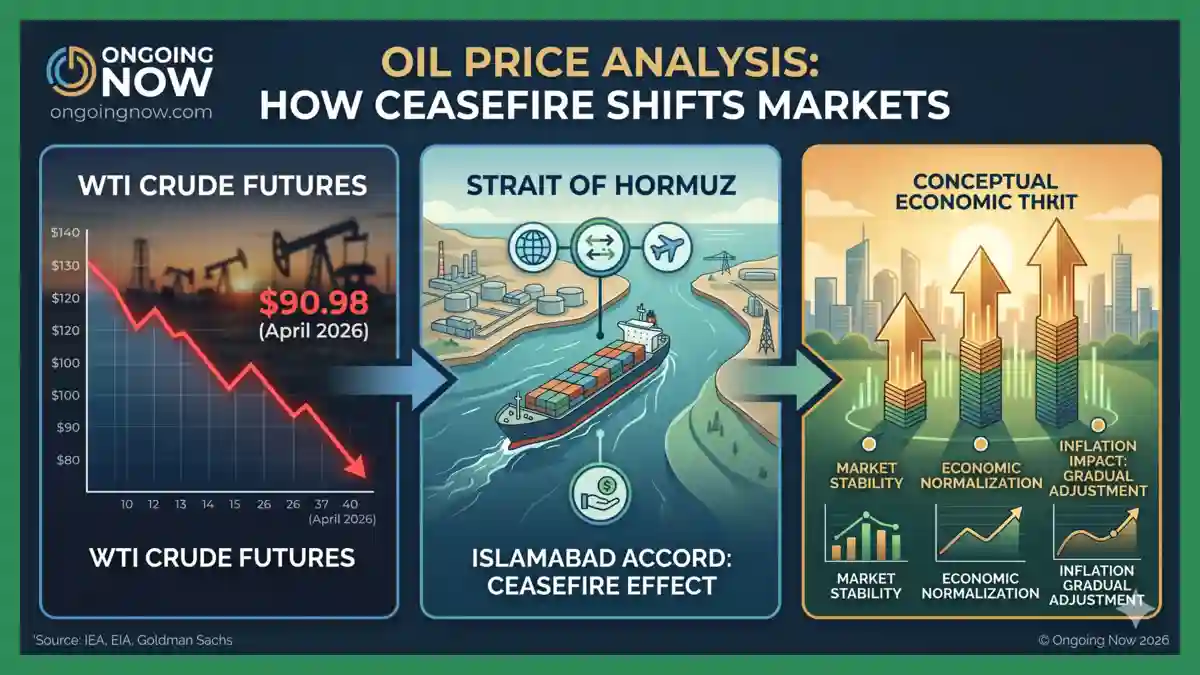
The current oil price environment is defined by a fragile balance between a historic supply-side shock and recent diplomatic progress aimed at reopening the Strait of Hormuz. Following a peak in March 2026 that saw Brent crude surge past $120 per barrel due to the “2026 Iran War,” markets have begun a period of cautious correction. The price analysis of West Texas Intermediate (WTI) and Brent now centers on the “Islamabad Accord,” a tentative ceasefire signed on April 6, 2026, which has introduced a two-way risk profile to the WTI crude futures forecast. While geopolitical premiums are receding, the impact of Hormuz on inflation persists as global supply chains and refined gasoline price structures face a lengthy normalization period.
Geopolitical Shifts Redefine the Oil Price Landscape
The April 2026 oil market is operating under the shadow of the largest supply disruption in history. According to the International Energy Agency (IEA), global oil supply plummeted by 10.1 million barrels per day (mb/d) in March as the Strait of Hormuz was effectively closed to transit. This disruption forced a radical shift in investment strategy after Iran deal discussions, as traders pivoted from pricing in a total blockade to evaluating the pace of a gradual maritime reopening.
Bank of America reported a 60% year-on-year surge in commodities trading revenue for Q1 2026, a direct result of the heightened commodity market volatility reports issued throughout the conflict. As of April 17, 2026, WTI futures have retreated from their $100 highs to hover near $90.98, while Brent crude trades at approximately $94.75. The market’s primary focus has shifted from immediate scarcity to the technical logistics of restoring 20% of the world’s seaborne crude and LNG exports.
Analysis: The Disconnect Between Futures and Physical Reality
Despite the cooling of futures prices, physical markets remain tight. IEA data indicates that while futures have dropped, spot crude benchmarks in the North Sea were recently trading at a $60 premium to pre-conflict levels. This “physical-futures disconnect” is driven by refiners scrambling for immediate replacement barrels while the financial markets price in the long-term impact of the April 6 ceasefire.
Goldman Sachs Oil Outlook: A Dual-Track Risk Profile
In its mid-April report, Goldman Sachs oil outlook analysts lowered their second-quarter 2026 forecasts for Brent and WTI to $90 and $87 per barrel, respectively. This adjustment reflects a reduction in the “geopolitical risk premium” following the two-week ceasefire agreement. However, the bank maintains that risks remain skewed to the upside if the diplomatic resolution proves temporary.
Market Snapshot: 2026 Oil Price Projections
| Quarter | Brent Forecast (USD/bbl) | WTI Forecast (USD/bbl) | Scenario Context |
| Q2 2026 | $90.00 | $87.00 | Post-ceasefire normalization |
| Q3 2026 | $82.00 | $77.00 | Gradual Hormuz reopening |
| Q4 2026 | $80.00 | $75.00 | Long-term stability target |
| Bull Case | $115.00 | $110.00 | Failed ceasefire / infrastructure damage |
Data Source: Goldman Sachs Global Investment Research, April 2026.
The bank noted that while global inventories are drawing down at a slower pace—roughly 2 million barrels per day (bpd) compared to 7 million bpd in early March—the recovery is uneven. “Reduced flows through Hormuz pose the biggest upside risk to Goldman’s price forecasts,” the report stated, noting that current flows through the strait are still only at 10% of pre-conflict volumes.
Impact of Hormuz on Inflation and Global Policy
The closure of the world’s most critical energy chokepoint has fundamentally altered the global inflation trajectory. The European Central Bank (ECB) recently postponed planned interest rate reductions, citing the energy-supply shock as a catalyst for a revised 2026 inflation forecast. In Asia, where countries like China, India, and Japan rely on the Strait for nearly 60% of their LNG imports, the impact of Hormuz on inflation has triggered aggressive government intervention to subsidize fuel costs.
The International Energy Agency characterized the situation as the “greatest global energy security challenge in history.” The disruption forced QatarEnergy to declare force majeure on all exports in March, a move that sent European gas prices (TTF) soaring before the April cooling. Although the Islamabad Accord provides a path forward, the delay in maritime insurance normalization continues to add “invisible costs” to every barrel of oil transported.
Evaluating Energy Sector Stocks to Buy in a Volatile Recovery
As the risk premium evaporates, the performance of energy sector stocks to buy has diverged from the broader market. During the height of the conflict, the MSCI World Energy index significantly outperformed global benchmarks. However, Trustnet analysis shows that since the March 27 suspension of strikes, energy has become the worst-performing global industry, as investors rotate back into “momentum stocks” and European equities.
Institutional investors are now looking for energy sector stocks to buy that offer resilience in a lower-price environment rather than those that benefited purely from the spike. Companies with significant non-Middle Eastern upstream assets—particularly in the U.S. Permian Basin and offshore Brazil—are being prioritized. The U.S. Energy Information Administration (EIA) notes that while Middle East production fell by 9.4 mb/d in March, non-OPEC+ supply, led by the U.S., is expected to be a primary driver of stability in late 2026.
By the Numbers: Global Supply and Demand (March/April 2026)
Total Supply Loss: 10.1 million barrels per day (March 2026).
Demand Contraction: 800,000 barrels per day (March); 2.3 million barrels per day (projected April).
Hormuz Flow: ~3.8 million barrels per day (April) vs. >20 million bpd (February).
U.S. SPR Release: 172 million barrels committed to offset supply gaps.
Shifting Investment Strategy After Iran Deal Developments
The transition to a post-conflict investment strategy after Iran deal frameworks requires a focus on structural changes in energy consumption. The EIA reported that global oil demand growth has been revised downward to 0.6 million bpd for 2026, half of the previous estimate, as “demand destruction” takes hold in high-cost environments.
“Markets are increasingly turning to EVs and fuel alternatives to navigate what could evolve into a prolonged upward trend in crude,” noted analysts at StoneX. This structural shift suggests that even if the oil price returns to pre-war levels, the competitive landscape for energy companies has permanently changed. Investors are increasingly weighing the “margin risks” of crude positions against the accelerating adoption of alternative energy sources in Asia and Europe.
What the Numbers Show: The Gasoline Price Trajectory
For consumers, the volatility in crude translates directly to the gasoline price at the pump. In Germany, petrol prices reached record highs in early March, prompting emergency tax relief measures. In the United States, the restart of Santa Ynez production and a massive Strategic Petroleum Reserve (SPR) draw have helped moderate the spike, but retail prices remain 15% higher than their January 2026 averages.
The EIA expects that even if traffic through the Strait of Hormuz returns to normal by late 2026, the “relatively long adjustment period” will keep energy prices elevated. The Brent average for 2027 is now forecasted at $76 per barrel, which is $23 higher than previous non-conflict projections. This “new normal” suggests that the inflationary tailwinds from the 2026 energy crisis will be felt long after the naval blockades are lifted.
Evidence-Based Business Insights: Navigating the Rebound
The current price analysis suggests a period of “bullish range-bound” activity. Technical resistance for WTI is established at the $105 mark, while firm support has formed at $75. A sustained break below $75 would require not just a ceasefire, but a full restoration of diplomatic ties and maritime security in the Persian Gulf.
“Resuming flows through the Strait of Hormuz remains the single most important variable in easing the pressure on energy supplies, prices, and the global economy.” — International Energy Agency (IEA), April 2026 Report.
“Given the reduction in the risk premium at the front of the curve, we nudge down our Q2 forecast… but risks remain skewed to the upside.” — Goldman Sachs Commodities Research.
For corporate strategy, the lesson of 2026 is the necessity of supply chain redundancy. Companies that relied on “just-in-time” energy procurement faced severe margin compression in Q1. The move toward “just-in-case” energy stockpiling and a diversified fuel mix is no longer a sustainability goal—it is a financial necessity.
Stay sharp with Ongoing Now!
Source and Data Limitations: This report is based on market data and regulatory filings as of April 17, 2026. Primary data sources include the International Energy Agency (IEA) Oil Market Report (April 14, 2026), the U.S. Energy Information Administration (EIA) Short-Term Energy Outlook (April 7, 2026), and Goldman Sachs Global Investment Research notes (April 15, 2026). Additional performance metrics were sourced from MSCI index reports and Bank of America’s Q1 2026 earnings disclosures. This analysis excludes speculative social media reports regarding unverified ceasefire violations and relies solely on confirmed diplomatic statements and satellite-verified maritime traffic data. Forecasts are subject to change based on the stability of the Islamabad Accord and the technical condition of Persian Gulf energy infrastructure.