US Ends Sanctions Waivers Amid Iran Oil Blockade
The United States Treasury Department has ended temporary waivers on Iranian and Russian oil as a naval blockade tightens pressure on Tehran.
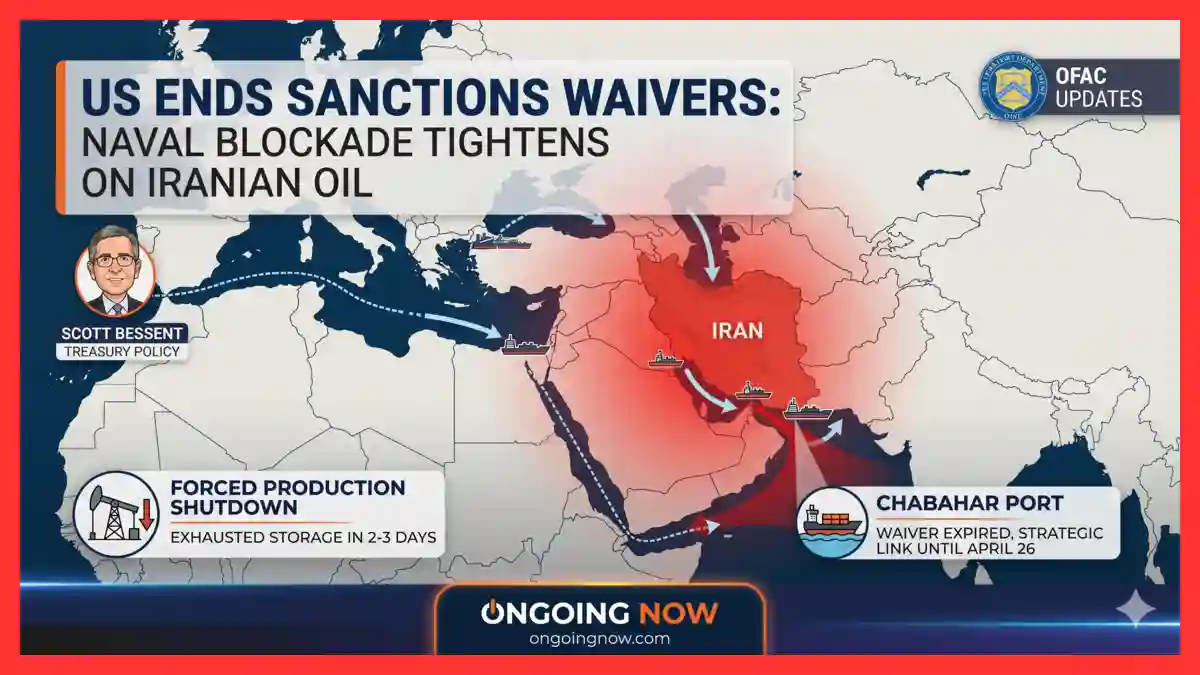
The United States has officially ceased the renewal of temporary sanctions waivers that previously allowed Iranian oil to reach global markets, marking a significant escalation in Washington’s “Economic Fury” campaign. Scott Bessent Treasury policy now centers on a full-scale Middle East naval blockade intended to halt all maritime energy exports from the Islamic Republic. This shift follows the collapse of diplomatic negotiations in Islamabad and has led to an immediate energy market reaction, with Brent crude climbing above $100 per barrel.
Tightening the Global Energy Net
The Treasury Department OFAC updates issued on April 25, 2026, confirmed that no further exemptions would be granted for petroleum products currently at sea. During a high-profile Scott Bessent interview with the Associated Press, the Treasury Secretary stated that the administration has no intention of extending a one-off exemption for Iranian oil. This policy effectively strands Iranian crude already loaded onto tankers, as the U.S. Navy continues to enforce a Middle East naval blockade.
According to Secretary Bessent, the primary objective is to target the “revenue lifelines” of the Iranian government. The Treasury has identified Kharg Island—the facility responsible for 90% of Iran’s oil exports—as the focal point of the current economic pressure. Officials indicate that with exports frozen, storage capacity on the island will be exhausted within days, necessitating a domestic production halt.
Projected Iran Production Shutdown
The cessation of maritime trade is expected to trigger a forced Iran production shutdown in the immediate future. Secretary Bessent warned that shuttering these wells could result in long-term technical damage to Iran’s energy infrastructure.
| Metric | Current Status (April 2026) |
| Brent Crude Price | > $100 per barrel |
| Kharg Island Export Volume | Restricted (estimated 90% capacity) |
| Blockade Implementation | Active (since April 13, 2026) |
| Daily Iranian Trade Loss | Estimated $455 million |
| Sanctions Waiver Status | Expired (April 25, 2026) |
Note: Data reflects verified reports from the U.S. Treasury and regional economic analysts; metrics are subject to rapid change.
Regional Impacts: The Chabahar Port Waiver Expiration
A critical component of this policy shift is the Chabahar Port waiver expiration scheduled for April 26, 2026. India had previously secured a conditional waiver for its operations at the Shahid Beheshti Terminal to maintain trade routes to Afghanistan and Central Asia. However, the broader US Iran military tension has complicated the renewal of such carve-outs.
The Ministry of External Affairs in New Delhi has been in active engagement with U.S. authorities to manage the wind-down of these operations. While the port serves as a strategic link for the International North-South Transport Corridor (INSTC), the U.S. Treasury has signaled that even high-priority strategic projects must now comply with the “Maximum Pressure” framework.
Analysis: The “Economic Fury” Strategy
The current Iran sanction enforcement represents a departure from previous calibrated measures. By combining a naval blockade with the refusal to renew maritime waivers, the U.S. is attempting to achieve a total cessation of Iranian oil revenue. This strategy, termed “Economic Fury,” seeks to systematically degrade Tehran’s ability to move or repatriate funds.
“We have the blockade, and there’s no oil coming out. And we think in the next two, three days, they’re going to have to start shuttering production, which will be very bad for their wells.”
— Scott Bessent, U.S. Treasury Secretary
Geopolitical analysts suggest that the U.S. calculates the Iranian economy will buckle under the combined pressure of internal protests and the complete loss of daily oil revenue before global energy markets suffer a catastrophic supply shock.
Global Oil Supply Disruption Concerns
The energy market reaction has been swift, as traders weigh the impact of a total global oil supply disruption. Although the U.S. previously allowed some Iranian tankers to transit the Strait of Hormuz to stabilize prices, the new directive removes this safety valve.
Institutional responses from the EU and major Asian importers indicate rising concern over price stability. The European Union is reportedly losing an estimated €500 million per day due to the combination of high energy costs and the shipping shock in the Persian Gulf. Russia has also reportedly declined requests from Iran to supply substitute polymers, citing its own sharp rise in domestic prices.
Human and Community Impact
The economic confrontation has had a direct effect on the Iranian population, who face a deepening currency crisis and shortages of consumer goods. Reports from domestic news outlets like Asr Iran indicate that the lack of access to raw materials has crippled the local petrochemical industry, which may take up to two years to restore.
Internal Displacement: Millions have been displaced across the region due to the conflict preceding the ceasefire.
Medical and Basic Goods: While humanitarian channels technically remain open, the freeze of over $344 million in cryptocurrency wallets and other financial networks has slowed the import of essential items.
Infrastructure Damage: Sustained military strikes on petrochemical hubs have left the country short of basic plastics and industrial polymers.
The Broader Geopolitical Context
The current US Iran military tension follows a 40-day combat period that began in February 2026. While a fragile ceasefire took effect on April 8, the transition from kinetic warfare to total economic blockade suggests that the confrontation has entered a new phase.
The U.S. Treasury’s Office of Foreign Assets Control (OFAC) continues to monitor “shadow fleets” and covert finance networks. Secretary Bessent has warned that any vessel or person facilitating Iranian trade—including through digital asset wallets—risks immediate exposure to U.S. sanctions. This posture aims to ensure that no “backdoor” trade with secondary partners like China can offset the primary losses from the naval blockade.
Measured Outcomes and Implications
The primary outcome of the Scott Bessent Treasury policy is the isolation of Iran from the international financial system. By targeting both physical exports and digital assets, the U.S. seeks to force a change in Tehran’s regional posture.
Monetary Isolation: The freezing of $344 million in cryptocurrency linked to Iranian networks has limited the regime’s ability to bypass traditional banking.
Market Realignment: Countries like Azerbaijan are being approached as alternative suppliers, though their capacity remains insufficient to replace the Iranian shortfall.
Diplomatic Stalemate: The failure of the Islamabad talks has left little room for immediate de-escalation, as both sides appear to be testing the other’s economic and political endurance.
As the storage capacity at Kharg Island reaches its limit, the world watches to see if the forced production shutdown will lead to a renewed diplomatic opening or a further escalation in the Strait of Hormuz.
Stay sharp with Ongoing Now!
Source and Data Limitations: This report is based on verified news dispatches from the Associated Press, Al Arabiya, and the Jerusalem Post as of April 26, 2026. Economic metrics, including Brent crude prices and daily trade loss estimates, are derived from Iranian International analysts and Treasury Department briefings. Some data regarding the internal state of Iranian oil wells remains speculative due to limited on-the-ground access in sanctioned zones. Information regarding the Chabahar Port waiver is based on official statements from the Indian Ministry of External Affairs. All quotes are attributed to named officials or verified publications to ensure editorial integrity and avoid speculation.