Inside Office of the Pardon Attorney Guidelines and the Constitutional Rules Governing Clemency
Explaining the Department of Justice clemency review standards, sentence commutation rules, and Article II presidential authority
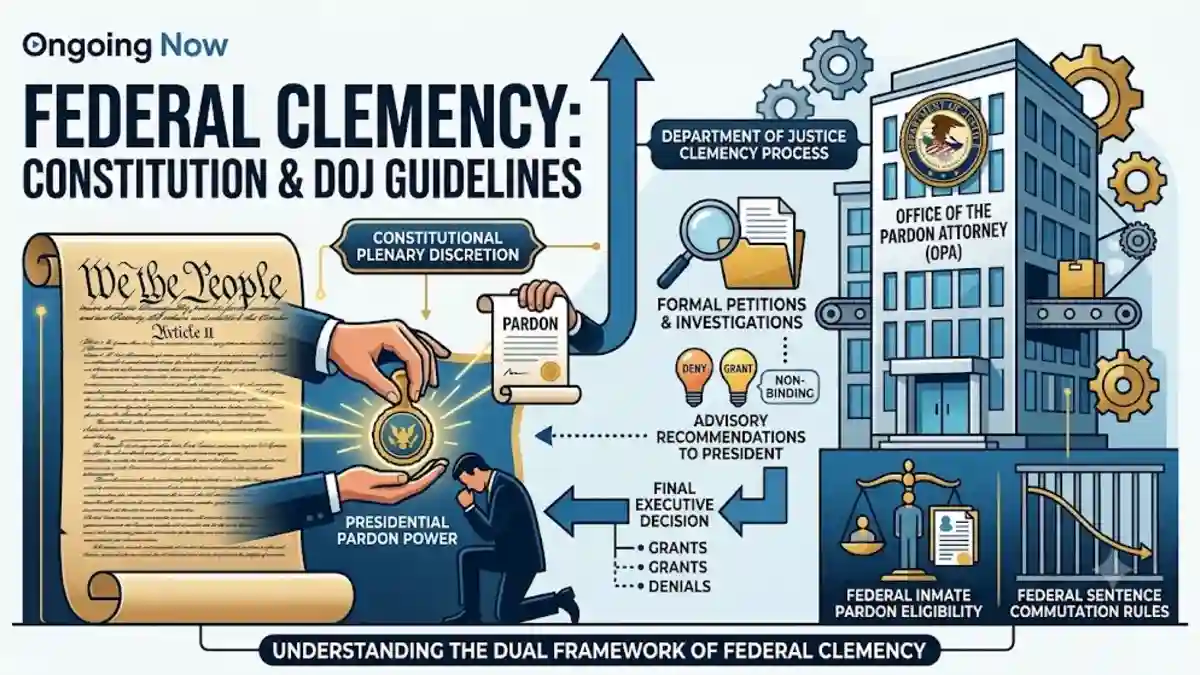
Executive clemency represents one of the most comprehensive single powers granted to the President of the United States under Article II of the Constitution. Administrations process requests for relief through the Office of the Pardon Attorney guidelines, which set formal rules for evaluating federal sentence commutation rules, pardon eligibility, and post-conviction relief. Understanding how the Justice Department clemency process evaluates petitions requires examining both constitutional boundaries and administrative procedures.
While the constitutional grant gives the president broad discretionary authority, federal agency procedures structure how thousands of applications are reviewed annually. The Department of Justice (DOJ) maintains a specialized administrative infrastructure under Title 28 of the Code of Federal Regulations (28 C.F.R. §§ 0.35, 0.36, and 1.1–1.11) to manage petitions. These administrative channels establish uniform criteria for federal inmate pardon eligibility, sentence commutation evaluations, and post-sentence pardons.
The interaction between executive clemency power limitations and presidential discretion remains a central aspect of federal constitutional law. Although presidents retain plenary power to act outside standard Department of Justice advisory recommendations, official regulations maintain the baseline standard for applicant processing, criminal record reviews, and federal law enforcement consultations.
Executive Clemency Framework: Constitutional vs. Administrative

  [ U.S. CONSTITUTION: Article II, Section 2, Clause 1 ]
                     │
         ┌───────────┴───────────┐
         ▼                       ▼
  [ Plenary Discretion ]  [ Jurisdictional Limits ]
  • Full Pardon           • Federal Offenses Only
  • Sentence Commutation  • Excludes State Crimes
  • Remission of Fines    • Excludes Impeachment
         │                       │
         └───────────┬───────────┘
                     ▼
  [ DOJ OFFICE OF THE PARDON ATTORNEY ]
  • 28 C.F.R. Administrative Rules
  • Background Investigations & FBI Reviews
  • Non-Binding Advisory Recommendations to President
The Constitutional Architecture of Presidential Clemency Authority
The constitutional foundation for executive clemency originates in Article II, Section 2, Clause 1 of the U.S. Constitution. This provision grants the president power to issue reprieves and pardons for offenses against the United States, except in cases of impeachment. Supreme Court precedent has consistently affirmed that this grant represents a broad presidential discretion that operates independently of congressional or judicial oversight.
Historical context reveals that the Framers modeled the presidential pardon power history after the English monarchical prerogative of mercy, intending it as a tool to promote public welfare, address judicial severity, and restore domestic stability. In early landmark rulings, such as Ex parte Garland (1866) and United States v. Klein (1871), the Supreme Court confirmed that executive clemency releases an individual from the punishment and legal disabilities attached to a federal offense.
However, jurisdictional limits on presidential power remain absolute under Article II. Presidential clemency applies exclusively to federal criminal offenses and federal courts, having no application to state criminal convictions or local ordinances. State-level pardons remain within the sole authority of state governors or state clemency boards. Additionally, clemency addresses criminal liability but does not extinguish civil liability, private lawsuits, or administrative regulatory actions resulting from the underlying conduct.
Navigating the Office of the Pardon Attorney Guidelines
The formal administrative pathway for seeking federal clemency is managed by the Office of the Pardon Attorney, a career senior executive component operating under the general oversight of the Deputy Attorney General. Under standard Office of the Pardon Attorney guidelines, the office processes two primary categories of relief: full pardons and sentence commutations.
  [ Step 1: Petition Submission ]
  Applicant files formal petition under 28 C.F.R. rules with Office of the Pardon Attorney.
                 │
                 ▼
  [ Step 2: Investigation & Review ]
  DOJ conducts background check, FBI record review, and consults U.S. Attorney's Office.
                 │
                 ▼
  [ Step 3: Advisory Recommendation ]
  Pardon Attorney submits non-binding advisory recommendation to Deputy Attorney General.
                 │
                 ▼
  [ Step 4: Executive Decision ]
  President reviews DOJ recommendation and makes final determination (Grant, Deny, or Hold).
A full pardon is typically requested after an individual has completed their term of incarceration and supervision. Under DOJ administrative guidelines, applicants generally must wait a minimum of five years after release from custody or completion of probation before applying. This waiting period is designed to demonstrate character post-conviction, community integration, and sustained rehabilitation.
Commutation of sentence, by contrast, targets individuals currently serving an active federal prison sentence. Commutations reduce sentence length or financial penalties but do not restore full civil rights or eliminate the underlying criminal conviction.
| Clemency Mechanism | Timing Requirement | Operational Impact | Primary Eligibility Criteria |
| Full Pardon | Minimum 5 years post-release | Forgives offense, restores civil rights (voting, gun ownership) | Conduct post-release, community service, clean record |
| Sentence Commutation | Active serving federal sentence | Reduces prison term or court-ordered financial fines | Excessive sentence length, sentence disparity, rehabilitation |
| Remission of Fine | Active financial obligation | Waives unpaid court fines or restitution balances | Demonstrated financial hardship, inability to pay |
| Reprieve | Active sentence/execution | Temporarily postpones execution of sentence | Ongoing legal review, humanitarian considerations |
Federal Inmate Pardon Eligibility and Sentence Commutation Rules
To evaluate federal inmate pardon eligibility, the Office of the Pardon Attorney applies specific criteria outlined in the U.S. Attorneys’ Manual and federal administrative rules. The review process considers several key factors when assessing petitions from currently incarcerated individuals or post-sentence applicants:
Disparity in Sentencing Guidelines: Changes in federal statutory sentencing schemes or mandatory minimum laws that create significant disparities between past and present sentences for identical conduct.
Institutional Conduct: Clear record of compliance with Federal Bureau of Prisons rules, participation in vocational programs, and educational achievement during incarceration.
Severity and Nature of Offense: Evaluation of whether the conviction involved violence, national security implications, or organized criminal leadership.
Rehabilitation and Public Safety: Evidence of personal accountability, absence of recent disciplinary infractions, and viable post-release reentry plans.
Key Factors Evaluated in DOJ Clemency Reviews

• Nature & Severity of Federal Offense
• Post-Conviction Conduct & BOP Disciplinary Record
• Length of Time Served vs. Current Statutory Guidelines
• Prosecutor & Sentencing Judge Recommendations
• Reentry & Community Support Infrastructure
During the administrative review, the Pardon Attorney solicits recommendations from the U.S. Attorney’s Office that prosecuted the case, the trial judge who imposed the sentence, and relevant investigative agencies like the FBI or DEA. These consultations assist in building a comprehensive record before an advisory recommendation is forwarded to the White House.
Executive Powers, Advisory Limits, and Policy Realities
While the Department of Justice provides structured administrative reviews, the president holds constitutional authority to grant clemency independently of DOJ recommendations. The Department’s advisory function serves as an administrative filter rather than a constitutional constraint.
Presidents throughout modern history have utilized both standard DOJ channels and direct executive action. For example, during the Obama administration, the Department of Justice launched the Clemency Initiative in 2014, establishing explicit criteria targeting non-violent, low-level drug offenders who had served at least ten years of long sentences. That structured initiative led to over 1,700 commutations.
In contrast, other executive administrations have frequently exercised presidential clemency power outside DOJ channels, relying on direct petitions, public appeals, or White House reviews. Because the pardon power is plenary under Article II, courts have routinely affirmed that presidential grants of clemency remain valid regardless of whether they pass through the formal Justice Department federal pardon list review channels.
Comparative Administrative Approaches to Executive Clemency

   [ DOJ Bureaucratic Pipeline ]             [ Direct Executive Action ]
   • 5-Year Post-Release Rule                 • Immediate Presidential Review
   • FBI Background Investigation             • Custom Executive Criteria
   • U.S. Attorney Consultation               • Direct Clemency Warrants
   • Formally Docketed at DOJ                 • Bypasses DOJ Clearance
Human and Societal Impacts of Clemency Reform
The administration of executive clemency directly impacts families, communities, and the broader federal justice system. For individuals who have completed federal sentences, receiving a pardon removes collateral consequences, such as restrictions on employment, professional licensing, voting rights, and housing access.
For currently incarcerated federal inmates, sentence commutations offer a structured legal mechanism to address historical sentencing disparities, such as those established during the drug enforcement legislative expansions of the late 20th century. Criminal justice advocacy groups, bar associations, and policy researchers emphasize that clear, predictable clemency guidelines provide stability within the federal prison system by encouraging positive inmate conduct and program participation.
At the same time, victims’ advocacy groups and legal scholars highlight the importance of balancing mercy with accountability. Maintaining transparent review standards through the Office of the Pardon Attorney helps ensure that victims are notified, public safety is prioritized, and the integrity of judicial sentences is respected.
Stay sharp with Ongoing Now!
—
Source and Data Limitations: This analysis relies on official statutory records, historical clemency data, and administrative guidelines published by the U.S. Department of Justice Office of the Pardon Attorney (28 C.F.R. §§ 0.35, 0.36, 1.1–1.11), relevant decisions of the Supreme Court of the United States (including Ex parte Garland and United States v. Klein), and Article II of the U.S. Constitution up to May 2026. Unverified political commentary, pending legislative proposals without statutory enactment, and individual speculative clemency petitions have been excluded to maintain factual accuracy.