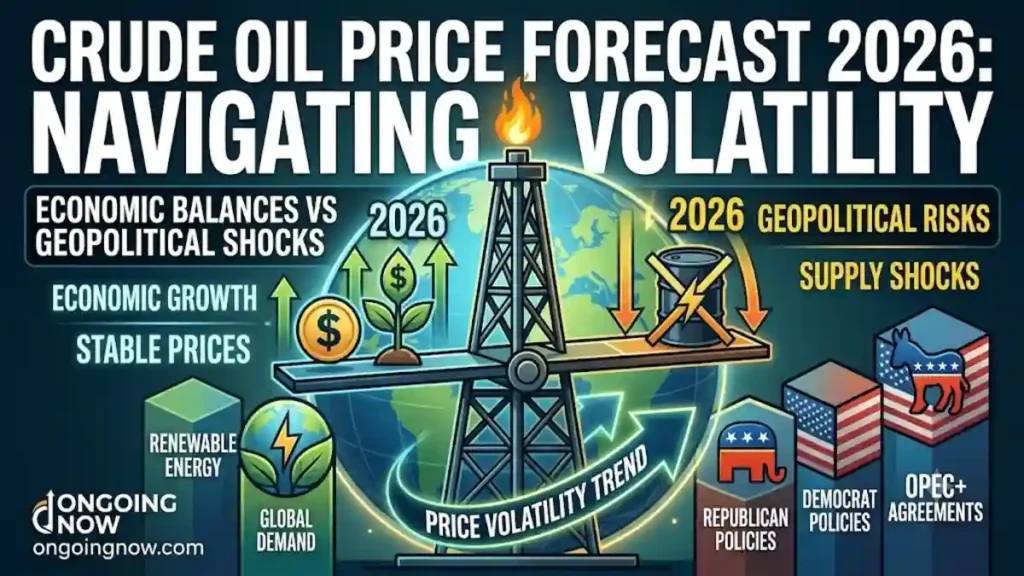
Brent Crude Market Reacts to Middle East Supply Risk
Brent crude benchmarks surged and stabilized near $108 per barrel following a significant escalation in Middle Eastern geopolitical tensions and disruptions to maritime logistics

Global oil market volatility intensified in early March 2026 as Brent crude benchmarks reacted to a rapid series of supply-chain disruptions in the Persian Gulf. Following a period of relative stability, prices surged toward a $120 intraday peak before moderating as international energy agencies weighed the potential for strategic reserve releases. The Iran Israel war oil impact has moved from a theoretical risk to a primary driver of physical market tightness, with the effective closure of the Strait of Hormuz halting nearly 20 million barrels of daily crude transit. While the oil price $100 breakout was initially viewed as a temporary spike, the Middle East supply disruption has forced a reassessment of the crude oil price forecast for the remainder of 2026, as oil trading desks manage the highest levels of uncertainty since 2020. This developing energy crisis now tests the resilience of global inventories and the strategic response of the International Energy Agency (IEA).
Market Performance and the Shift in Brent Crude
The international benchmark for oil has undergone a fundamental repricing in the first week of March 2026. On Monday, March 9, Brent crude was trading at approximately $108.00 per barrel, representing a nearly 17% increase from the previous week’s close. This followed a volatile Sunday session where prices briefly touched $119.50, the sharpest single-day rise in six years.
The sudden elevation in global oil market volatility is directly linked to reports of damage to Iranian oil infrastructure and the subsequent standstill of maritime traffic in the Strait of Hormuz. Financial institutions, including Morgan Stanley and Goldman Sachs, have noted that while underlying fundamentals for 2026 initially pointed toward a surplus, the current “geopolitical premium” has completely detached prices from pre-conflict models.
Market Snapshot: Energy Benchmarks (March 9, 2026)
| Benchmark | Current Price (USD) | 24h Change | Weekly Change |
| Brent Crude | $108.00 | +1.2% | +17.2% |
| WTI Crude | $104.50 | +1.5% | +16.8% |
| Natural Gas (EU) | €42.50/MWh | +30.0% | +45.0% |
| Gold | $5,127/oz | +0.05% | +1.1% |
Data Note: Prices reflect morning trade on March 9, 2026. Volatility remains high.
Direct Impact of Middle East Supply Disruption
The primary catalyst for the current energy crisis is the physical restriction of crude flows. The Strait of Hormuz, which handles approximately 20% of the world’s total petroleum consumption, is currently categorized as “non-navigable” by several major shipping insurers. This has led to an immediate halt in exports from Iraq, Kuwait, and the United Arab Emirates.
On March 6, 2026, Brent oil prices surpassed $92 per barrel, but the weekend escalation pushed the market through the oil price $100 breakout threshold. “This isn’t your grandfather’s oil market,” noted Kevin Book, Senior Adviser at CSIS. He highlighted that the “sudden eruption of war in the Mideast Gulf has created dramatic new risks for global energy security,” with attacks damaging critical infrastructure.
Production Outages and Regional Response
Iraq: Officials from the world’s second-largest OPEC producer stated that production may be cut by over 3 million barrels per day if tanker access remains blocked.
Iran: Reports of damage to 30 fuel storage facilities have curtailed domestic refining and export capabilities.
Saudi Arabia: Satellite imagery from March 2, 2026, confirmed damage at the Ras Tanura refinery, further tightening the availability of refined products like diesel.
Refined Crude Oil Price Forecast and Economic Outlook
Before the recent escalation, the crude oil price forecast for 2026 was largely bearish. In February, the U.S. Energy Information Administration (EIA) predicted Brent would average $58 per barrel for the year, citing strong production growth in the Americas. However, the Iran Israel war oil impact has rendered these baseline projections obsolete in the short term.
Analysts at J.P. Morgan Global Research previously noted that regime changes or major conflicts in large-scale oil-producing nations typically lead to an average price increase of 76% from onset to peak. While they initially projected a surplus-driven average of $60/bbl, Natasha Kaneva, head of Global Commodities Strategy, acknowledged that further destabilization could lead to “significantly higher oil prices sustained over extended periods.”
“The bigger issue is physical reality: roughly one-fifth of global oil supply passes through the Strait of Hormuz… markets are more concerned with whether barrels can move than with spare capacity on paper.”
— Jorge Leon, Senior Vice President, Rystad Energy
Global Oil Market Volatility and the Strategic Reserve Response
In response to the oil price $100 breakout, G7 nations and the IEA are currently discussing a coordinated release of strategic petroleum reserves (SPR). Preliminary reports suggest an intervention of 300 to 400 million barrels, a volume significantly larger than the 2022 releases following the invasion of Ukraine.
While such a move could theoretically reduce prices by $10 to $20 per barrel, analysts warn the relief might be temporary. Oil trading remains focused on the “crude-to-product” gap; even if crude supply is bolstered by reserves, the damage to Middle Eastern refining hubs means fuel prices for consumers—particularly diesel and gasoline—may remain elevated.
By the Numbers: Global Inventories
U.S. Commercial Stockpiles: 439.3 million barrels (3% below the five-year average).
Chinese Strategic Reserves: Building at a rate of 1.0 million barrels per day.
Proposed IEA Release: 300–400 million barrels (Under Discussion).
Corporate and Industrial Consequences
The Middle East supply disruption is creating a ripple effect across the global supply chain. Refiners in India, South Korea, and the United States, which rely heavily on Iraqi Basrah oil, are now scrambling to secure heavier grades from Canada, Venezuela, and the U.S. Gulf Coast.
Sector Impacts
Aviation and Logistics: Jet fuel and diesel prices have touched multi-year highs. The “Heavy Louisiana Sweet” crude grade closed at its highest premium since 2020 on March 3, 2026.
Manufacturing: European gas prices jumped 30% on March 9, increasing the cost of energy-intensive production.
Global Trade: Shipping reroutes away from the Red Sea and the Persian Gulf are adding 10–14 days to transit times, inflating freight costs.
Human and Societal Impact of the Energy Crisis
The real-world effects of the global oil market volatility are most visible at the consumer level. Diesel prices closed at $3.19 a gallon on March 3 and surged toward $3.45 during subsequent sessions. Because diesel is the primary fuel for global shipping and trucking, these costs are expected to translate into higher prices for food and consumer goods within weeks.
In the United States, the administration has expressed concerns that attacks on fuel storage facilities would “deepen global oil shortages and further increase fuel prices.” For import-dependent nations like Japan, the crisis is even more acute; the country may be forced to spend up to 70% more in dollar terms to secure the same volume of energy imports.
Analysis: Why the $100 Breakout Matters
The oil price $100 breakout is more than a psychological milestone; it represents a fundamental shift in the 2026 economic narrative. Earlier this year, the World Bank projected that commodity prices would fall to a six-year low due to a growing oil surplus. The Iran Israel war oil impact has effectively deleted that surplus from the immediate market.
What the Numbers Show:
The current tightness is not just a result of the war but a collision of events. While oil trading activity spiked due to the conflict, it met a market where U.S. gasoline inventories were already drawing down by 1.7 million barrels per week. This lack of a “buffer” has amplified the price response to every headline.
For the crude oil price forecast to return to previous levels, two things must happen: a verifiable de-escalation that reopens the Strait of Hormuz and a sustained increase in non-OPEC production. Until then, the energy crisis remains the dominant factor for global inflation and corporate earnings.
Stay sharp with Ongoing Now!
Source and Data Limitations: This report is based on market data and official statements available as of March 9, 2026. Primary sources include the U.S. Energy Information Administration (EIA) Short-Term Energy Outlook (February/March 2026), International Energy Agency (IEA) Oil Market Reports, and official communications from the European Commission’s Oil Coordination Group. Price data for Brent and WTI crude reflects ICE and NYMEX morning trade on March 9, 2026. Analyst commentary is attributed to named experts from Rystad Energy, J.P. Morgan Global Research, and CSIS. While every effort has been made to verify data, the fluid nature of the conflict in the Middle East means that infrastructure damage reports and shipping status are subject to rapid change. Speculative forecasts regarding the duration of the conflict or the specific timing of a “market crash” have been excluded in favor of verified physical supply data.