How the Supreme Court’s New Redistricting Map Decisions Fallout Redefines Southern Representation
The Court’s decision in Louisiana v. Callais alters Section 2 legal standards, raising evidentiary thresholds for racial gerrymandering claims and impacting pending state maps.
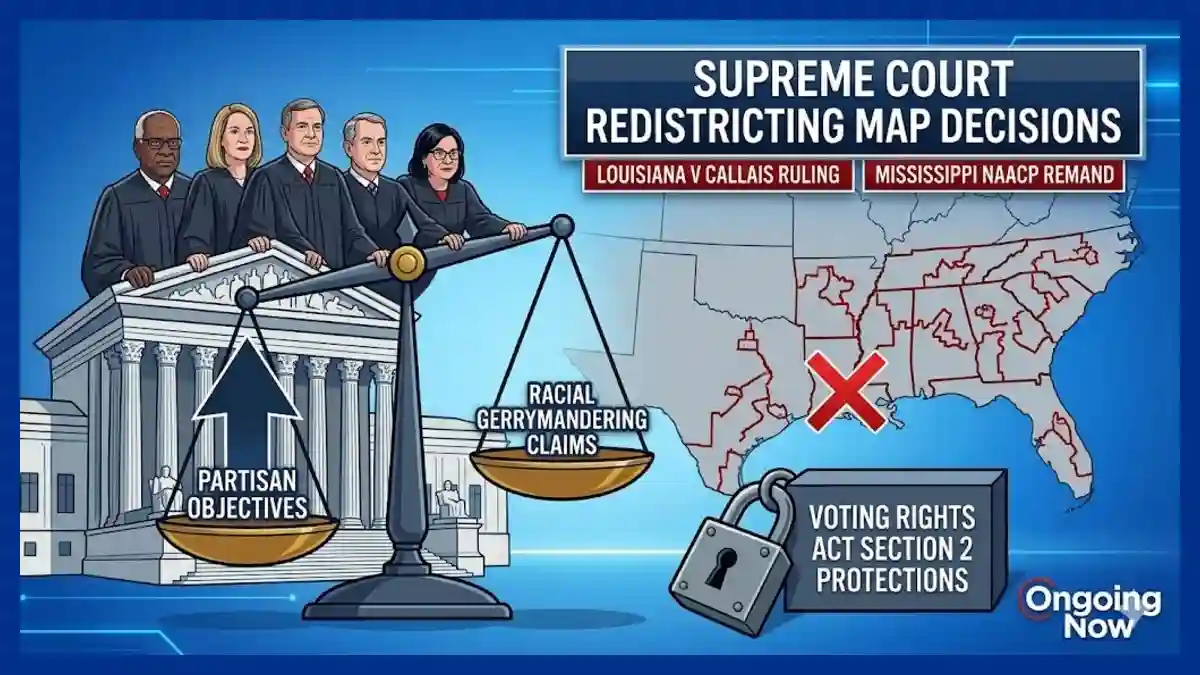
The Supreme Court of the United States has fundamentally altered the enforcement mechanisms of the landmark Voting Rights Act of 1965 (VRA), altering how state legislative and congressional maps are drawn and defended. In its highly anticipated April 29, 2026, decision in Louisiana v. Callais, a 6–3 majority ruled that Louisiana’s redrawn congressional map, which featured a second majority-Black district, constituted an unconstitutional racial gerrymander under the Fourteenth Amendment’s Equal Protection Clause. By tightening the evidentiary framework established 40 years ago in Thornburg v. Gingles, the high court’s ruling significantly raises the bar for civil rights plaintiffs seeking to prove racial vote dilution under Section 2 of the VRA.
The immediate fallout extends far beyond Louisiana, prompting a federal appeals court to vacate and remand the Mississippi NAACP court case remand for reconsideration under this more restrictive standard. Concurrently, the decision recontextualizes ongoing legal battles regarding whether a section 2 private right of action exists for individual citizens, while direct impacts ripple through a series of supreme court redistricting map decisions shaping the 2026 midterm elections. In a vigorous justice jackson voting rights dissent, joined by Justices Elena Kagan and Sonia Sotomayor, the minority warned that the majority’s insistence on disentangling race from partisan affiliation effectively neutralizes core statutory protections against racial gerrymandering supreme court precedents. This article examines the mechanical shifts in voting rights litigation, the institutional responses across Southern states, and the long-term systemic impact on native american voting rights law and minority representation nationwide.
The Mechanical Shift: How Louisiana v. Callais Alters the Gingles Framework
The supreme court voting rights act 2026 jurisprudential pivot centers on a substantial revision of the three-pronged Gingles test, which has governed Section 2 enforcement since 1986. Writing for the majority, Justice Samuel Alito asserted that the intentional creation of majority-minority districts must withstand strict scrutiny, requiring states to prove a compelling governmental interest that is narrowly tailored. While the majority acknowledged that compliance with Section 2 can theoretically constitute a compelling interest, it added severe evidentiary burdens that plaintiffs must satisfy to establish that a violation occurred in the first place.
Under the updated Gingles framework, plaintiffs can no longer satisfy the first precondition simply by presenting illustrative alternative maps that establish the mathematical possibility of an additional majority-minority district. Instead, the Court now requires that any alternative map submitted by plaintiffs fully account for and achieve all of a jurisdiction’s legitimate, non-racial political objectives, including the protection of political incumbents.
Furthermore, the majority altered the second and third Gingles preconditions, which assess the presence of racially polarized voting. Plaintiffs must now statistically isolate racial voting patterns from partisan affiliation, demonstrating that cohesive voting blocs are driven by race rather than shared political party preferences. Finally, during the “totality of circumstances” phase, the Callais ruling demands direct evidence of present-day, intentional racial discrimination, explicitly noting that historical disparities or past discriminatory practices are insufficient to justify race-predominant remedies today.
| Gingles Precondition Element | Pre-2026 Standard | Post-Louisiana v. Callais Standard (2026) |
| 1. Illustrative Map Sufficiency | Map must show a minority group is sufficiently large and geographically compact to form a majority. | Map must satisfy the compactness threshold and achieve all of the state’s legitimate political goals, including incumbent protection. |
| 2 & 3. Racially Polarized Voting | Focuses on whether the minority group votes cohesively and the majority votes as a bloc to defeat preferred candidates. | Plaintiffs must statistically isolate race from party, proving polarized voting cannot be explained by partisan affiliation. |
| Totality of Circumstances Phase | Heavy reliance on historical, socio-economic, and political disparities within the jurisdiction. | Requires explicit, strong evidence of present-day, intentional racial discrimination regarding voting access or map drawing. |
Caveat: The application of these new evidentiary metrics remains subject to interpretation by federal district courts as they evaluate existing trial records and newly introduced expert witness testimony.
From Capitol Hill to State Capitals: The Immediate Regional Effects
The structural revisions mandated by Louisiana v. Callais triggered immediate procedural disruptions across several state jurisdictions, altering active maps ahead of the 2026 midterm elections. In Mississippi, the U.S. Court of Appeals for the Fifth Circuit acted swiftly upon the joint motion of the state and civil rights plaintiffs, wiping away a prior district court ruling that had struck down Mississippi’s state Supreme Court districts. The mississippi naacp court case remand sends the litigation back to U.S. District Judge Sharion Aycock to evaluate whether the existing record can withstand the heightened Callais thresholds.
Mississippi’s state Supreme Court boundaries have remained un-redrawn since 1987. Black residents and civil rights organizations argue that the three sprawling multi-member districts dilute minority voting power, preventing Black voters from electing a candidate of their choice to the nine-member high court. Following the remand, a planned special legislative session called by Republican Governor Tate Reeves was averted, leaving the contested 1987 boundaries in place for the upcoming election cycles while Judge Aycock determines if supplementary evidence is required to prove modern intentional discrimination.
In Louisiana, the ruling invalidates the SB8 congressional map that featured a newly configured, non-contiguous Second District running from Shreveport to Baton Rouge. Because primary deadlines and filing dates for the 2026 cycle are active, state officials face severe logistical hurdles in drafting replacement lines, introducing a direct conflict with the Purcell doctrine, which traditionally bars federal courts from altering electoral mechanisms close to an election.
The Legal and Democratic Debate: Institutional Perspectives
The institutional divide within the Supreme Court reflects deep-seated disagreements over the statutory intent of Congress when it amended the Voting Rights Act in 1982. The 1982 amendments explicitly established a “results-based” test under Section 2, designed to capture laws that have a discriminatory effect regardless of whether plaintiffs can prove an underlying discriminatory intent by lawmakers.
The Majority Opinion: Guarding Against Judicial Overreach
Justice Alito’s majority opinion anchored its reasoning in the principle that the U.S. Constitution permits race-based government action only under the most exceptional and narrowly tailored circumstances. The majority maintained that Section 2 was never intended to mandate proportional representation or to subvert traditional, race-neutral districting goals such as maintaining political continuity or pursuing partisan advantage.
“The Constitution almost never permits the government to use race as a factor in decision-making, especially in drawing legislative districts, unless doing so is needed to remedy specific, identified past discrimination,” wrote Justice Alito. “Section 2, properly construed, does not intrude on States’ prerogative to draw districts based on nonracial factors, including to achieve partisan advantage.”
The Dissenting Opinion: Warning of Constitutional Erosion
In a sharply formulated justice jackson voting rights dissent, the minority argued that the court’s conservative majority has effectively rewritten the text of the VRA, overriding clear congressional mandates. Justice Jackson asserted that forcing plaintiffs to perfectly disentangle race from political party in the American South—where racial identity and partisan alignment are deeply intertwined—creates an impossible standard of proof that shields structural discrimination under the guise of partisan strategy.
Justice Jackson noted that by requiring alternative maps to match the state’s exact political objectives, the Court has insulated incumbent lawmakers from legitimate challenges, effectively converting partisan self-preservation into a constitutional defense against civil rights claims.
Wider Analytical Implications: The Fragmented National Map
The legal shift occurs amidst a broader series of supreme court redistricting map decisions that underscore a highly polarized national redistricting landscape. In late May 2026, the Supreme Court issued a brief, unsigned order denying an emergency appeal by Virginia Democrats who sought to revive a proposed congressional redistricting referendum, cementing the state’s 2021 map for the upcoming midterms. This followed an earlier December 2025 order in Abbott v. League of United Latin American Citizens, which permitted Texas to conduct its elections under a newly altered, heavily pro-Republican map despite a lower three-judge court finding that lawmakers had divided citizens predominantly along racial lines.
These combined rulings demonstrate a clear trend: the current high court majority exhibits a high degree of deference to state legislatures when they assert that political partisanship, rather than racial animus, drove their line-drawing decisions.
Impact on the Section 2 Private Right of Action
The Callais decision also casts a long shadow over a parallel legal dispute regarding who has the right to file federal lawsuits under the VRA. For nearly six decades, individual voters and civil rights organizations have operated under an implied section 2 private right of action, initiating the vast majority of historical voting rights enforcement actions.
However, conservative legal challenges have increasingly sought to limit this right, arguing that only the U.S. Attorney General possesses explicit statutory authority to enforce Section 2. While Callais focused primarily on the evidentiary standard rather than standing, the tightening of Gingles metrics reduces the institutional capacity of private civil rights groups to sustain long, multi-million-dollar redistricting trials, shifting the enforcement burden significantly back onto the federal government.
Societal and Community Impacts: Representation and Policy Echoes
The long-term consequences of the Callais precedent will be felt directly within local communities, particularly across regions where political representation has historically depended on structured majority-minority districts. Legal analysts estimate that approximately 140 congressional seats nationwide are currently classified as majority-minority districts. By increasing the difficulty of defending or expanding these configurations, the ruling is projected to result in a measurable reduction in the number of minority lawmakers elected to both state houses and the U.S. House of Representatives over the next decade.
Diversifying Legal Pressures on Native American Law
The impact of the new evidentiary thresholds is not confined to Black and Hispanic populations in urban or Southern contexts; it introduces severe challenges to native american voting rights law. In western and upper-midwestern states—such as North Dakota, South Dakota, and Arizona—tribal nations have frequently relied on Section 2 of the VRA to challenge at-large voting systems or county commission boundaries that dilute Native American voting strength.
Unlike Southern dynamics, where Black voters vote overwhelmingly for one political party, Native American voters often exhibit more variable partisan voting patterns depending on the specific region, state, or election cycle. Under Justice Alito’s altered framework requiring plaintiffs to rigidly isolate race from party affiliation, tribal nations face distinct statistical challenges. Because their populations are frequently smaller and geographically isolated on reservations, demonstrating that a state failed to meet “traditional nonracial districting goals” while simultaneously proving modern, localized intentional discrimination presents an exceptionally steep financial and evidentiary barrier for tribal governments.
Evidence-Based Political Insights: What the Data Shows
A precise analysis of contemporary voting patterns indicates that the Supreme Court’s mandate to “control for party affiliation” touches upon the core sociological reality of modern American politics. In the deep South, racial identity and partisan preference remain highly correlated.
According to verified exit polling and demographic data from recent federal election cycles, white voters in rural and suburban Southern precincts consistently vote Republican at rates ranging from 75% to 88%. Conversely, Black voters in the same states consistently support Democratic candidates at rates exceeding 85%.
Because of this intense polarization, any legislative map designed to maximize Republican seats will naturally dilute the voting strength of concentrated Black communities, just as any map drawn to maximize Democratic seats will rely heavily on minority turnout. By classifying these dynamics as purely “partisan objectives,” the Supreme Court’s 2026 jurisprudence provides state legislatures with a robust legal defense. If a state legislature can demonstrate that it drew convoluted district boundaries primarily to maximize its own party’s seat share or protect its incumbents, federal courts under the Callais standard must treat that action as a permissible political maneuver rather than an unconstitutional racial act—even if the real-world effect results in the systematic removal of minority-preferred representatives.
Stay sharp with Ongoing Now!
Source and Data Limitations: This analysis is based strictly on official public records, including the Supreme Court of the United States majority opinion and dissenting text in Louisiana v. Callais (Docket No. 24-109, decided April 29, 2026); federal court filings from the U.S. Court of Appeals for the Fifth Circuit regarding the Mississippi NAACP remand (May 2026); and historical statutory records from the Department of Justice Civil Rights Division regarding Section 2 of the Voting Rights Act of 1965. Quantitative assessments of district compositions and voting patterns are derived from official state election returns and verified census data. This explainer deliberately excludes speculative partisan projections regarding specific net seat changes in the 2026 midterms or unverified assertions concerning the private motives of state legislators.