Utah Supreme Court Controversy: Ethics Probe & Judicial Integrity
Investigation into Alleged Conflict in Landmark Redistricting Ruling Raises Questions About Governance and Public Trust in Utah Courts
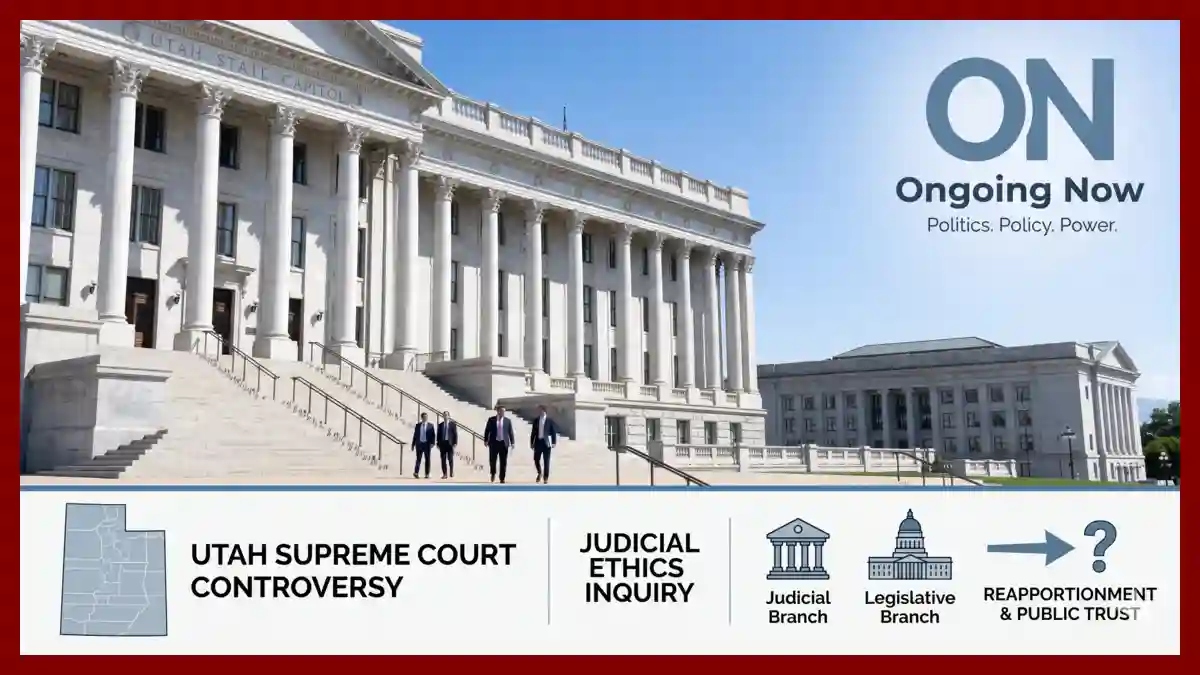
The Utah Supreme Court controversy intensified this week as Governor Spencer Cox and legislative leaders authorized an independent investigation into Justice Diana Hagen regarding allegations of an unethical relationship with a prominent attorney. This Utah Supreme Court probe 2026 focuses on whether a conflict of interest existed during the high-stakes litigation over the state’s congressional maps. The Justice Hagen redistricting scandal centers on claims involving David Reymann, a redistricting lawyer who successfully challenged the state’s 2021 boundaries. As public trust in Utah courts becomes a focal point of legislative debate, the GOP vs Utah Supreme Court dynamic highlights a significant institutional friction following the 2024 ruling that altered Utah’s electoral landscape. Utah voter sentiment remains divided as the Judicial Conduct Commission’s prior dismissal of the Diana Hagen ethics complaint is revisited by state officials.
Institutional Friction and the Independent Probe
The current political situation in Salt Lake City marks a rare public escalation between the executive and judicial branches. On April 17, 2026, Governor Spencer Cox, alongside House Speaker Mike Schultz and Senate President J. Stuart Adams, announced a new independent inquiry. This move follows the “inappropriate” release of confidential records from the Judicial Conduct Commission (JCC) involving Justice Hagen’s ex-husband allegations.
The core of the dispute involves the 2024 League of Women Voters of Utah v. Utah State Legislature case. In that decision, the Utah Supreme Court unanimously ruled that the Legislature had overstepped its authority by overriding a voter-approved independent redistricting commission. Justice Hagen was part of that unanimous panel, and critics now question if her personal life influenced the proceedings.
By the Numbers: Utah Political Landscape 2026
| Metric | Current Status (April 2026) | Institutional Impact |
| Spencer Cox Approval Rating 2026 | 55% Favorable / 33% Unfavorable | High; Governor maintains broad support despite GOP internal friction. |
| Redistricting Status | Court-Mandated Map Active | One congressional seat shifted toward “Competitive” or “Lean Blue.” |
| JCC Ruling | Complaint Dismissed (Early 2026) | Formal case closed; executive probe now seeks further “transparency.” |
| Judicial Retention | Election Scheduled (Fall 2026) | Justice Hagen faces a retention vote amid the ongoing controversy. |
The Origin of the Conflict: Redistricting and Legal Ethics
The Salt Lake City court scandal stems from a complaint filed in late 2025 by the ex-husband of Justice Hagen. He alleged that “inappropriate” text messages existed between the justice and David Reymann, the lead counsel for the plaintiffs in the redistricting case.
Justice Hagen has categorically denied any wrongdoing or ethical breach. In a statement released through the Utah Courts, she clarified the timeline of her recusal. “My last involvement in the redistricting case was October 2024,” Hagen stated. She further noted that she voluntarily updated her recusal list in May 2025 after reconnecting with old friends, which included Reymann, following her marital separation.
Key Developments in the Hagen Inquiry
December 2025: An ethics complaint is filed with the JCC involving allegations of an undisclosed relationship.
Early 2026: The Judicial Conduct Commission conducts a preliminary investigation and dismisses the complaint.
April 16, 2026: Confidential JCC documents are leaked to local media, prompting public outcry from legislative leaders.
April 17, 2026: Governor Cox and legislative heads launch a separate, independent investigation.
Separation of Powers and Constitutional Tension
The decision by the executive and legislative branches to bypass the JCC’s dismissal has sparked a debate over the separation of powers. Democratic leaders in the Utah House and Senate issued a joint statement criticizing the new probe. “Efforts by the Legislature to investigate a member of the judiciary raise significant concerns over the separation of powers,” the statement read. “This is part of a broader pattern of overstepping judicial independence.”
Republican leaders, however, argue that the gravity of the Utah redistricting case conflict necessitates absolute transparency. Speaker Mike Schultz defended the release of certain records, stating, “We followed the statute in releasing these records. Allegations of this nature… must be examined with transparency and accountability to maintain public confidence.”
Analysis: Why This Matters for Utah Governance
This development is more than a personal ethics matter; it is an institutional struggle over the finality of judicial rulings. The 2024 redistricting decision fundamentally changed how power is distributed in Utah. By tossing out the GOP-drawn maps, the court allowed for more competitive districts, which Republicans argue was a judicial overreach.
“An initial review by the Judicial Conduct Commission and the Court left important questions unresolved. Maintaining trust in our institutions is essential.” — Joint Statement by Gov. Cox, Speaker Schultz, and President Adams
The Utah redistricting case conflict is particularly sensitive because the resulting map led to a significant shift in the 2026 midterm outlook. If the integrity of the justice who helped craft that ruling is questioned, the ruling itself faces a crisis of legitimacy in the eyes of the public and the legislature.
Public Sentiment and the 2026 Retention Election
As the Spencer Cox approval rating 2026 remains stable at 55%, the Governor’s involvement in the probe may be seen as an attempt to bridge the gap between moderate voters and the more conservative wing of the Utah GOP. Rank-and-file Republicans have shown high favorability toward Cox, yet the party’s convention delegates have historically been more critical of his judicial appointments.
For Utah voters, the primary concern is the impartiality of the bench. Justice Hagen is set to face a retention election this fall. Historically, judicial retention in Utah is a routine process with high pass rates. However, the Utah Supreme Court controversy could turn a standard administrative procedure into a referendum on the court’s recent rulings.
Voter Impact and Community Regional Variations
Salt Lake County: Voters here generally supported the redistricting changes and may view the probe as a political maneuver.
Rural Utah: Residents in more conservative districts have expressed concern that the court’s 2024 ruling diluted their influence.
Legal Community: Professional organizations are watching the Judicial Conduct Commission Hagen proceedings closely to see if the independence of the commission is upheld.
Historical Context: Judicial Independence in the Beehive State
Utah has a long-standing tradition of a non-partisan judiciary. Justices are selected through a nominating commission and appointed by the Governor, followed by Senate confirmation. This system was designed to insulate judges from the “political winds” that often affect elected judiciaries in other states.
The current GOP vs Utah Supreme Court tension mirrors past disagreements over the state’s “Proposition 4” initiative, which first sought to create the independent redistricting commission. The ongoing struggle highlights a fundamental disagreement: Does the Legislature have the final say on electoral maps, or does the State Constitution grant the judiciary the power to ensure those maps are not “unconstitutionally partisan”?
Evidence-Based Political Insights
Data from recent state polls suggests that while Utahns value judicial independence, they also prioritize ethical transparency. A March 2026 survey indicated that 62% of respondents believe high-ranking officials should be subject to independent oversight even if a specialized commission has already cleared them.
The Utah voter sentiment is currently characterized by a desire for closure. The upcoming independent investigation will likely focus on the metadata of text communications and the exact timing of the alleged relationship relative to the court’s deliberations.
Comparison: 2024 vs 2026 Judicial Dynamics
| Feature | 2024 Redistricting Ruling | 2026 Ethics Probe |
| Primary Focus | Legislative Authority vs. Voter Will | Personal Ethics vs. Judicial Impartiality |
| Key Entity | League of Women Voters | Judicial Conduct Commission |
| Political Climate | High tension over map boundaries | High tension over institutional trust |
| Outcome | Unanimous ruling against Legislature | Pending independent investigation |
Conclusion: The Path Forward for Utah’s Judiciary
The outcome of the Utah Supreme Court probe 2026 will have lasting implications for the state’s political landscape. If the investigation finds no evidence of a conflict during the active litigation period, it may serve to bolster the court’s standing. Conversely, any evidence of a lapse in judgment could lead to calls for a reassessment of the redistricting decision.
As Governor Cox navigates this “minefield” between legislative hardliners and the broader electorate, the focus remains on the integrity of the law. The Utah Supreme Court controversy serves as a case study in the delicate balance of power between those who make the laws and those who interpret them.
Stay sharp with Ongoing Now!
Source and Data Limitations: This report is based on official press releases from the Utah Governor’s Office (April 17, 2026), official statements from the Utah State Courts, and legislative news releases from both GOP and Democratic leadership. Polling data regarding the Spencer Cox approval rating 2026 is cited from Noble Predictive Insights and UtahPolitics.news (October 2025 – January 2026). Information regarding the Judicial Conduct Commission is derived from Article VIII of the Utah Constitution and publicly available procedural summaries. Claims involving Justice Diana Hagen and David Reymann are based on reported filings and public denials; no criminal charges or formal findings of guilt have been established by a court of law as of this publication. Speculative reports from anonymous social media sources were excluded to maintain journalistic standards.