The High-Stakes Fallout Driving Judicial Safety Funding to a Historic High
Federal Law Enforcement Expands Protective Operations for High-Profile Jurors
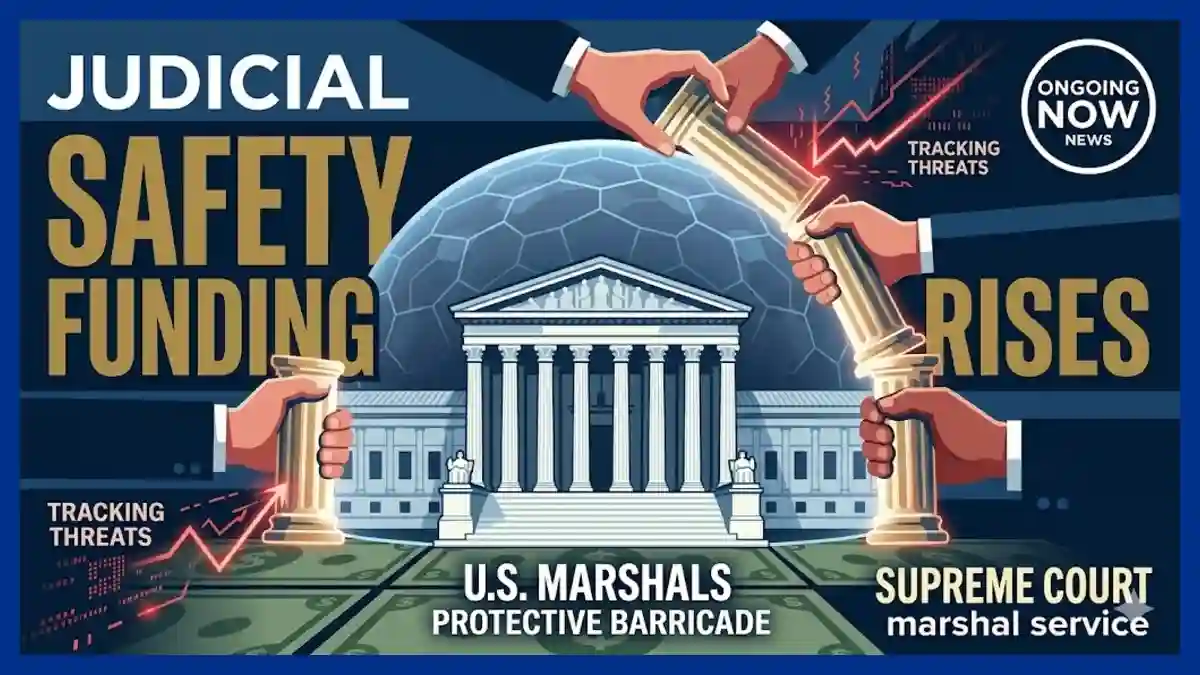
WASHINGTON — The structural architecture safeguarding the American judiciary faces critical operational adjustments as Congress, federal law enforcement agencies, and the Supreme Court of the United States confront an unprecedented volume of security challenges. According to the Administrative Office of the United States Courts, the federal judiciary has submitted a $9.4 billion discretionary budget request for fiscal year 2026, representing a 9.3 percent increase over the $8.6 billion enacted appropriation for fiscal year 2025. A central pillar of this fiscal expansion is the court security account, which seeks $892 million—a sharp 18.9 percent escalation designed to reinforce physical infrastructure, expand tracking capabilities for threats against federal judges, and augment field resources for the United States Marshals Service (USMS).
The legislative and executive focus on constitutional security measures courts rely upon has intensified following a series of high-profile incidents that underscore the vulnerabilities of judicial officers when traveling outside Washington, D.C. In early 2026, public security concerns led to the abrupt modification of a scheduled in-person appearance by Associate Justice Clarence Thomas at an American University law school conference, where he ultimately delivered his remarks remotely from Capitol Hill. This operational shift, paired with broader trends monitored by the USMS Judicial Security Division, has catalyzed bipartisan legislative discussions surrounding a permanent supreme court marshal service expansion to systematically handle domestic and interstate protective details.
Escalating Risks Reshape Federal Court Security Protocols
The baseline operational environment for the USMS Judicial Security Division has shifted from passive facility protection to active, 360-degree threat mitigation. Operational data released by federal law enforcement repositories indicates that threats targeting federal jurists nationwide expanded dramatically over the past decade, shifting the defensive posture of the Department of Justice (DOJ). The agency currently oversees the physical protection of approximately 2,700 sitting federal judges, along with more than 30,300 federal prosecutors and court officials spanning 94 federal judicial districts and 12 regional circuits.
To manage the escalating intelligence requirements, the federal government relies on specialized units dedicated to tracking threats against federal judges. These intelligence analysts assess digital communication, direct correspondence, and physical surveillance indicators to categorize risk profiles before jurists travel or preside over high-profile litigations. The implementation of these protective measures directly affects how court personnel operate, transforming standard judicial conferences and public academic addresses into strictly managed law enforcement operations.
Legislative Architecture of Supreme Court Police Funding Legislation
The mechanisms to fund these upgraded defensive structures remain tethered to complex congressional appropriations bills. Within the proposed fiscal year 2026 judicial budget, the requested $141.9 million program increase for court security is explicitly earmarked for advanced vulnerability management, the integration of security infrastructure into new courthouse construction projects, and direct personnel support for the USMS. This request follows a constrained fiscal year 2025 cycle during which the enacted $750.2 million court security allocation fell $47.2 million short of the judiciary’s conference appeal, forcing administrators to defer critical infrastructure updates.
+-----------------------------------------------------------------------+
|  Federal Judicial Court Security Appropriations: FY 2025 vs. FY 2026  |
+------------------------------------+----------------------------------+
| Fiscal Year 2025 Enacted Level     | $750.2 Million                   |
+------------------------------------+----------------------------------+
| Fiscal Year 2026 Requested Level   | $892.0 Million                   |
+------------------------------------+----------------------------------+
| Total Requested Net Increase       | $141.8 Million (18.9% Change)    |
+------------------------------------+----------------------------------+
| Supplemental Courthouse Upgrades   | $56.0 Million (Remaining Amount) |
+------------------------------------+----------------------------------+
| Note: FY 2025 funding shortfalls deferred primary security spending,   |
| requiring the reliance on lingering FY 2023 supplemental allocations. |
+-----------------------------------------------------------------------+
To counter these structural shortfalls, members of both chambers of Congress are drafting targeted supreme court police funding legislation. This statutory framework seeks to decouple the protective budgets of the nation’s highest court from broader, omnibus discretionary spending packages. Proponents argue that standalone funding ensures uninterrupted protection for the nine justices, establishing a statutory baseline that prevents protective details from being compromised during temporary federal government shutdowns or protracted budgetary impasses.
Analysis: Balancing Judicial Openness with Public Safety for High-Profile Judges
The technical reality of protecting public safety high profile judges requires balancing the historical transparency of the American legal system against modern defensive requirements. Legal scholars and law enforcement executives emphasize that the legitimacy of the judicial branch depends partly on its accessibility to the public, public proceedings, and open academic discourse. However, when security risks alter civic engagements—such as Justice Thomas’s decision to shift an in-person appearance to a remote broadcast to prevent “endangering anyone by [his] mere presence”—the visibility of the judiciary shifts.
“The protection of court officials and safeguarding the public is a responsibility that permits no errors,” notes the official program brief of the U.S. Marshals Service. “It is a comprehensive effort accomplished by anticipating and deterring threats to the judiciary and by continuously developing and employing innovative protective tactics.”
This operational reality has forced a reassessment of federal judge protection laws. Current statutes, including the Daniel Anderl Judicial Security and Privacy Act, focus heavily on scrubbing the personally identifiable information of federal judges from public internet registries. Current congressional evaluations seek to expand these measures by establishing harsher statutory penalties for interstate stalking and intimidation directed at judicial families, recognizing that modern threats frequently bypass the courthouse entirely to target private residences.
Comparative Context: How Modern Threats Reshape Historical Precedents
Historically, the safety of the federal judiciary was managed primarily through localized courthouse security officers (CSOs) and regional deputy marshals who secured physical courtrooms during active trials. The modern threat landscape, characterized by decentralized digital networks, has rendered that localized model incomplete. A historical analysis of judicial security spending demonstrates a clear inflection point following landmark targeted attacks on judicial residences over the last two decades, forcing a transition from reactive perimeter defense to predictive, intelligence-driven protective details.
Comparatively, the proposed supreme court marshal service expansion represents a structural shift similar to the post-1970 expansion of the United States Secret Service’s protective mandates. While the Supreme Court Marshal historically maintained order within the physical courtroom and structural grounds of the One First Street building, contemporary demands require the office to operate as a nationwide protective agency. When justices travel across state lines for institutional speeches, the coordination between the Supreme Court Police, the USMS Judicial Security Division, and local state law enforcement requires a unified command structure that current statutory frameworks do not fully accommodate.
Institutional and Regional Variations in Security Deployment
The execution of enhanced judicial safety funding threats vary significantly depending on regional geographic factors and court tiers. Urban federal districts within the Second, Ninth, and District of Columbia Circuits absorb a disproportionate share of high-intensity security allocations due to the concentration of high-profile corporate, political, and national security litigations. Conversely, rural districts face distinct logistical hurdles, as deputy marshals must cover vast geographical jurisdictions to secure isolated federal judges and satellite courthouses lacking permanent law enforcement installations.
Urban Judicial Districts: Prioritize digital threat monitoring, complex physical perimeter barriers, and coordinated multi-agency tactical details for high-profile trials.
Rural Judicial Districts: Focus resources on residential security system installations, long-distance transport protection, and rapid-response protocols with local county sheriffs.
Appellate Circuits: Emphasize traveling protection details for multi-judge panels conducting regional hearings outside their home chambers.
To address these vulnerabilities equitably, the judiciary’s Capital Security Program (CSP) is actively reviewing existing courthouse infrastructures where full building replacements are structurally or financially unfeasible. For fiscal year 2026, the judiciary has requested that Congress allocate $30 million directly to the General Services Administration (GSA) to remediate physical safety gaps in older, historically preserved facilities, ensuring that structural reinforcement keeps pace with evolving tactical assessments.
What the Data Shows: The Long-Term Impact on Judicial Governance
An evidence-based assessment of judicial administration indicates that sustained funding shortfalls alter the operational independence of the courts. When the court security account is underfunded, resources are frequently diverted from auxiliary judicial functions—such as information technology modernization and defender services—to shore up baseline physical protection. The University of Washington’s Center for an Informed Public observed in May 2026 that institutional stresses, including federal funding gaps for court-appointed private counsel, often intersect with broader public pressures facing the third branch of government.
The correlation between specialized security spending and the preservation of judicial independence remains clear. Law enforcement analysts argue that without robust, statutory guarantees of personal safety, the recruitment of highly qualified legal minds to the federal bench could face long-term headwinds. By prioritizing comprehensive tracking, expanding the protective scope of the USMS, and solidifying congressional appropriations, the federal government aims to insulate the mechanism of constitutional adjudication from external physical coercion.
Stay sharp with Ongoing Now!
Source and Data Limitations: This analysis is compiled utilizing official federal documentation, including the Judiciary Fiscal Year 2026 Congressional Budget Summary published by the Administrative Office of the United States Courts and the FY 2026 Budget and Performance Summary from the United States Department of Justice. Historical data regarding threat vectors and protective mandates is sourced from the official program directives of the United States Marshals Service Judicial Security Division. Academic and public trust assessments rely upon data published by the University of Washington Center for an Informed Public in May 2026. This article excludes speculative reporting regarding non-publicized security threats, unverified leaks concerning specific judicial itineraries, and partisan commentary regarding pending cases before the Supreme Court.