King Charles Address to Congress Affirms Transatlantic Ties
British Monarch highlights shared democratic values and defense cooperation during a historic joint session of Congress royal address
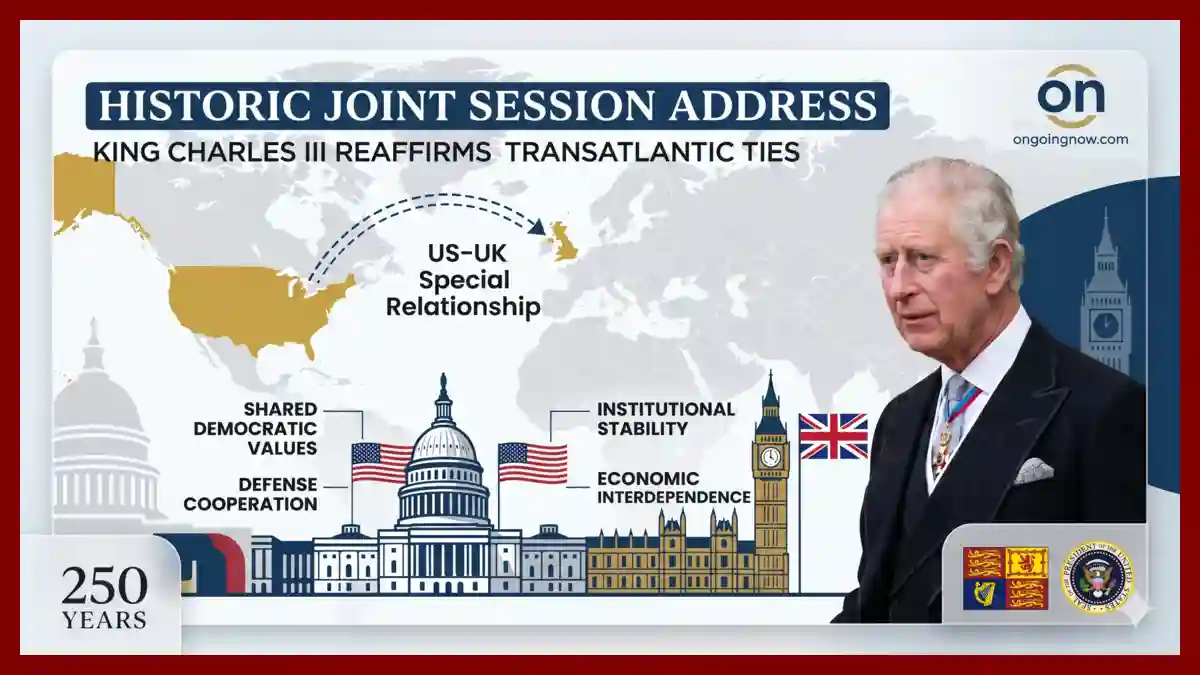
British monarch King Charles III addressed a joint session of Congress on April 28, 2026, marking only the second time in history a reigning British sovereign has delivered such a speech. The joint session of Congress royal address serves as the centerpiece of a high-profile state visit aimed at reinforcing the US-UK special relationship 2026 amid evolving global security challenges. In his remarks, the King emphasized that despite a “partnership born out of dispute” 250 years ago, the two nations remain unified in their commitment to democratic institutions and collective defense.
The visit, which included a White House state dinner hosted by President Donald Trump and First Lady Melania Trump, provides a critical diplomatic platform for discussing shared military objectives and economic ties. Beyond the ceremonial pomp, the address at the U.S. Capitol underscored the “unshakeable resolve” of the transatlantic alliance in the face of modern threats to democratic governance. This historic engagement reflects a strategic effort by both the British government and the U.S. administration to project a united front on the international stage.
Strategic Significance of the Joint Session of Congress Royal Address
The joint session of Congress royal address is a rare diplomatic tool, historically reserved for the closest of allies or pivotal world leaders. When King Charles III stood before the assembled members of the House of Representatives and the Senate, he stepped into a role previously occupied only by his mother, Queen Elizabeth II, in 1991. This appearance was formally invited by Speaker of the House Mike Johnson, who described the partnership as “one of the most consequential in history.”
Politically, the speech functioned as a bridge between the historical legacy of the two nations and their contemporary legislative goals. The King pointedly referenced the “Spirit of 1776,” acknowledging the fundamental disagreements that led to American independence while framing them as the shared democratic values of “no taxation without representation.” By rooting the alliance in these shared principles, the monarch provided a non-partisan framework for continued cooperation between the U.K. and the U.S. government.
The address also served to address recent internal and external pressures on the alliance. Amidst a geopolitical climate characterized by shifting trade policies and regional conflicts, the King’s presence in the “citadel of democracy” was intended to signal stability. Observers noted that the speech received approximately 12 standing ovations, particularly when the King spoke of the necessity for executive power to remain subject to checks and balances.
Key Developments in the US-UK Special Relationship 2026
The year 2026 carries significant symbolic weight as the United States celebrates its semi-quincentennial, or 250th anniversary of the Declaration of Independence. The King Charles Washington DC schedule was specifically designed to coincide with these commemorations, reframing the “special relationship” from one of colonial conflict to one of mutual defense and economic interdependence. This visit is the King’s 20th to the United States but his first as sovereign and Head of the Commonwealth.
Institutional and Legislative Context
The following table outlines the key milestones and institutional engagements during the 2026 royal state visit.
| Event | Date | Institutional Significance |
| Arrival at Joint Base Andrews | April 27, 2026 | Formal reception by U.S. Chief of Protocol and British Ambassador. |
| State Arrival Ceremony | April 28, 2026 | Full military honors on the White House South Lawn, including a 21-gun salute. |
| Bilateral Meeting | April 28, 2026 | Private discussion between King Charles and President Trump in the Oval Office. |
| Joint Session Address | April 28, 2026 | Only the second address to Congress by a reigning British monarch. |
| State Dinner | April 28, 2026 | Diplomatic hospitality in the East Room involving 250 pieces of White House vermeil. |
| 9/11 Memorial Visit | April 29, 2026 | Commemoration of the upcoming 25th anniversary of the September 11 attacks. |
The bilateral meeting in the Oval Office, while private, coincided with discussions regarding the “biggest sustained increase in defense spending since the Cold War” by the United Kingdom. These developments are critical for the U.S. Department of Defense and NATO, as both nations collaborate on high-tech military hardware, including the F-35 Lightning II aircraft.
King Charles Washington DC Schedule and Diplomatic Engagements
The King Charles Washington DC schedule involved a meticulous balance of statecraft and symbolic outreach. Upon landing on the Royal Air Force Voyager Vespina, the King and Queen Camilla were met by U.S. Chief of Protocol Monica Crowley. Their initial reception at the White House included a private tea in the Green Room, where the couples viewed the newly expanded White House beehive—a nod to the King’s long-standing advocacy for environmental conservation and biodiversity.
Following the ceremonial greeting on the South Lawn, which featured the U.S. Army Herald Trumpets and the U.S. Marine Band, the schedule pivoted to the Capitol. The King’s address to Congress was televised globally, with C-SPAN King Charles address coverage providing a direct window into the monarch’s plea for international unity. The King noted that the modern relationship spans over four centuries, citing his ancestors’ attention to American affairs since the colonial era.
In addition to federal engagements, the royal couple hosted a garden party at the British Embassy for 650 guests. This event served a dual purpose: celebrating the removal of recent U.S. tariffs on British goods—symbolized by the serving of British roast beef—and engaging with civil society leaders. Queen Camilla met with representatives from organizations such as the House of Ruth to discuss efforts against domestic abuse, highlighting the visit’s focus on societal issues alongside high-level diplomacy.
Queen Camilla White House State Dinner: Protocol and Symbolism
The Queen Camilla White House state dinner on the evening of April 28 was an exercise in “soft power” diplomacy. Hosted by President Trump and First Lady Melania Trump in the East Room, the event was meticulously themed to reflect the beauty of English and American gardens. First Lady Melania Trump curated the evening to honor the special relationship during the 250th anniversary year, using cherry blossoms and lilac to decorate the historic space.
The menu featured ingredients from the White House Kitchen Garden, including a spring herb ravioli with morels and a classic Dover sole meunière. This choice of cuisine was intended to honor the shared heritage of the two nations while celebrating American winemaking with selections like the 2024 Hopkins Riesling. Beyond the culinary details, the dinner provided an informal setting for the British monarch and American leadership to solidify personal ties that often underpin formal treaty obligations.
The guest list included members of the U.S. Cabinet, such as Treasury Secretary Scott Bessent, and prominent figures from both parties, including former Speaker Nancy Pelosi. This bipartisan attendance underscored the institutional nature of the U.S.-U.K. alliance, which traditionally remains independent of whichever political party holds power in either capital.
Historical Precedent and British Monarch Congress History
The British monarch Congress history is brief but significant. King Charles III acknowledged the “weight of history” on his shoulders as he spoke from the same rostrum where his mother, Queen Elizabeth II, stood 35 years prior. Before the 1991 address, no reigning British monarch had ever addressed a joint meeting of the U.S. legislature. This rarity highlights the exceptional nature of the 2026 visit and its timing during the American semi-quincentennial.
Historically, the first reigning British sovereign to visit the United States was King George VI in 1939. That visit, occurring just months before the outbreak of World War II, was pivotal in securing American support for Great Britain. King Charles drew a direct parallel to that era, noting that just as his grandfather stood with the U.S. against fascism, the modern alliance must stand firm for the “defense of Ukraine” and the security of the North Atlantic.
“The alliance that our two nations have built over the centuries… is truly unique,” King Charles stated during his address. “Whatever our differences, whatever disagreements we may have, we stand united in our commitment to uphold democracy.”
Analysis: The Future of the Special Relationship
From a policy perspective, the royal visit serves as a stabilizing force in the US UK special relationship 2026. While the U.K. has faced internal debates regarding its global role post-Brexit and the U.S. continues to navigate a complex domestic political landscape, the visit reaffirms that the underlying institutional ties remain intact.
The emphasis on defense spending and the F-35 program suggests that the “special relationship” is increasingly defined by technological and military integration. King Charles’ mention of the “thousands of U.S. service personnel” stationed in the U.K. and British personnel serving across 30 American states highlights a level of cooperation that few other nations share with the United States.
Regional and Societal Impact
The visit extends beyond the “Beltway” of Washington, D.C. The itinerary includes stops in New York City and Virginia, focusing on community impact.
New York City: The King and Queen will meet with first responders at the 9/11 Memorial, emphasizing shared resilience in the face of terrorism.
Virginia: Events linked to the 250th anniversary celebrations will focus on the historical roots of American governance, involving local communities in “block party” style events.
Economic Ties: The removal of tariffs on British beef and other goods, highlighted at the embassy garden party, has direct implications for agricultural sectors in both the U.K. and the U.S. Midwest.
What the Data Shows: Public Perception and Defense
According to recent diplomatic briefings, the U.K.-U.S. intelligence-sharing relationship remains the “gold standard” for global security. The 2026 visit has seen a surge in public interest, with the C-SPAN King Charles address recording high viewership numbers. This interest reflects a public desire for international stability during a period of global uncertainty.
A Legacy of Reconciliation
The state visit of King Charles III and Queen Camilla is more than a ceremonial tradition; it is a calculated diplomatic gesture. By addressing the U.S. Congress, the King has reinforced the concept of a shared “British Enlightenment” heritage while acknowledging the independence and sovereignty of the American republic. As the United States looks toward its next 250 years, the 2026 royal visit suggests that the partnership with the United Kingdom will remain a cornerstone of its foreign policy and democratic identity.
Stay sharp with Ongoing Now!
Source and Data Limitations: This report is based on official itineraries released by Buckingham Palace and the White House Office of the Press Secretary as of April 2026. Speech transcripts were sourced from the official records of the U.S. House of Representatives and the Royal Household. Historical data regarding prior royal visits was verified through the National Archives and Congressional Research Service (CRS) reports. Information regarding trade tariffs and defense spending reflects current 2026 government statements from the U.S. Department of Commerce and the U.K. Ministry of Defence. This analysis excludes unverified social media rumors regarding private conversations and speculative polling data not released by accredited agencies such as Gallup or Pew Research.