Alabama Redistricting Court Updates: Why Maps Shift
Federal courts and state officials evaluate the Alabama redistricting court updates as recent 2026 rulings impact election maps.
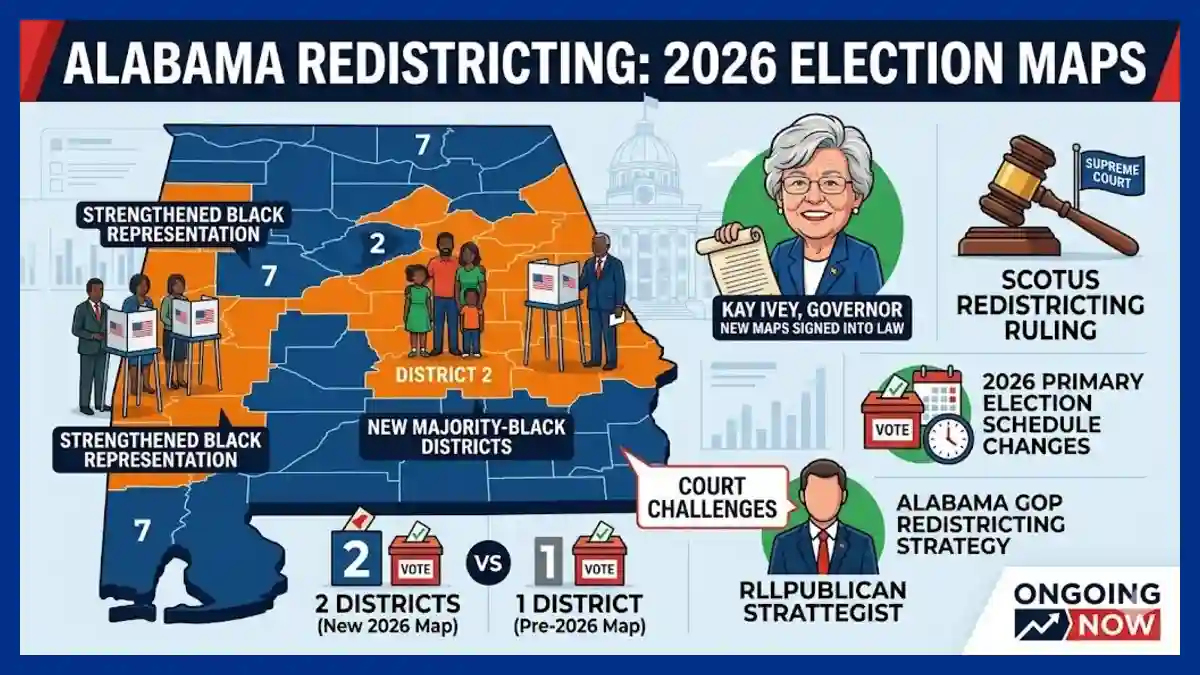
The landscape of Southern representation is undergoing a significant transition as Alabama redistricting court updates emerge following a pivotal SCOTUS redistricting ruling 2026. This development involves a complex intersection of the Voting Rights Act gutting 2026 precedents and a newly issued executive order from Governor Kay Ivey, who called a Kay Ivey special session to address the state’s legislative boundaries. At the core of the dispute are 2026 Alabama House map changes and Alabama gerrymandering lawsuit updates that have thrown the Alabama primary election schedule changes into immediate flux. As the Alabama GOP redistricting strategy moves toward redrawing lines for the state senate redistricting Alabama, the broader redistricting impacts on 2026 midterms are being analyzed by legal experts and federal authorities alike.
The 2026 Judicial Shift and Legislative Response
In early May 2026, the United States Supreme Court issued a ruling that significantly altered the application of Section 2 of the Voting Rights Act, specifically regarding race-conscious districting. This decision, which legal analysts describe as a substantial narrowing of federal oversight, provided the impetus for Alabama officials to challenge existing court orders. Previously, a three-judge federal panel had mandated a map with two majority-Black districts, a requirement the state is now seeking to vacate.
Governor Kay Ivey’s proclamation for a special session, issued on May 1, 2026, explicitly authorizes the Alabama Legislature to redraw both congressional and state legislative maps. The move is a direct response to the Supreme Court’s shifting stance, which state leadership views as an opportunity to move away from what they characterize as “racial quotas.” The timing of this session is critical, as it coincides with the final weeks of the traditional primary season.
Federal courts are currently weighing a motion from the Alabama Attorney General to stay the 2024 court-imposed map. If granted, this would allow the state to implement a new Republican-led design immediately. Opponents of the move, including civil rights organizations, have filed emergency responses, noting that absentee voting for the scheduled May 19 primary is already underway.
Impact on Election Logistics and Voter Access
The immediate consequence of these legal maneuvers is the potential for Alabama primary election schedule changes. For the first time in recent history, a state is considering the suspension of an active primary while ballots are already in the hands of voters. This creates a unique administrative challenge for the Alabama Secretary of State’s office, which must manage the logistical fallout of potentially voided ballots.
Local election officials have expressed concern regarding the “chaos” of changing rules mid-cycle. If the primary is postponed to accommodate the 2026 Alabama House map changes, the state may need to conduct a condensed special election cycle later in the summer. This would compress the timeline for the November general election and could impact voter turnout patterns across the state’s seven congressional districts.
Key Dates and Administrative Milestones
| Event | Original 2026 Date | Status as of May 3, 2026 |
| Primary Election Day | May 19, 2026 | Under review for suspension |
| Absentee Ballot Return Deadline | May 18, 2026 | Active, but subject to litigation |
| Special Legislative Session | Begins May 4, 2026 | Confirmed by Executive Order |
| 2026 Midterm General Election | November 3, 2026 | Unchanged |
Analyzing the Alabama GOP Redistricting Strategy
The Alabama GOP redistricting strategy focuses on leveraging the recent Supreme Court precedent to maximize partisan advantage while arguing for “colorblind” map-making. By redrawing the lines now, the Republican-led legislature seeks to secure up to six of the seven congressional seats, potentially reversing the gains made by Democratic candidates in the 2024 cycle under court-ordered maps.
This strategy involves more than just congressional lines; it extends to state senate redistricting Alabama and the redrawing of State House districts. The objective is to consolidate rural voting blocs and adjust the boundaries of the “Black Belt” region, which has historically been the focal point of Section 2 litigation.
Proponents of the redraw argue that the legislature should have the primary authority to determine its own districts, rather than having maps “imposed” by the federal judiciary. Critics, however, maintain that this approach effectively dilutes the voting power of minority communities, who make up approximately 27% of the state’s population but may soon be represented in only one majority-opportunity district.
Constitutional Precedents and the Voting Rights Act
The Voting Rights Act gutting 2026 refers to the legal community’s interpretation of recent SCOTUS decisions that have limited the “intent” versus “effect” tests in redistricting. Historically, under Allen v. Milligan, the Court protected the creation of multiple opportunity districts. However, the 2026 rulings have introduced a higher burden of proof for plaintiffs to show that race was not the “predominant factor” in a way that violates the Equal Protection Clause.
“We will act as quickly as possible to apply this ruling to Alabama’s redistricting efforts and ensure that our congressional maps reflect the will of the people, not a racial quota system.” — Steve Marshall, Alabama Attorney General
This shift has created a “litigation vacuum” where states with Republican trifectas are moving to enact maps that were previously blocked. The Alabama gerrymandering lawsuit updates indicate that while the state was under a court order to keep maps in place until 2030, the recent change in federal law may provide a “material change in circumstances” sufficient to vacate that injunction.
Human and Societal Impact: The Black Belt Perspective
For residents of Alabama’s Black Belt—a region named for its rich soil and historic significance to the African American community—these map changes are not merely abstract legal theories. Redistricting determines which communities share a representative and, consequently, how federal resources are allocated for infrastructure, healthcare, and education.
Community Cohesion: The practice of “cracking” (splitting a community into multiple districts) often leaves local leaders with multiple representatives to lobby, none of whom may see that specific community as their primary constituency.
Economic Advocacy: Districts with shared economic interests, such as the automotive corridors or agricultural regions, rely on unified representation to secure federal grants.
Political Engagement: Constant shifts in election dates and district boundaries can lead to “voter fatigue,” where confusion over who is on the ballot reduces participation in the democratic process.
By the Numbers: Alabama’s Representation Gap
7: Total Congressional Seats in Alabama.
27.2%: Approximate Black voting-age population in the state.
1 of 7: Districts where Black voters are currently the majority (under the contested 2023 map).
0 of 7: Districts where Black voters would be the majority under some proposed GOP drafts.
National Implications for the 2026 Midterms
The redistricting impacts on 2026 midterms extend far beyond the borders of Alabama. With a razor-thin majority in the U.S. House of Representatives, a shift of even one or two seats in a single state can alter the balance of power in Washington. National political committees are closely watching the Alabama special session as a bellwether for similar efforts in Louisiana, Georgia, and North Carolina.
If Alabama successfully implements a new map for the 2026 cycle, it sets a precedent that court-ordered maps are not “final” and can be revisited whenever the Supreme Court’s ideological makeup or jurisprudence shifts. This could lead to a cycle of “permanent redistricting,” where maps are redrawn every few years rather than once a decade.
The outcome of the Kay Ivey special session will likely be the subject of immediate litigation in lower federal courts, potentially creating a “yo-yo” effect for candidates who have already raised funds and campaigned in specific districts. As of May 3, 2026, the primary remains scheduled for May 19, but the state’s push to “halt and redraw” remains the most significant legal hurdle to the 2026 election cycle.
Stay sharp with Ongoing Now!
Source and Data Limitations: This report is based on May 1–3, 2026, updates from the Alabama Governor’s Office, the Alabama Attorney General’s public filings, and SCOTUS emergency docket records. Primary data on election logistics was sourced from the Alabama Secretary of State’s 2026 election calendar and Ballotpedia’s 2026 election tracker. Historical context regarding Allen v. Milligan and the Voting Rights Act is based on verified Department of Justice archives and Supreme Court opinions. This article excludes speculative commentary regarding the specific partisan outcome of the special session, focusing instead on the verified legal mechanisms and administrative proclamations currently in effect.