Gender Affirming Therapy: What the SCOTUS Ruling Shifts
The Chiles v. Salazar ruling on gender-affirming care and reparative therapy forces a collision between First Amendment doctrine and decades of mental health research on LGBTQIA+ youth.
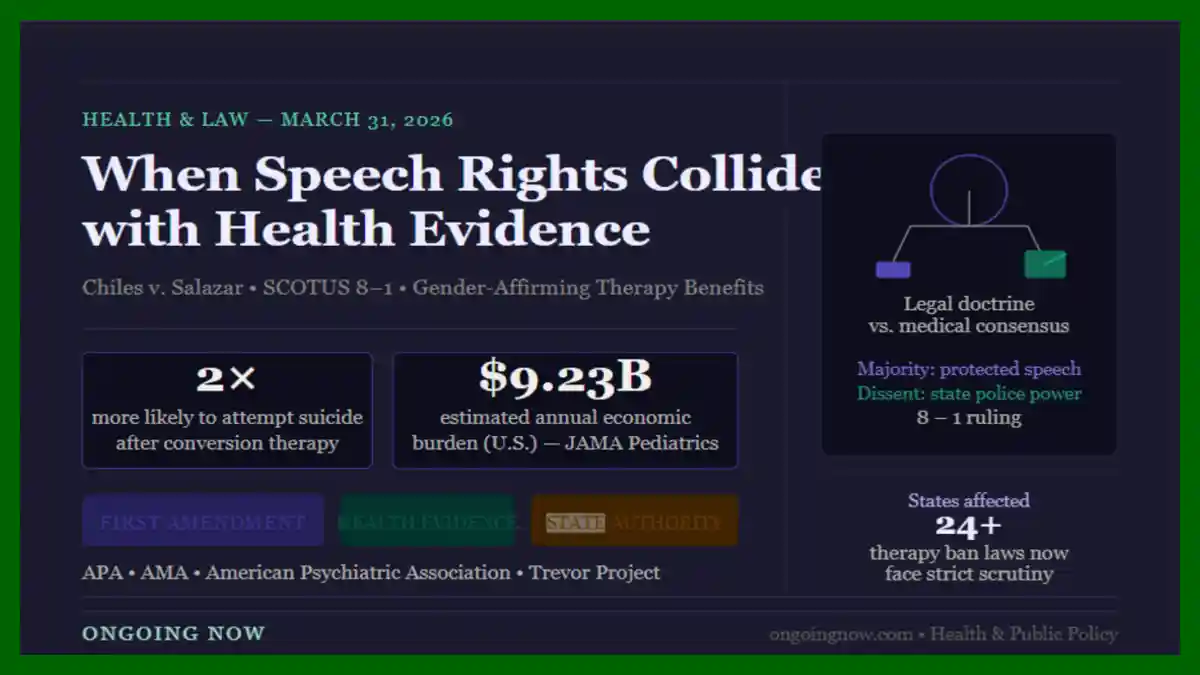
The Chiles v. Salazar SCOTUS decision, handed down on March 31, 2026, has fundamentally altered the landscape of evidence-based mental health care for LGBTQIA+ youth across the United States. In an 8–1 ruling, the Supreme Court held that Colorado’s ban on conversion therapy — when applied to talk-based counseling — constitutes viewpoint-based speech regulation subject to the most demanding form of judicial review. The decision, authored by Justice Neil Gorsuch, intersects with a long-standing body of research on gender-affirming therapy benefits, cognitive behavioral therapy for LGBTQ individuals, trauma-informed affirming care, and the documented harms of reparative therapy. For clinicians, health researchers, and public health advocates, the legal framework has now shifted — even as the scientific consensus has not. Every major medical and mental health organization in the United States, including the American Psychological Association (APA), the American Psychiatric Association (APA-Psych), and the American Medical Association (AMA), continues to oppose conversion therapy and support humanistic, identity-affirming approaches.
What the Science Says: Identity-Affirming Care vs. Reparative Practices
At the center of the Chiles v. Salazar ruling is a clinical and legal question that researchers have been studying for decades: does therapy that attempts to change a person’s sexual orientation or gender identity cause harm, and does therapy that affirms identity promote well-being?
The evidence on these two questions is now substantial. Research shows that LGBTQ+ youth who experienced conversion therapy are more than twice as likely to attempt suicide and more than 2.5 times as likely to report multiple suicide attempts in the past year. The Trevor Project This finding, drawn from a large-scale national survey, has been replicated across multiple peer-reviewed studies and institutional reports, forming the bedrock of every major professional organization’s opposition to the practice.
A broad consensus among major medical and mental health organizations holds that conversion therapy is both ineffective at achieving its stated goals and harmful to those who are subjected to it. The American Psychological Association notes that conversion therapy is associated with a wide range of negative mental health outcomes, including depression, anxiety, suicidal thoughts and behaviors, substance abuse, and post-traumatic stress.
On the other side of the clinical ledger, identity-affirming interventions show a markedly different pattern. A 2025 systematic review synthesizing 16 studies conducted between 2014 and 2024 found that gender-affirming hormone therapy was broadly associated with reductions in depression, anxiety, and suicidality, while surgical interventions yielded positive outcomes for mental health, gender dysphoria, body satisfaction, and self-esteem. PubMed Central These findings pertain to medical interventions, but they situate psychological and talk-based affirming care within a broader pattern of benefit.
The Ruling Explained: What Chiles v. Salazar Actually Decided
Understanding the health implications of the Supreme Court’s decision requires clarity about what it did — and did not — do.
Chiles v. Salazar is a United States Supreme Court case that ruled that a Colorado state law banning conversion therapy on minors must be reviewed under strict scrutiny, as such therapy was considered protected speech under the First Amendment. The Court’s 8–1 ruling reversed the lower court rulings and remanded the case to be reviewed under strict scrutiny. The majority found that Colorado’s law disfavored protected viewpoints, and thus demanded stricter review. Wikipedia
The decision is a narrow one and does not overturn Colorado’s law outright. It requires the lower courts to apply the most stringent level of scrutiny when evaluating its constitutionality, one that sets a high bar for the state to meet. CBS News In practical terms, however, legal analysts broadly expect that laws banning conversion therapy as talk-based counseling will fail strict scrutiny, given the difficulty of meeting that standard.
Writing for the majority, Justice Gorsuch stated: “Colorado’s law addressing conversion therapy does not just ban physical interventions. In cases like this, it censors speech based on viewpoint.” CBS News This framing — that the state was regulating not a medical procedure but a communicative act — was central to the majority’s constitutional reasoning.
Justice Ketanji Brown Jackson, the lone dissenter, pushed back in categorical terms. In her dissent, Jackson wrote that to do anything other than allow Colorado’s regulation of medical treatment “opens a dangerous can of worms,” warning it “threatens to impair States’ ability to regulate the provision of medical care in any respect.” CBS News Justices Elena Kagan and Sonia Sotomayor joined the majority but wrote separately, with Kagan noting that the constitutional problem was that Colorado’s law suppressed one side of a debate, an observation that cut in unexpected directions: Kagan wrote that “because the state has suppressed one side of a debate, while aiding the other, the constitutional issue is straightforward,” suggesting that another state could theoretically enact a law barring counselors from offering therapy that affirms a minor’s sexual orientation or gender identity. CNN
What the Evidence Shows: Affirming Care and LGBTQIA+ Mental Health Outcomes
Analysis: The Research Base for Identity-Affirming Therapy
Research on identity-affirming mental health care — which encompasses LGBTQIA+ identity-affirming care, gender-affirming therapy, humanistic therapy for queer youth, and trauma-informed affirming care — has grown substantially over the past two decades.
A 2025 systematic review published in Healthcare (MDPI) evaluated psychological and physical health outcomes associated with gender-affirming medical care in transgender and gender-diverse (TGD) youth. The review examined peer-reviewed studies published between 2000 and 2025 and concluded that, given the state of current research, youth should not be restricted from accessing gender-affirming care. MDPI
Psychosocial interventions — including professional psychological support, social transition, and affirming talk therapy — show particular relevance to the Chiles ruling, since such approaches are most directly affected by how courts categorize counseling speech. A 2025 systematic review in Pediatric Medicine that included 105 studies found that affirming psychosocial interventions — such as social transition and professional psychological support — were associated with decreases in suicidality and depression in TGD youth, though certainty of evidence was rated as very low under GRADE methodology. PubMed Central The low certainty rating reflects the challenges of conducting randomized controlled trials in this population, not the absence of consistent directional findings.
A study of 1,697 trans youth drawn from a large survey of LGBTQA+ 14–21-year-olds in Australia found that participants who felt supported to affirm their gender medically, legally, or socially reported less suicidal ideation and self-harm, lower psychological distress, lower anxiety, and greater happiness. ScienceDirect The study also found that support for gender affirmation was associated with lower odds of experiencing bias-based harassment.
Key Data: Harm, Scale, and Economic Burden of Conversion Practices
By the Numbers
| Metric | Finding | Source |
|---|---|---|
| LGBTQ youth reporting conversion therapy exposure | 13% nationally | Trevor Project, 2021 National Survey |
| Proportion who were under 18 at time of exposure | 83% | Trevor Project, 2021 National Survey |
| Increased suicide attempt risk after conversion therapy | >2× more likely | Published in American Journal of Public Health |
| Multiple suicide attempts in past year | >2.5× more likely | Trevor Project / American Journal of Public Health |
| Annual economic burden of conversion therapy harms | $9.23 billion (U.S.) | JAMA Pediatrics, 2022 |
| Active conversion therapy practitioners identified | 1,300+ | Trevor Project Report, December 2023 |
| States with restrictions on conversion therapy (pre-ruling) | 23 states + D.C. | Multiple sources |
Note: These data represent findings from specific studies and surveys, not universal population estimates. Variability across methodologies and sampling approaches should be considered when interpreting these figures.
An economic evaluation published in JAMA Pediatrics estimated that LGBTQ youth subjected to so-called conversion efforts incur $83,366 in lifetime excess health care costs, primarily associated with suicidality, anxiety, severe psychological distress, depression, and substance abuse. AMA
Conversion therapy and its associated harms — including substance abuse and negative mental health outcomes such as depression, anxiety, and suicide attempts — are estimated to cost the United States approximately $9.23 billion annually. The Trevor Project
From Courtroom to Clinic: Implications for Pro-LGBTQ Counseling Practices
The Chiles ruling has direct and indirect consequences for how licensed mental health professionals approach LGBTQIA+ care. While the ruling primarily addresses the constitutional framework for regulating licensed professional speech, its downstream effects extend to how evidence-based mental health care for LGBTQ populations is structured, practiced, and protected.
The ruling in Chiles is expected to sharply limit states’ ability to oversee speech-based therapies. With such therapy treated as free speech rather than medical treatment, it becomes harder for states to define and enforce what counts as accepted professional practice. Wikipedia This creates a complex environment for clinicians committed to trauma-informed affirming care and cognitive behavioral therapy for LGBTQ clients.
Finding pro-LGBTQ counselors — a practical concern for many LGBTQIA+ individuals and families — may also become more complicated in states where conversion therapy bans are challenged or overturned. Licensed providers hold positions of authority and trust, are bound by professional ethical standards, and are expected to deliver evidence-based care that does not cause harm. When conversion therapy is administered by healthcare professionals, it may be perceived as clinically legitimate, potentially increasing its psychological impact and undermining trust in the healthcare system. The Trevor Project
Advocates and clinicians note that professional ethics codes, independent of state law, remain in place. The APA’s ethical guidelines and the standards of care established by organizations such as WPATH (World Professional Association for Transgender Health) continue to guide practitioners committed to identity-affirming frameworks, regardless of what state legislatures can or cannot prohibit.
The Chiles Ruling and Public Health: A Broader Societal Analysis
Why This Matters for LGBTQIA+ Community Health
The Supreme Court’s decision lands in the context of a measurably elevated mental health risk environment for LGBTQ youth. Research consistently shows that this population faces disproportionate rates of depression, anxiety, and suicidality — and that supportive, affirming environments serve as protective factors.
There is a strong evidence base emphasizing that, especially for transgender and gender-diverse people, mental health and resilience is predicted by the presence of peer-support, feeling connected to others (often referred to as community connectedness), and the availability of safe spaces. One study of transgender youth found that the use of a chosen name by members of an individual’s family and wider system is associated with reduced depressive symptoms and suicidal ideation. Taylor & Francis Online
The Trevor Project’s 2021 National Survey on LGBTQ+ Youth Mental Health found that 13% of surveyed LGBTQ+ young people ages 13–24 reported being subjected to so-called conversion therapy practices, with 83% of them reporting that it occurred when they were under the age of 18. Human Rights Campaign
Trevor Project CEO Jaymes Black responded to the ruling with a statement that drew directly on this research foundation: “These efforts, no matter what proponents call them, no matter what any court says, are still proven to cause lasting psychological harm. LGBTQ+ youth subjected to conversion therapy are more than twice as likely to attempt suicide compared to their peers. That’s why protections have been enacted in more than 20 states, and are supported by every major medical and mental health association in the country.” CNN
Colorado Attorney General Phil Weiser, whose office defended the state law, reflected on the ruling’s implications for state regulatory authority: Weiser said the ruling “is a setback for Colorado’s efforts to protect children and families from harmful and discredited mental health practices, and it limits the authority states have long exercised to safeguard patients from substandard care.” CBS News
Justice Gorsuch, Justice Jackson, and the Medical Consensus Question
Analysis: Where Law and Health Evidence Diverge
The Chiles majority opinion did not dispute the weight of medical evidence against conversion therapy. Rather, it declined to permit that evidence to substitute for First Amendment scrutiny. Justice Gorsuch wrote: “Colorado may regard its policy as essential to public health and safety. Certainly, censorious governments throughout history have believed the same. But the First Amendment stands as a shield against any effort to enforce orthodoxy in thought or speech in this country.” CNN
Several commentators observed that the decision’s timing, on the International Transgender Day of Visibility (March 31), added a layer of symbolic weight. The ruling in Chiles is also expected to raise broader questions about medical authority: Vox noted that it may be inconsistent for the Court to allow some states to prohibit specific forms of gender-affirming healthcare because they believe it is harmful, while stopping other states from restricting conversion therapy for the same reason. Wikipedia
Justice Jackson’s dissent raised foundational concerns about the implications for all professional medical regulation: Jackson cited precedent in writing, “‘There is no right to practice medicine which is not subordinate to the police power of the States.’ This was true 100 years ago, and it should be true today. Many states have now chosen to exercise their police powers to ban conversion therapy based on the medical profession’s broad consensus that this medical treatment is ineffective and harmful.” Legal Information Institute
This tension — between First Amendment professional speech doctrine and public health regulatory authority — is likely to generate ongoing litigation in lower courts as states’ existing conversion therapy bans face new legal challenges under the strict scrutiny standard now required.
Reparative vs. Affirming Therapy: What the Comparative Evidence Tells Us
The distinction between reparative (conversion) therapy and evidence-based affirming talk therapy is not merely semantic. They differ in theoretical foundations, clinical methods, ethical frameworks, and documented outcomes.
| Feature | Reparative/Conversion Therapy | Identity-Affirming Therapy (e.g., CBT, Humanistic) |
|---|---|---|
| Goal | Change sexual orientation or gender identity | Support client’s stated goals; affirm identity |
| Medical consensus | Rejected by all major U.S. health bodies | Endorsed by APA, AAP, AMA, and others |
| Documented outcomes | Associated with depression, anxiety, elevated suicidality | Associated with improved mental health, reduced distress |
| Theoretical basis | Pathologizes LGBTQIA+ identity | Treats LGBTQIA+ identity as a normal human variant |
| Ethical standing | Widely considered a breach of professional ethics | Aligned with established standards of care |
| Legal status (pre-Chiles) | Banned for licensed providers in 23 states + D.C. | No restrictions; affirmatively supported |
Sources: APA, AMA, Trevor Project, WPATH Standards of Care. Table reflects pre-ruling legal landscape and current clinical consensus.
A peer-reviewed study published in American Journal of Public Health found that, relative to young people who had not experienced conversion efforts, those who reported undergoing such efforts were more than twice as likely to report having attempted suicide and to report multiple suicide attempts. PubMed Central The researchers noted that their findings echo other recent studies and that the lack of evidence of effectiveness, combined with evidence of associated suicidality, supports policy efforts to end the practice.
These harmful practices are based on the false claim that being gay or transgender is a mental illness that should be cured. In fact, the American Psychiatric Association determined that homosexuality was not a mental illness but a normal variant of human nature in 1973. Dr. Robert Spitzer, whose research had previously been misused to support conversion therapy, retracted his original claims, stating that all data regarding conversion therapy had been misinterpreted and that there is no conclusive evidence that it works. The Trevor Project
What Remains Stable: Professional Standards, Ethics Codes, and Affirming Care Access
Despite the legal shift created by the Chiles ruling, several pillars of LGBTQIA+ mental health care remain structurally intact.
Professional ethics codes enforced by licensing boards are independent of statutory bans. Clinicians who practice conversion therapy on minors may still face license revocation, professional sanctions, and civil liability under existing negligence and malpractice frameworks. The APA’s ethical standards require practitioners to use evidence-based approaches, which currently do not include conversion therapy.
For individuals and families seeking affirming care, directories maintained by LGBTQ+ mental health advocacy organizations — including those affiliated with the APA’s Division 44 (Society for the Psychology of Sexual Orientation and Gender Diversity) — remain resources for finding pro-LGBTQ counselors trained in trauma-informed affirming care, humanistic therapy for queer youth, and cognitive behavioral therapy adapted for LGBTQ populations.
Every major medical and mental health association in the United States has condemned conversion therapy, including the American Psychiatric Association, the American Psychological Association, and the American Medical Association. The Trevor Project Those institutional positions are unaffected by the Chiles ruling and continue to shape the standards by which professional practice is evaluated.
The ruling also has a potential symmetrical implication, as noted in Justice Kagan’s concurrence: because the court’s reasoning was based on viewpoint discrimination, a state could theoretically enact a law barring counselors from offering therapy that affirms a minor’s sexual orientation or gender identity, on the same First Amendment grounds. CNN This reading suggests that the decision’s effects on affirming care are not unidirectional, and could be used to challenge both restriction and permission depending on how future legislatures act.
The Path Forward: Research Gaps, Legal Uncertainty, and Clinical Responsibilities
As lower courts now apply strict scrutiny to existing and future conversion therapy bans, clinicians, researchers, public health authorities, and advocacy organizations face a period of legal uncertainty unlike any in the recent history of LGBTQIA+ mental health policy.
The medical and research community has been clear that this uncertainty is legal, not scientific. The decision elevates free-speech doctrine over a growing body of medical evidence and leaves LGBTQ+ youth more exposed to a practice doctors have long described as harmful. The Advocate
From a research standpoint, continued investment in longitudinal studies of identity-affirming care outcomes — including cognitive behavioral therapy for LGBTQ populations, trauma-informed affirming care models, and peer-based support frameworks — will be essential to strengthening an already substantial but methodologically heterogeneous evidence base.
Research suggests that interventions aiming to alleviate gender dysphoria may not be sufficient on their own to reduce all mental health difficulties experienced by this population. Factors such as peer-support, community connectedness, and the availability of safe spaces are also significant predictors of mental health and resilience for transgender and gender-diverse people. Taylor & Francis Online
For clinicians, the fundamental guidance from every major health organization remains consistent: provide care that is evidence-based, ethically grounded, and responsive to each client’s self-identified needs and goals — without attempting to alter a client’s sexual orientation or gender identity. That standard has not changed. The legal mechanism for enforcing it at the state level, however, has become substantially more complex.
This article provides general health information based on publicly available research and professional consensus. It does not constitute medical, legal, or mental health advice. Individuals seeking mental health support are encouraged to consult a licensed mental health professional.
Stay sharp with Ongoing Now!
Source and Data Limitations: This article draws primarily on the Supreme Court’s March 31, 2026 opinion in Chiles v. Salazar (No. 24–539), as published by the Supreme Court of the United States; reporting by CBS News, CNN, NPR, and SCOTUSblog (all March 31, 2026); and peer-reviewed research including: Price-Feeney et al. (2020), American Journal of Public Health (Trevor Project conversion therapy/suicidality study); Forsythe et al. (2022), JAMA Pediatrics (economic burden of conversion therapy); Tordoff et al. (2022), JAMA Network Open (mental health outcomes in youth receiving gender-affirming care); a critical review published in Healthcare (MDPI, July 2025, PMC12294553); a systematic review published in Indian Journal of Endocrinology and Metabolism (Sep–Oct 2025, PMC12604846); and a 2025 systematic review published in Pediatric Medicine (PMC11916081). The Trevor Project’s 2021 and 2024 National Surveys on LGBTQ Youth Mental Health are cited for epidemiological data. APA, AMA, and APA-Psych position statements are referenced for professional consensus. The Chiles ruling was decided one day prior to publication; downstream legal effects on state laws remain undetermined pending lower court proceedings. All certainty-of-evidence ratings for clinical interventions reflect the GRADE methodology applied within cited reviews, not editorial assessments. No unverified claims are included.