New Vancouver World Cup Shuttle Routes Set to Overhaul Regional Matchday Traffic
TransLink Adjusts Metro Infrastructure to Secure Stadium Perimeters and Manage Severe Surge Volumes
VANCOUVER, BC — TransLink has unveiled a system-wide transit operations overhaul designed to handle massive passenger volumes for the upcoming global tournament matches at BC Place. The public transit authority outlined a centralized movement strategy that shifts traditional stadium access points, expands rapid transit operations, and implements mandatory pedestrian corridors to ensure regional security and transit efficiency.
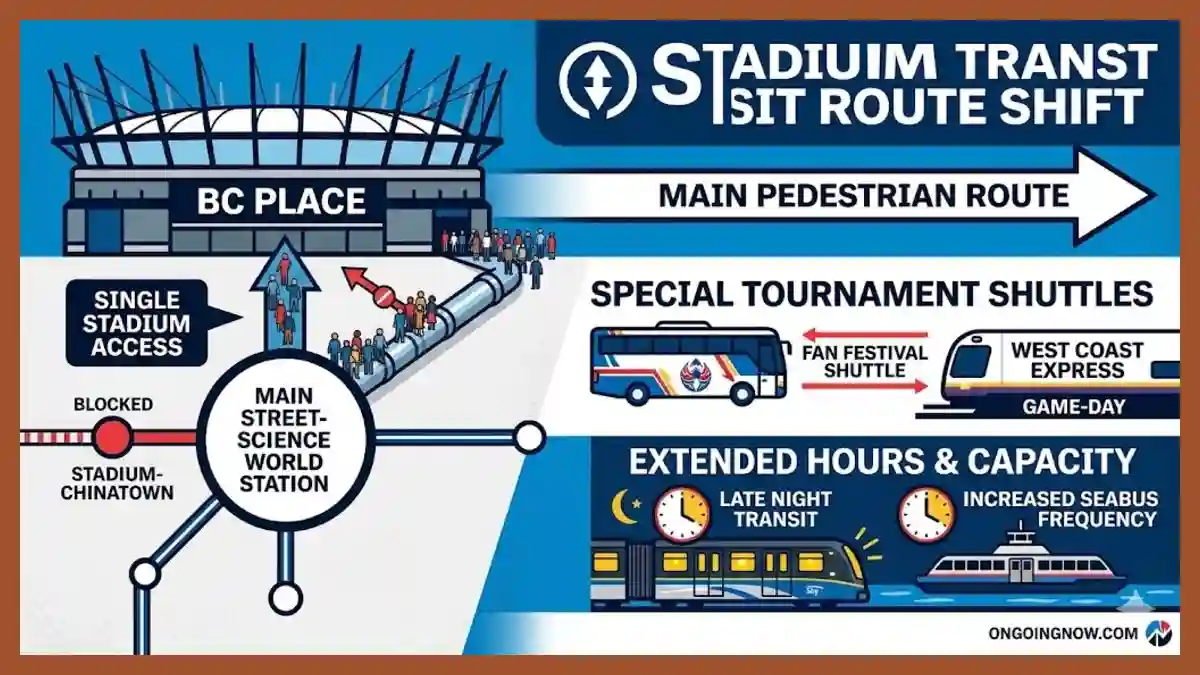
On local matchdays, standard entry and exit routes near the stadium will be heavily modified. Due to strict security perimeters and crowd-control measures coordinated with international sporting bodies and safety agencies, the Expo Line’s Stadium-Chinatown Station and the Canada Line’s Yaletown-Roundhouse Station will not offer direct pedestrian access to BC Place. Instead, regional authorities have designated a mandatory pipeline for all ticket holders to manage flow and prevent localized bottlenecks in the downtown core.
The Mandatory Pedestrian Pipeline
To navigate these structural adjustments, the regional transit framework routes all spectators through a specific urban corridor.
All matchday access to BC Place will be handled via the designated Last Mile pedestrian route, which originates strictly outside the Expo Line’s Main Street-Science World station transit hub. This operational shift establishes a singular, monitored pathway across the Concord Lands to the stadium’s primary entrance near Carrall Street and Pacific Boulevard. To speed departures after the final whistle, empty trains will be systematically staged at the Main Street–Science World platform to clear crowds at a rate of up to one train every two minutes.
Conversely, the Expo Boulevard entrance of Stadium–Chinatown Station will be completely sealed to incoming and outgoing stadium traffic, though passengers can still enter the station via Keefer and Beatty streets for non-stadium regional travel.
Regional Integration Across Land and Water
The transit adjustments extend well beyond the immediate vicinity of the stadium, creating an integrated matrix across Metro Vancouver’s rapid transit, marine, and commuter rail systems.
[North Shore / SeaBus] ──► [Waterfront Station] ──► [Expo Line SkyTrain] ──► [Main Street-Science World] ──► [The Last Mile Route] ──► [BC Place]
Expanded SkyTrain Operations
To accommodate late-night matches beginning at 8:00 PM or later, SkyTrain extended hours match night protocols will be enforced. The Canada, Expo, and Millennium lines will run an additional hour past their standard schedules, operating at peak rush-hour frequencies to prevent station overcrowding.
SeaBus Marine Enhancements
Cross-inlet transit between downtown Vancouver and the North Shore will see a significant capacity increase via the SeaBus ferry service. Sailings will operate at a minimum 15-minute frequency all day, every day throughout the tournament window. This frequency increases to 10-minute intervals immediately before and after matches at BC Place. On late-game nights, SeaBus operations will extend by one hour to align with the revised SkyTrain schedules.
Special Commuter Rail Service
For spectators traveling from eastern outer sub-regions, the West Coast Express tournament tickets system will incorporate rare weekend operations. Special round-trip game-day trains are scheduled for Saturday, June 13, and Sunday, June 21. A westbound locomotive will depart Mission approximately three hours prior to kickoff, with a corresponding eastbound return train departing Waterfront Station two hours after the match concludes.
Centralized Festival and Micro-Mobility Connectivity
Parallel to stadium movements, TransLink and the City of Vancouver have established specific corridors to serve peripheral event sites, notably the vancouver fifa fan festival transit hub located at the Pacific National Exhibition (PNE) Fairgrounds / Hastings Park.
To connect the festival grounds with the broader rail grid, a high-frequency translink vancouver world cup shuttle service—designated as Route 11 Fan Festival Express—will operate every five minutes during peak hours. This dedicated shuttle connects the PNE grounds directly to both the Expo Line (via 29th Avenue Station) and the Millennium Line (via Renfrew Station). Standard urban express routes, including the R5 Hastings RapidBus, will see increased daily frequencies.
Active transportation and micro-mobility operators have modified infrastructure to ease downtown vehicular gridlock. Secure, staffed vancouver bike valet locations fifa fans can use will be established at two strategic points: near the Main Street–Science World Station and inside Callister Park adjacent to the PNE Fairgrounds. These free facilities function via a secure check-in system, alleviating pressure on rapid transit interiors. Furthermore, regional e-scooter share partners are deploying temporary flat-rate passes and designated valet parking drop zones to manage localized trips.
Fare Management and Visitor Logistics
The massive influx of international travelers necessitates streamlined ticketing protocols to prevent long queues at automated vending machines. TransLink recommends that international visitors pre-select specific transit cards for vancouver tourist use to ensure uninterrupted travel across the network.
| Fare Product Type | Best Suited For | Network Validity | Key Operational Feature |
| Adult Compass Card | Long-stay visitors and frequent transit users | SkyTrain, SeaBus, Public Buses, West Coast Express | Reloadable smart card; requires a $6 refundable deposit. |
| Compass DayPass | Intensive, multi-trip single days | SkyTrain, SeaBus, Public Buses | Unlimited travel across all zones until the end of the service day. |
| Contactless / Mobile Wallet | Spontaneous or single-trip travelers | SkyTrain, SeaBus, Public Buses | Direct tap at gates via credit card, Apple Pay, or Google Pay. Note: Regional zone tap-out rules apply. |
Operational Caveat: While contactless credit cards and mobile wallets offer immediate entry at SkyTrain fare gates, international travelers should verify potential foreign transaction fees with their banking institutions. Additionally, users must tap the same physical card or device upon entry and exit to ensure correct zone fare calculation and avoid maximum-fare penalties.
Analysis: The Infrastructure Pressure Test
The decision to completely alter the bc place skytrain matchday route and funnel tens of thousands of passengers exclusively through a single station represents an aggressive crowd-management strategy. By shifting the operational load away from Stadium-Chinatown, authorities are utilizing geographic distance as a natural metering mechanism. The walk along the Last Mile pedestrian corridor distributes the crowd linearly, preventing a simultaneous, overwhelming surge onto station platforms.
This method replicates transit strategies utilized during the 2010 Winter Olympic Games, adapting them to modern density realities. The deployment of roughly 600 additional daily bus trips across the region represents the largest temporary scaling of rubber-tire transit in Metro Vancouver’s recent history. The fiscal resources for this operational surge are drawn directly from the centralized tournament operating budget, shielding everyday municipal transit levies from event-driven inflation.
Regional Impact and Structural Accountability
The scale of the transit deployment carries profound implications for the daily mobility of residents who rely on these corridors for non-event travel. While the plan prioritizes moving spectators efficiently to take transit to bc place, it introduces significant route diversions and street closures, such as the extended closure of Pacific Boulevard, which will alter commercial logistics and commute times across the downtown peninsula.
Public transit officials emphasize that the success of the tournament’s mobility model hinges on public compliance and early structural awareness. “This region knows what it takes to host the world, and our transit system has been part of that success every step of the way,” stated TransLink CEO Kevin Quinn during the framework’s unveiling. “TransLink will leverage that experience to scale up service and move large crowds safely and reliably.”
Frontline security staffing will see a proportional increase. TransLink is deploying supplemental SkyTrain attendants, Transit Police officers, and voluntary ambassadors to assist unacquainted travelers with regional navigation and language barriers. The enforcement of these rigid transit pathways represents a highly calculated operational trade-off, prioritizing regional safety and systematic crowd mitigation over individual route flexibility.
Stay sharp with Ongoing Now!
Source and Data Limitations: Data and structural outlines within this report are derived directly from official transit frameworks published by TransLink (the South Coast British Columbia Transportation Authority) and the City of Vancouver’s “Know Before You Go” operational directives issued between March and May 2026. Figures regarding the 600 additional daily bus trips, SeaBus 10-minute frequencies, and the closure parameters for Stadium-Chinatown and Yaletown-Roundhouse stations are verified via official TransLink media briefings. Direct quotes are sourced from TransLink CEO Kevin Quinn’s public statement on March 3, 2026. This analysis excludes speculative unverified scheduling metrics, unannounced third-party commercial shuttle services, or provisional parking rates not governed by municipal transit authorities.