Europe Cruise Safety Concerns: Navigating Global Shifting Tides
Geopolitical adjustments and security protocols drive Mediterranean itinerary changes and fleet redeployments for 2026.

The landscape of maritime travel is undergoing a significant transition as Europe cruise safety concerns 2026 become a primary factor in fleet deployment and route planning. Current data from the International Maritime Organization (IMO) and major carriers like Royal Caribbean indicate that regional security and the geopolitical impact on cruises are necessitating a departure from traditional sailing patterns. This shift is characterized by a “pencil sketch” approach to maps, where Mediterranean itinerary changes and the avoidance of the Red Sea have become standard operational responses. For travelers, these adjustments represent a move toward more stable Western Mediterranean corridors and Northern European routes as the industry prioritizes risk mitigation over historical transit routes.
Structural Realignment in European Waters
The cruise industry in 2026 is defined by a strategic retreat from volatile maritime corridors, most notably the Suez Canal. Persistent security risks have effectively severed the traditional link between European ports and Asian destinations via the Red Sea. In response, major operators are implementing a massive “redraw” of global maps, shifting capacity away from the Eastern Mediterranean and toward more predictable waters.
The Cruise Lines International Association (CLIA) reports that this redeployment is not merely a temporary pause but a long-term structural change. Ships that previously utilized the Suez Canal are now frequently rerouted around the Cape of Good Hope, a move that adds significant travel time and operational costs. For European tourism, this has resulted in an unexpected surplus of vessel capacity in regions like the Canary Islands and the Western Mediterranean, as lines seek “safe harbor” for their fleets.
The Geopolitical Impact on Cruises and Fleet Deployment
The geopolitical impact on cruises extends beyond mere rerouting; it is fundamentally altering the availability of specific vessels in European markets. When a major transit point like the Red Sea becomes high-risk, the ripple effect reaches as far as the Baltic and North Seas. For instance, MSC Cruises was forced to cancel an entire 2026 Baltic season for the MSC Magnifica due to the need to reposition ships following Middle East security concerns.
This “domino effect” means that a conflict in one region can lead to Royal Caribbean booking cancellations or redeployments in an entirely different hemisphere. Carriers are now prioritizing “stable regions” such as the Norwegian coast and the British Isles, where political fault lines are less likely to disrupt seasonal schedules.
Verified Safety Metrics and Key Operational Data
The following table outlines the current status of major maritime regions as of April 2026, based on official cruise travel advisories 2026 and port authority reports.
| Region | Status (April 2026) | Primary Concern | Operational Change |
| Western Mediterranean | High Activity | Overtourism | Shift to shoulder/winter seasons |
| Eastern Mediterranean | Monitored | Proximity to conflict | Reduced calls to niche ports |
| Red Sea / Gulf | High Risk | Maritime Security | Transits largely suspended |
| Baltic Sea | Stable | Port Accessibility | St. Petersburg remains excluded |
| Norwegian Fjords | Regulated | Environment | Zero-emission rules (effective 2026) |
Note: Data is subject to daily updates by the Global Security & Intelligence teams of individual cruise lines.
Analysis: Why Itinerary Flexibility is the New Standard
The current era of cruising marks the end of the “set-in-stone” itinerary. Industry analysts suggest that Royal Caribbean safety protocols and similar frameworks across the sector now emphasize “operational agility.” This means that while a ship may be scheduled for a specific port, the contract between the passenger and the line explicitly allows for changes based on real-time security assessments.
Royal Caribbean has maintained a transparent stance on this, noting that their Global Security & Intelligence team monitors global events 24/7. When a destination like Labadee or a specific Mediterranean port is flagged, the line opts for immediate suspension. According to an official statement from Royal Caribbean updated in early 2026:
“As part of our ongoing itinerary planning process—which sometimes requires flexibility due to scheduling, port agreements, or operational needs—vessels will be redeployed to ensure the safety and comfort of our guests.”
Understanding Europe Cruise Safety Concerns 2026
Safety concerns in 2026 are multifaceted, involving both traditional security and new environmental mandates. In Northern Europe, the Norwegian government has implemented zero-emission regulations for UNESCO-listed fjords effective this year. This has created a secondary type of “safety” concern—environmental compliance—which is forcing older, less efficient ships out of prized locations like Geirangerfjord.
Furthermore, cruise travel advisories 2026 issued by agencies such as the U.S. State Department and the UK Foreign, Commonwealth & Development Office (FCDO) remain the primary triggers for itinerary modifications. Travelers are increasingly advised to view their port of call as a “pleasant surprise” rather than a guaranteed stop, as lines prioritize avoiding even the periphery of geopolitical tension.
Management of Booking Disruptions and Cancellations
When why are cruises being canceled becomes a question for thousands of passengers, the answer is usually a mix of logistics and safety. In March 2026, Royal Caribbean suddenly canceled multiple sailings on Freedom of the Seas due to redeployment needs. While frustrating for travelers, these moves are often made to shore up capacity in regions with higher demand and lower risk profiles.
Rebooking Options: Most lines offer a “lift and shift” policy, allowing travelers to move their booking to a similar itinerary.
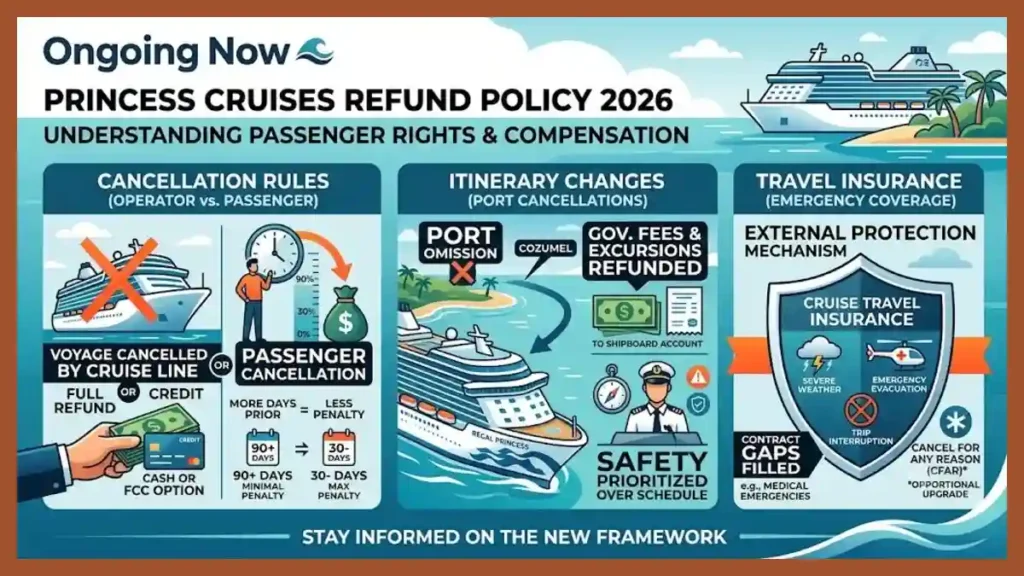
Refund Protocols: Full refunds are typically offered when a line cancels a sailing entirely, though “port skips” rarely trigger full reimbursement.
Travel Insurance Limitations: Experts warn that many standard insurance policies exclude “war or conflict,” meaning claims related to geopolitical cancellations may only be covered under specific “cancel for any reason” (CFAR) riders.
Port Resilience
The shift in cruise patterns has a profound impact on local communities. While some ports in the Western Mediterranean are struggling with overtourism, others in the Eastern Mediterranean are facing economic shortfalls as ship calls dwindle. Associations like MedCruise and Cruise Europe are currently working to benchmark these patterns to help smaller ports survive the volatility of 2026’s maritime map.
The move toward “off-peak” cruising is one solution being used to balance safety and sustainability. By spreading traffic into the winter months, lines can avoid the “bottlenecks” of major hubs like Barcelona or Rome, which are increasingly seen as security and logistical challenges during peak summer months.
Evidence-Based Guidance for 2026 Travelers
For those navigating Europe cruise safety concerns 2026, the consensus among travel experts is to favor stability. Choosing itineraries that stay within a single, stable geopolitical block—such as the British Isles or the Western Mediterranean—significantly reduces the risk of a major rerouting. Additionally, using major air hubs (Rome, Barcelona, Athens) for embarkation provides more “backup options” should a flight or ship schedule change at the last minute.
The current state of the industry reflects a mature response to a complex world. While the “hopeful lines across the atlas” are now more fluid, the rigorous application of Royal Caribbean safety protocols and international maritime law ensures that the horizon remains secure for those willing to adapt to the changing tides.
Stay sharp with Ongoing Now!
Source and Data Limitations: This report is based on data and official statements current as of April 17, 2026. Primary sources include the Royal Caribbean Travel Updates (January–March 2026), official circulars from the International Maritime Organization (IMO), and 2026 deployment reports from Seatrade Cruise News and Cruise Collective. Factual data regarding Red Sea transit suspensions and Baltic season cancellations (MSC) were verified through carrier-specific press releases. Information regarding Norwegian fjord emission rules is based on the 2026 implementation timeline set by the Norwegian Maritime Authority. Limitations: Geopolitical situations are fluid; travel advisories can change hourly. While direct quotes from Royal Caribbean and industry chairs (Simone Maraschi, Klaus Bondham) are verified, specific future itinerary changes remain subject to the discretion of individual cruise line security boards.