Critical Security Fallout: How Instructure’s API Key Rotation Impacts Global Canvas Data
Educational technology infrastructure faces renewed scrutiny following a major cybersecurity incident affecting global learning management.
On May 1, 2026, Instructure, the parent company of the Canvas learning management system (LMS), confirmed a significant cybersecurity incident that has necessitated large-scale API key rotation security measures across its global infrastructure. The breach, which was claimed by the threat group ShinyHunters, involves unauthorized access to personal identifiable information (PII) of students and faculty, including names, email addresses, and student ID numbers. Initial technical reports indicate the group may have utilized a server-side request forgery (SSRF) or a similar cross-site tracking vulnerabilities exploit within the platform’s cloud-hosted environment security layers to gain persistence.
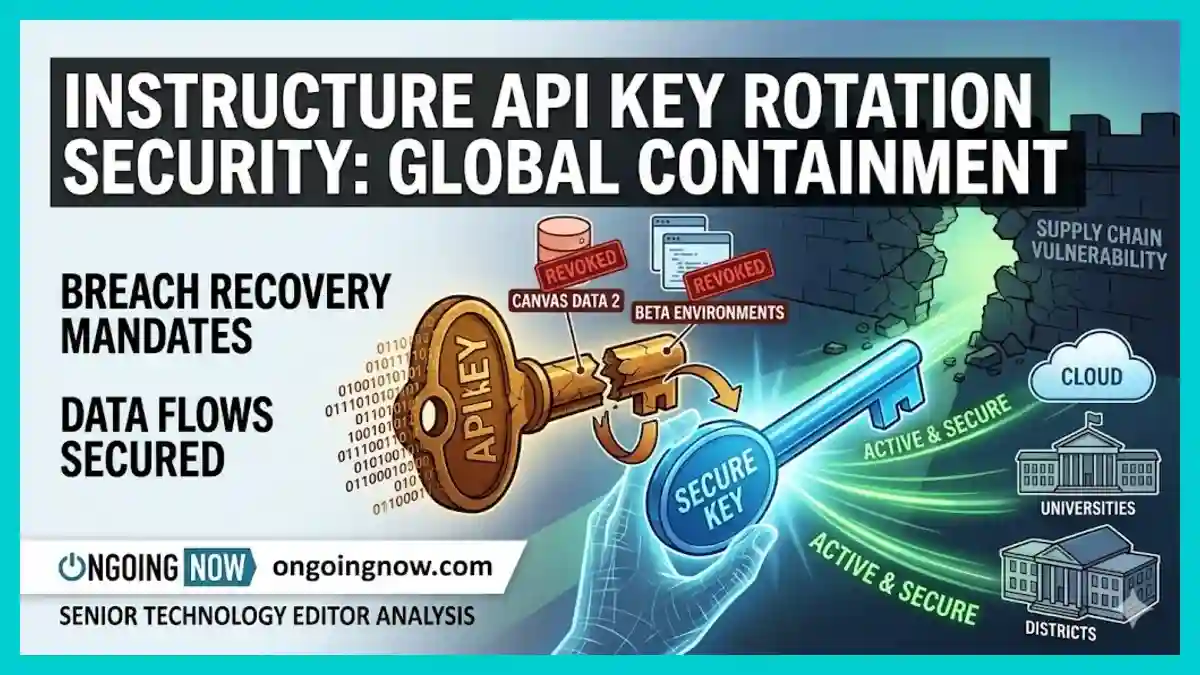
The incident highlights critical third-party supply chain risk, as the compromise of a central SaaS provider has downstream effects on thousands of integrated educational tools. Organizations and institutions are currently navigating an Instructure vulnerability report that details the revocation of privileged credentials and the deployment of security patches to mitigate potential zero-day exploit Canvas risks. As a primary containment strategy, Instructure has mandated API key rotation security for all users of Canvas Data 2 and Canvas Beta, disrupting automated data pipelines to ensure the integrity of the ecosystem.
Technical Scope of the Instructure Data Breach
The breach was first detected by Instructure on April 29, 2026, following suspicious activity within their production environment. Forensic analysis performed by external security firms suggests the attackers targeted the company’s internal service tokens and Salesforce instance, a vector similar to a prior incident in September 2025. This recurring ShinyHunters attack vector suggests a sophisticated focus on cloud infrastructure rather than direct database penetration.
While the company has stated that database encryption standards remained intact for highly sensitive data—preventing the exposure of passwords, financial records, or government IDs—the exfiltration of 3.65 TB of data, as claimed by the threat actor, poses a massive social engineering risk. The exposed student ID numbers and internal messages facilitate highly targeted spear-phishing campaigns, moving the threat from a technical infrastructure issue to an end-user security challenge.
Implementation of API Key Rotation Security
In response to the credential compromise, Instructure initiated a platform-wide reset of application keys and restricted token creation pathways. This mandatory API key rotation security ensures that any tokens previously harvested by the threat actor are rendered useless. For administrators, this means all third-party integrations—ranging from plagiarism detection software like Turnitin to classroom engagement tools like iClicker—must be re-authorized.
| Metric | Details |
| Confirmed Impact | Names, Emails, Student IDs, Internal Messages |
| Data Volume Claimed | 3.65 Terabytes |
| Affected Institutions | Approximately 9,000 |
| Estimated User Scope | 275 Million (Claimed by ShinyHunters) |
| Mitigation Status | API Rotation Active; Critical Patches Deployed |
The disruption to Canvas Data 2 services was a direct result of these containment efforts. By taking these environments offline temporarily, the security team prevented further data egress while validating that the cloud-hosted environment security had been fully restored. The process of re-authorization serves as a manual audit, forcing institutional IT departments to verify the legitimacy of every connected application.
Vulnerability Vectors and Supply Chain Risks
The incident underscores the inherent third-party supply chain risk in modern educational technology. When a core platform like Canvas is compromised, every district, university, and corporate entity using the software inherits the vulnerability. Analysts suggest that the potential use of server-side request forgery (SSRF) allowed the attackers to bypass internal firewalls by tricking the server into making requests to internal-only resources
Furthermore, the focus on SQL injection education platforms in historical threat modeling has shifted toward more complex API-based attacks. While traditional SQL injection remains a threat, the modern “educational attack surface” is increasingly defined by the interconnectedness of cloud services. The zero-day exploit Canvas administrators faced in this instance required a rapid pivot toward hardening the metadata service and rotating secrets that manage identity across distributed cloud nodes.
Analysis: The Sustainability of Centralized LMS Security
From an industry perspective, this event marks a critical turning point for SaaS-based educational infrastructure. The “Shared Responsibility Model” of cloud security is being tested, as institutions realize that even with robust database encryption standards, the metadata and PII stored in the cloud remain high-value targets.
“This second breach in under a year, involving the same threat actor and similar infrastructure components, raises material questions about the adequacy of prior remediation steps,” noted a cybersecurity brief from Dataminr. “The structural vulnerability is consistent: a single SaaS provider holding records for tens of millions of students becomes a single point of failure.”
The industry must now look toward more decentralized authentication methods or more rigorous, automated API key rotation security protocols that do not rely on manual administrative intervention during a crisis.
Human and Societal Impact
The exposure of student data has profound implications for privacy and long-term security. Unlike corporate data, student records often follow an individual for decades. The potential for these records to be used in identity theft or “long-game” social engineering is a primary concern for regulators and privacy advocates.
Heightened Phishing Risk: Students and faculty are advised to be skeptical of any communication requesting “re-verification” or password changes that do not occur through official institutional portals.
FERPA and Regulatory Scrutiny: The breach likely triggers notification obligations under the Family Educational Rights and Privacy Act (FERPA) in the United States and GDPR in Europe.
Trust Erosion: The recurring nature of these incidents at major EdTech providers may lead institutions to demand more transparent security audits and stricter service-level agreements (SLAs) regarding data protection.
Evidence-Based Security Insights
Data from the 2026 Cyber Threat Landscape Report indicates that educational institutions are now the third most targeted sector for data extortion groups. This is largely due to the high volume of “clean” PII (data not previously leaked) and the relatively lower cybersecurity budgets of public school districts compared to financial institutions.
The successful containment of the zero-day exploit Canvas via rapid patching and API key rotation security demonstrates that while the initial breach was significant, the recovery infrastructure was more resilient than in previous years. However, the true test will be the long-term effectiveness of the new token creation pathways in preventing a third occurrence of this ShinyHunters attack vector.
Stay sharp with Ongoing Now!
Source and Data Limitations: This report is based on official security advisories from Instructure (dated May 1–6, 2026), incident status updates from UC Berkeley and Yale University, and threat intelligence briefs from Dataminr and UpGuard. Claims regarding the 3.65 TB data volume and 275 million users originate solely from the threat actor ShinyHunters and have not been independently verified by Instructure or third-party forensic auditors as of May 7, 2026. Technical specifics regarding the exploit vector (SSRF) are based on preliminary industry analysis and remain subject to change pending the final forensic report.