Bluesky Down: Why Feed Server Connection Issues Surge
A breakdown of the April 2026 decentralized network disruptions and the underlying architecture of the AT Protocol.
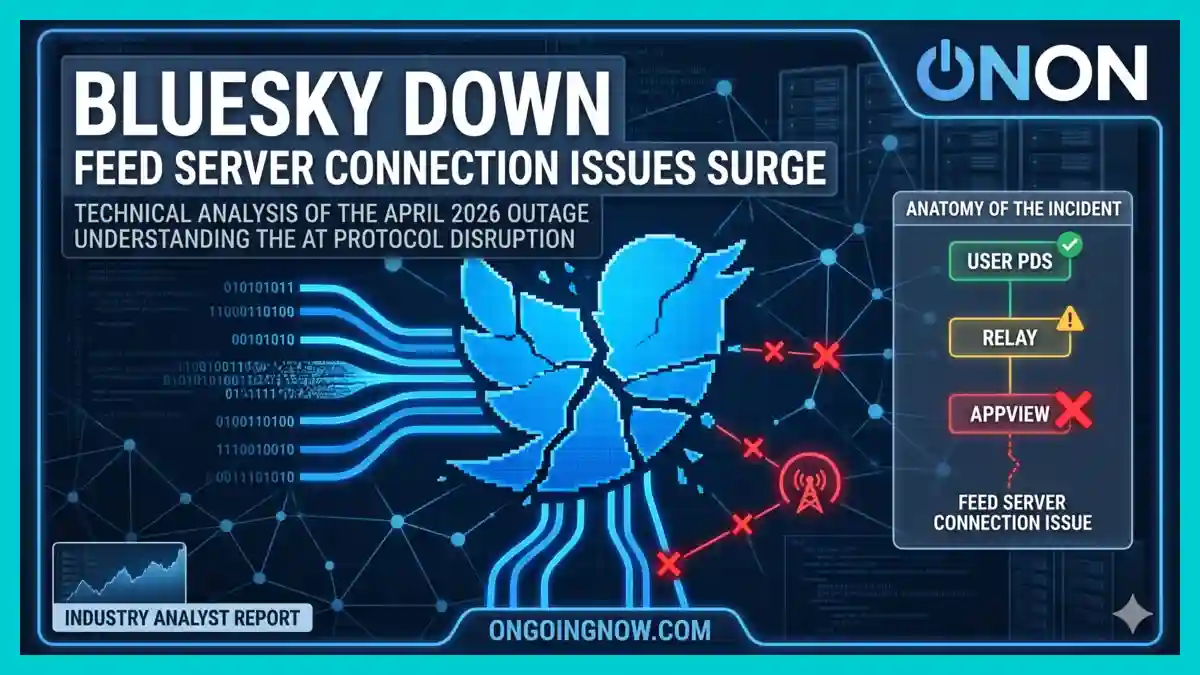
The decentralized social media platform Bluesky experienced significant service disruptions on April 16, 2026, characterized by widespread “feed server connection issue” errors and localized performance degradation. Unlike traditional centralized outages, this incident primarily impacted the Home and Explore feed delivery systems, leaving the core authentication and profile navigation intact for a majority of users. Technical analysis indicates the failure originated within upstream service providers and specific data-routing layers, highlighting the unique vulnerabilities inherent in the platform’s scaling architecture as it transitions toward IETF standardization.
The Bluesky down event, while not a total blackout, rendered the “bsky app” effectively unusable for content discovery across major regions including the United States, the United Kingdom, and parts of Europe. Users reported persistent “Failed to load feeds” messages, even while successfully logged into their accounts. This breakdown serves as a critical case study for the AT Protocol (Authenticated Transfer Protocol), as engineers work to resolve resource saturation issues—specifically ephemeral port exhaustion and TCP socket “TIME_WAIT” lags—that have historically hampered the network’s resilience during traffic surges.
Technical Anatomy of the April 2026 Outage
The disruption observed on April 16 followed a pattern of partial service failure. According to real-time status checkers and internal incident reports, the server status bsky app remained green for basic connectivity, yet the “AppView”—the component responsible for aggregating posts into a readable feed—failed to communicate with regional relays. This created a scenario where the application could not fetch new data, resulting in blank timelines and “Unable to connect” errors.
Data from independent monitoring services and the bsky social outage map indicated that the impact was most severe in high-density user corridors. Unlike the major outages recorded earlier in the month (notably on April 4 and April 6), this incident was attributed to an external upstream provider rather than an internal logic error. However, the recurring nature of these interruptions in 2026 has prompted a deeper look into the platform’s infrastructure.
Analysis: The Vulnerability of Feed Delivery
At the heart of the current issue is the separation of data storage and data presentation. In the AT Protocol, your data lives on a Personal Data Server (PDS), but the feed you see is generated by an “AppView” and indexed by relays. When a feed server connection issue occurs, it is often a breakdown in this “Big Graph” indexer.
| Component | Function | Status During Outage |
| Personal Data Server (PDS) | Stores user posts and identity | Operational |
| Relay (Network Firehose) | Aggregates all global posts | Degraded |
| AppView (Feed Generator) | Packages posts into user timelines | Critical Failure |
| PLC (Identity Directory) | Resolves user handles | Operational |
“The layered architecture of decentralized systems means that even if the core system remains operational, a failure in one component, such as feed delivery, can significantly impair the user experience,” noted analysts from the Global Desk during the April 16 reports.
Managing Regional Service Interruptions
The regional service interruptions seen this month emphasize the challenges of global scaling. Reports from the United Kingdom and the Eastern United States peaked between 06:00 and 15:00 UTC, suggesting that as these regions “woke up” and increased demand on regional CDN nodes, the infrastructure struggled to maintain concurrent connections.
Engineering post-mortems from similar incidents in April 2026 identified “ephemeral port saturation” as a primary culprit. When the system makes thousands of calls to internal data planes, it can run out of available ports to establish new connections. If the “connection pool” is not configured to handle rapid-fire requests, the system enters a “TIME_WAIT” state, effectively locking out new traffic for a fixed period.
Real-Time Status Checkers and User Mitigation
For users encountering an app not loading posts scenario, traditional troubleshooting steps—such as clearing the app cache or restarting devices—often prove ineffective. Because the fault lies server-side within the decentralized routing layer, the resolution depends entirely on the restoration of upstream service stability and the re-indexing of the network firehose.
Experts recommend utilizing real-time status checkers that monitor specific API endpoints (such as api.bsky.app or api.pop2.bsky.app) rather than just the landing page. In the context of social media outages April 2026, these granular tools provide a more accurate picture of whether an issue is global or localized to a specific regional relay.
Official Status Page:
status.bsky.appDecentralized Monitoring:
isdown.app/status/blueskyThird-Party Analytics:
statusgator.com
Human Impact: The Professional Cost of Network Instability
As social media platforms transition from entertainment hubs to professional distribution channels, the stakes for technical reliability increase. For the journalists, researchers, and developers who have migrated to the AT Protocol for its “open” nature, these outages represent more than a minor inconvenience.
The inability to access real-time feeds during a bsky social outage disrupts the flow of verified information, particularly for those relying on the platform for industry-specific news. While the decentralization of Bluesky offers protection against single-point censorship, the current infrastructure shows that it remains susceptible to single-point technical failures in its aggregation layers.
Industry and Regulatory Context
The technical challenges faced by Bluesky in April 2026 coincide with the AT Protocol’s submission to the Internet Engineering Task Force (IETF) for standardization. As the protocol moves toward becoming a universal standard for public data synchronization, its ability to handle “saturation” and “sync 1.1” workflows is under intense scrutiny.
Standardization Goals: Moving portions of the protocol to the IETF aims to receive community feedback on data synchronization.
Resource Management: Recent updates have focused on upgrading relay instances to incorporate more efficient “Sync” mechanisms.
Security Measures: Efforts are underway to implement “Permissioned Data” and multi-factor authentication (2FA) to harden the network against unauthorized access during periods of instability.
Evidence-Based Technology Insights
The data suggests that while the server status bsky app has maintained a 98.4% uptime over the last 90 days, the “utility uptime”—the percentage of time the platform is fully functional—is lower. Frequent “minor” incidents, often lasting 20–30 minutes, suggest a system that is operating near its capacity limits.
What the data shows is a platform in a high-growth “optimization” phase. The transition from a small, invite-only beta to a global network has forced the AT Protocol to confront classic SRE (Site Reliability Engineering) hurdles: connection pooling, batch processing of URIs, and the physical limitations of regional data centers.
Stay sharp with Ongoing Now!
Source and Data Limitations: This report is based on real-time incident data from April 16, 2026, including official status reports from status.bsky.app and third-party monitoring via StatusGator and IsDown.app. Technical analysis of ephemeral port saturation and TCP “TIME_WAIT” issues is sourced from the “April 2026 Outage Post-Mortem” published by Bluesky engineering on April 12, 2026. Data regarding IETF standardization and AT Protocol roadmap is derived from official spring 2026 documentation from atproto.com. Regional outage maps are subject to user-reporting bias and may not reflect the total global impact. Claims regarding “upstream providers” are based on initial corporate statements and are subject to change pending final technical audits.




Greetings,
I was doing a quick review of ongoingnow.com and noticed you might be missing a few required legal pages for modern website privacy laws.
Lawyers usually charge $500+ for this. Most of us just hate dealing with legal paperwork.
We created a straightforward compliance bundle that builds a professional Privacy Policy, Terms of Service, and Cookie Banner tailored to your site in minutes.
Unlike the others, it’s just a $6.99 one-time payment. You get the full bundle instantly.
Check it out here: https://complianceservice.solutions
Best,
Adam