The $425 Million Capital One Settlement Eligibility Check
How the $425 million resolution and the elimination of two-tiered interest rates impact long-term consumer banking rights.
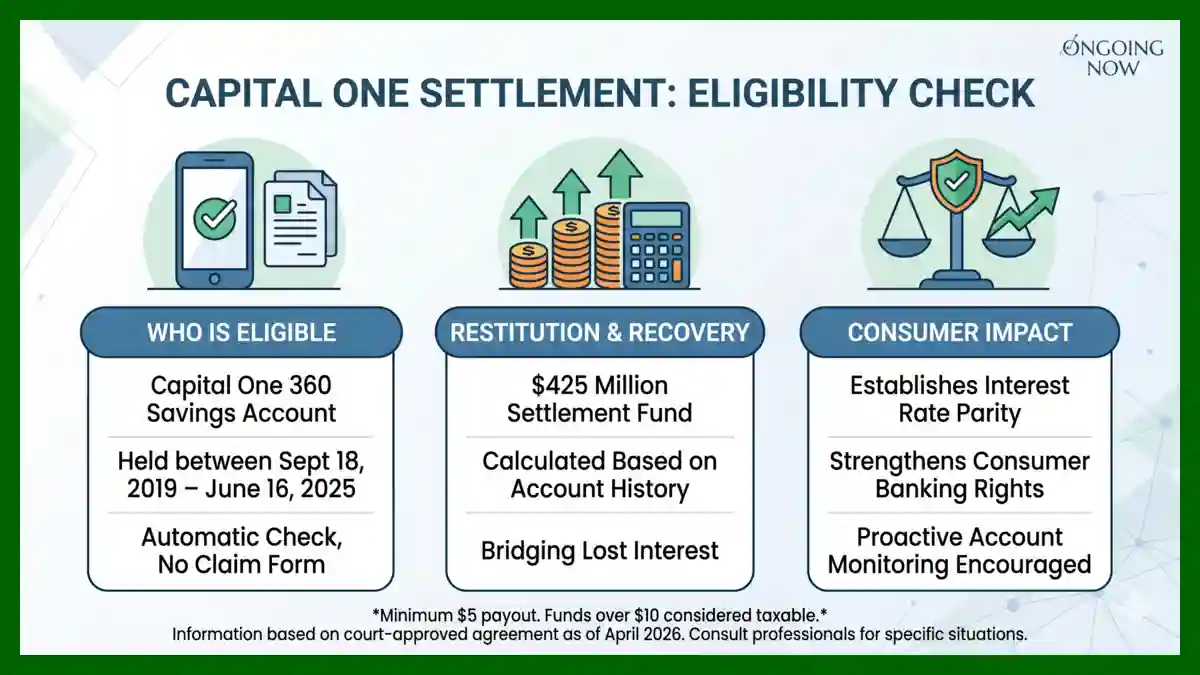
For many Americans, an old savings account is often a forgotten relic of a previous financial chapter. A recent development in the banking sector has turned these idle accounts into a focal point of consumer restitution. As of April 2026, a federal judge has granted final approval to a $425 million settlement involving Capital One 360 Savings accounts. This legal outcome stems from allegations that the bank maintained a “two-tiered” system, keeping long-term customers in older accounts with significantly lower interest rates while offering a nearly identical “Performance” version to new customers.
Understanding the Capital One settlement eligibility check is now a time-sensitive priority for millions. Unlike many class-action lawsuits that require manual filing, this settlement is structured for automatic eligibility. Individuals who held a 360 Savings account between September 18, 2019, and June 16, 2025, are typically identified through bank records. This shift reflects a broader regulatory trend: the expectation that financial institutions must proactively ensure legacy customers are not penalized for their loyalty while newer products receive preferential market rates.
The Landscape of Consumer Rights in Bank Lawsuits
The modern financial era has seen a marked increase in the rigor of consumer rights in bank lawsuits. In this specific case, a bipartisan coalition of attorneys general, including those from New York and Maryland, successfully opposed an initial $300 million proposal, arguing it was insufficient. The final $425 million restitution fund serves as a landmark for how automated banking systems must disclose rate changes. It highlights that “high interest” marketing claims are now being strictly scrutinized by state and federal regulators to ensure they apply to all relevant account holders, not just a selected tier.
These lawsuits typically center on the clarity of disclosures regarding interest-bearing accounts. When interest rates rose nationwide beginning in 2022, many legacy accounts remained stagnant while new products captured the gains. The court-approved resolution does more than just pay out cash; it requires the bank to match interest rates across both the legacy 360 Savings and the 360 Performance Savings accounts. For the everyday consumer, this signifies that a “set it and forget it” strategy should now be backed by a regulatory environment that demands rate parity for identical products.
Determining the Value of Restitution
A common question arising during this final approval phase is: how much is the bank settlement check likely to be? The Settlement Administrator determines individual payouts based on historical account balances during the class period. While there is no universal flat rate, the fund is designed to bridge the gap between the interest actually earned and the interest that would have been earned at the higher “Performance” rate. For many, this represents a lost interest recovery guide in action, where the economic “harm” is quantified by a data-driven calculation.
It is important to note that checks will only be mailed to the primary account holder for amounts of $5 or more. For those with smaller claims, the window to select electronic payment closed on March 30, 2026. This threshold ensures that the administrative costs of the settlement do not outweigh the benefit to the consumer. While a 360 Savings restitution calculator is not officially provided for public use, the $425 million pool is estimated to return an average of several hundred dollars to many long-term, high-balance savers, depending on their specific balance history.
Managing Old Savings Accounts and Hidden Value
The phenomenon of managing old savings accounts has taken on a new level of importance as consumer awareness grows. Many people keep accounts open with low balances simply because the effort to close them seems high, a behavior known as “financial inertia.” However, the 360 Savings litigation demonstrates that there is a tangible cost to neglecting these accounts. Checking for unclaimed bank settlement funds is a critical step for anyone who may have moved or changed contact information since 2019, as the settlement administrator uses the last known address on file.
Financial behaviorists observe that consumers often trust “brand name” institutions to automatically provide the best available terms. This case serves as a reminder that the responsibility for optimization often rests with the individual. Being proactive about a Capital One settlement eligibility check encourages a healthier relationship with one’s balance sheet. It transforms the saver from a passive participant into an active manager of their own capital, ensuring that “zombie” accounts are either yielding competitive rates or being consolidated into more productive assets.
Maximizing Savings Account Yield in a Post-Settlement World
While the settlement addresses past grievances, it also serves as a catalyst for maximizing savings account yield moving forward. As of late April 2026, the requirement to align interest rates means that legacy 360 Savings holders are finally seeing their APY match the higher market-standard rates of the Performance product (currently around 3.20% APY). This “rate matching” is a major victory for consumer transparency, as it prevents banks from quietly substituting products to avoid paying higher interest to their most loyal customer base.
For the savvy saver, this is an opportune moment to look beyond the settlement and evaluate the broader market. The publicity of this lawsuit has led to a more discerning public that looks for “fine print” regarding rate tiers. Consumers are increasingly looking for accounts that offer clear notifications when new tiers become available. This shift in behavior promotes a more competitive banking landscape where institutions must work harder to retain long-term deposits through transparency rather than technical account distinctions.
The Impact of Bank Settlements on Taxes and Recovery
One often overlooked aspect of receiving a payout is the impact of bank settlements on taxes. Generally, the IRS views recovered interest as taxable income in the year it is received. If a settlement check is issued in 2026, recipients should expect a 1099-INT form if the interest portion exceeds $10. This is a critical consideration for personal finance recovery from bank fees and interest, as the net benefit may be slightly lower after tax obligations are met.
Understanding these tax implications prevents surprises during the next filing season. It also highlights the complexity of financial restitution. While the primary goal is to return lost value, the administrative frameworks ensure these payments are integrated into the broader economic system. For many, the settlement represents a successful exercise in consumer advocacy, but it requires a final step of diligence to ensure all reporting requirements are met. This holistic view is essential for maintaining an accurate personal financial record.
Why Behavior Trends Toward Accountability
There is a growing trend of “active consumerism” in the financial sector. Today’s consumers are more likely to participate in a Capital One settlement eligibility check or monitor regulatory updates than in previous decades. This shift is supported by the ease of information sharing and the aggressive stance of state attorneys general. It reflects a broader cultural move toward the expectation that financial institutions should operate with the same level of digital precision and fairness that consumers apply to their own lives.
This behavior is about more than just a check; it is about the principle of fairness in a digital economy. As banking becomes more automated, the risk of systemic errors—such as miscalculated interest or hidden tiered rates—increases. By accepting the benefits of the settlement, consumers validate the oversight work of regulators. This collective vigilance serves as a safeguard for the entire financial ecosystem, ensuring that the rights of the individual are protected even against the largest global financial institutions.
Key Takeaways
Final Approval Granted: As of April 2026, the $425 million settlement is officially approved for distribution to eligible 360 Savings account holders.
Automatic Eligibility: Most current and former account holders (Sept 2019 – June 2025) do not need to file a claim; checks are mailed automatically to the primary holder.
$5 Threshold: Physical checks are only mailed for amounts of $5 or more; the deadline for electronic payment selection for smaller amounts has passed.
Interest Rate Parity: Capital One is now required to match interest rates between legacy 360 Savings and 360 Performance Savings accounts.
Taxable Income: Any recovered interest from the settlement is typically considered taxable income and should be reported to the IRS.
Conclusion: The Value of Vigilance
Navigating the world of bank settlements requires a blend of patience and proactive research. The Capital One settlement eligibility check is a reflection of a larger movement toward financial accountability. By staying informed about consumer rights in bank lawsuits and the status of unclaimed bank settlement funds, individuals can ensure they are not leaving money on the table due to institutional technicalities.
Ultimately, the goal of these legal actions is to reinforce the trust between the bank and the saver. In an era where financial products change rapidly, that trust is the foundation of a stable personal economy. Whether it is through maximizing savings account yield or seeking personal finance recovery from bank fees, the modern consumer has more tools than ever to protect their assets. Staying vigilant is not just about the next check; it is about ensuring your financial future is built on transparency and fairness.
This is for informational purposes only and not personalized financial advice. Consult a licensed professional for your specific situation.
Stay sharp with Ongoing Now!
—
Source and Data Limitations: This report is based on the finalized $425 million settlement agreement approved by federal courts as of April 23, 2026, following litigation in “In re: Capital One 360 Savings Account Interest Rate Litigation.” Data regarding eligibility periods (Sept 18, 2019 – June 16, 2025) and the $5 check threshold is sourced from the official Settlement Administrator and announcements from the Offices of the Attorneys General of New York and Maryland. Current interest rate data (3.20% APY) reflects market conditions as of late April 2026 and is subject to change. Tax information is provided for general context and is not a substitute for professional tax advice.