Mark Cuban Equity Proposal Could Shift Workplace Wealth Across American Companies
Examining how connecting corporate tax rates to employee stock grants could reshape income equality and broad-based equity sharing.
When households review their monthly budgets, the focus almost always lands on paychecks, hourly rates, or annual base raises. Yet, across the corporate landscape, long-term wealth building has historically been driven by equity ownership rather than liquid wages. This growing divide between wage growth and stock market appreciation is prompting a fresh look at how workplace compensation is structured.
Public discourse surrounding the proportional stock options model—a concept recently championed by entrepreneur Mark Cuban—has placed employee equity back in the financial spotlight. The proposal suggests using federal tax incentives to encourage corporations to distribute equity to every worker, rather than limiting stock grants to top executives.
For everyday employees, understanding how equity sharing models operate is becoming an important part of personal finance literacy as labor markets shift toward total compensation packages.
+-----------------------------------------------------------------------------------+
|                        PROPORTIONAL EQUITY DISTRIBUTION MODEL                      |
+-----------------------------------------------------------------------------------+
|  [Executive Tier Example]           [Entry-Level Worker Example]                  |
|  • Base Cash Salary: $1,000,000     • Base Cash Salary: $50,000                   |
|  • Stock Option Grant: $100,000     • Stock Option Grant: $5,000                  |
|  • Equity Ratio: 10% of Cash Pay    • Equity Ratio: 10% of Cash Pay               |
+-----------------------------------------------------------------------------------+
|  MECHANISM: Companies retain preferential corporate tax rates only if equity      |
|  ratios remain equal across all job levels within the organization.               |
+-----------------------------------------------------------------------------------+
Why Asset Ownership Outpaces Standard Wage Growth
To understand why equity compensation is gaining attention, it helps to examine broader wealth trends across the U.S. labor force. According to data from the Federal Reserve, the top 10% of American households hold roughly 88% of all individually owned corporate equities and mutual fund shares. Meanwhile, the bottom 50% of households hold less than 2% of equity wealth, relying almost entirely on cash wages and home equity for their financial net worth.
Over long horizons, equity appreciation has outstripped basic wage increases. Bureau of Labor Statistics (BLS) reporting shows that while median real earnings have grown moderately over recent decades, major broad-market indexes like the S&P 500 have generated long-term historical returns averaging around 10% annually before inflation.
Because traditional compensation models reserve stock options, restricted stock units (RSUs), and stock warrants for senior management, lower- and middle-tier workers miss out on the financial upside when their employers grow.
Executive Compensation Structure: Top leadership packages frequently combine a base salary with performance equity, allowing wealth to compound as company valuation rises.
Rank-and-File Compensation Limits: Salaried and hourly workers receive fixed cash wages that cover immediate living costs but do not build long-term corporate asset value.
The Accumulation Gap: When a firm expands, cash earners receive their standard wages, while equity holders participate directly in corporate expansion.
How the Proportional Stock Options Model Operates
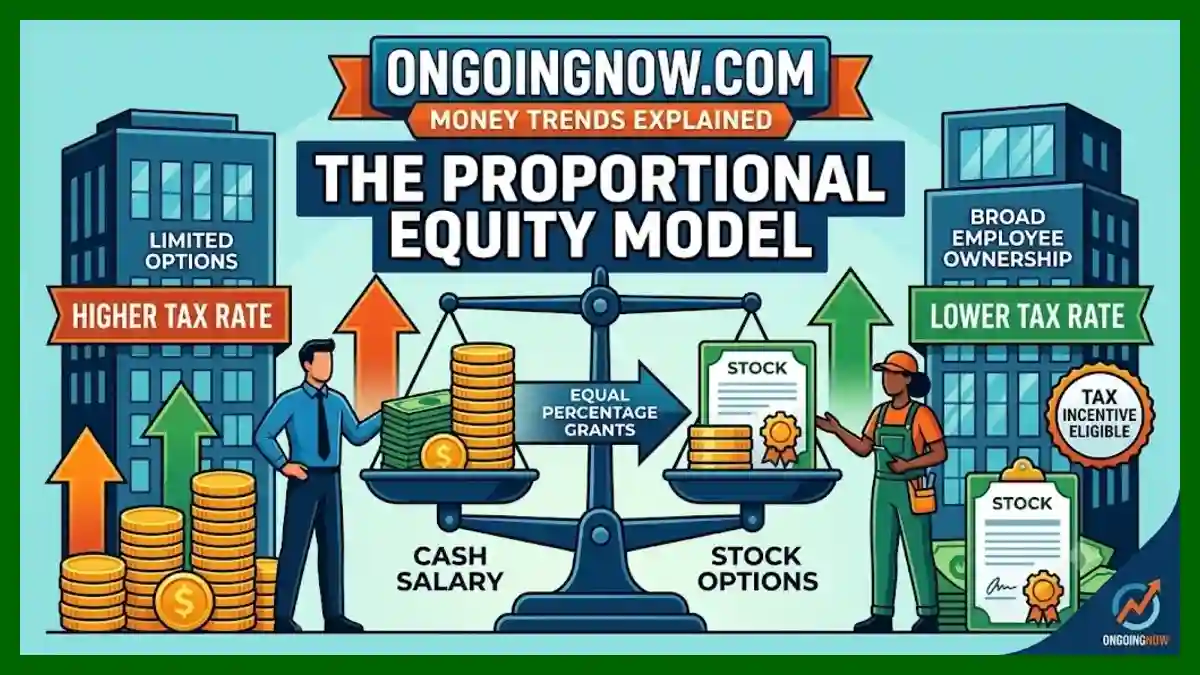
The proportional stock options model addresses equity concentration by linking workforce grants to executive compensation ratios. Instead of prescribing a flat dollar amount for every worker, the model applies a uniform percentage based on annual cash earnings.
Under this model, if a chief executive earning $1 million in cash salary receives $100,000 in stock options, that represents a 10% equity-to-cash ratio. To satisfy the model’s standard, a frontline worker earning $50,000 in base pay must receive $5,000 in stock options—matching the same 10% ratio.
+-----------------------------------------------------------------------------------+
|                   CASH COMPENSATION VS. PROPORTIONAL EQUITY GRANTS               |
+-----------------------------------------------------------------------------------+
|  Feature                  Standard Cash Salary       Proportional Equity Model    |
|  -----------------------  -------------------------  ---------------------------  |
|  Payout Type              Bi-weekly paycheck         Base pay plus stock options  |
|  Growth Path              Subject to wage raises     Tied to company valuation    |
|  Immediate Volatility     None (fixed rate)          Option value varies over time|
|  Tax Treatment            Ordinary income tax        Capital gains upon exercise  |
|  Long-Term Function       Daily living expenses      Asset base accumulation      |
+-----------------------------------------------------------------------------------+
Data from the National Center for Employee Ownership (NCEO) indicates that employee-owned businesses often see higher productivity and lower voluntary turnover. NCEO studies show that frontline workers participating in employee stock ownership plans (ESOPs) accumulate roughly 92% more in retirement savings compared to peers at non-employee-owned firms.
The Role of Federal Tax Incentives in Broadening Equity Access
A key feature of current policy discussions is using federal tax incentives for corporate equity rather than relying on mandates. Under current tax policy established by the Tax Cuts and Jobs Act, the standard U.S. federal corporate tax rate sits at 21%.
Proposals built around broad based equity grants suggest tying access to this baseline tax rate directly to internal equity distribution:
    [ 21% Corporate Tax Bracket ]
                 │
                 ├──► Meets Proportional Rule ──► Retains 21% Corporate Tax Rate
                 │    (Equal option ratio for all employees)
                 │
                 └──► Fails Proportional Rule ──► Reverts to Higher Baseline Rate
                      (Equity grants restricted to executives)
By linking tax bracket eligibility to workforce-wide options grants, the strategy aims to create a clear financial motivation for corporate boards. For businesses, lower corporate tax liabilities can help offset the share dilution that occurs when issuing stock options to a larger workforce.
Balancing Cash Compensation and Stock Options in Household Budgets
While broad based employee stock ownership plans offer wealth-building potential, stock options serve a fundamentally different purpose than liquid paychecks. Financial planners emphasize that equity grants cannot substitute for the stable cash required to pay rent, buy groceries, or service debt.
A stock option grants an employee the right to buy corporate shares at a fixed “strike price” after a specific waiting period. If the company’s valuation rises above that strike price, the option holds financial value. If the share price drops below the exercise threshold, the option remains “underwater” and yields no immediate gain.
   [ Cash Paycheck ] --------------------─► Immediate Bills (Rent, Utilities, Food)
               │
               ▼
   [ Stock Option Grant ] ───────────────► Long-Term Assets (Subject to Vesting Schedules)
When evaluating job offers or workplace benefit changes that involve stock options versus cash compensation, several trade-offs require attention:
Immediate Liquidity vs. Future Upside: Cash pay provides guaranteed purchasing power today, while stock options represent conditional wealth that may take years to realize.
Market and Company Risk: Options fluctuate in value based on market volatility and business operational performance.
Tax Considerations: Exercising stock options creates specific tax liabilities, depending on whether the options are Incentive Stock Options (ISOs) or Non-Qualified Stock Options (NSOs).
Understanding Vesting Schedules and Financial Exposure
For workers participating in broad based equity grants, unlocking actual financial value depends heavily on the employee stock options vesting schedule. Vesting schedules determine when employees gain full ownership rights to their granted options or stock awards.
According to survey data from the Plan Sponsor Council of America, standard corporate equity vesting schedules typically span three to four years:
Gradual Vesting: Employees gain ownership of a set percentage of their options each year (for example, 25% annually over four years).
The One-Year Cliff: Many plans require employees to complete one full year of service before any portion of their stock options vests. If a worker leaves before reaching that milestone, unvested options are forfeited.
Company Concentration Risk: Holding significant equity in an employer ties both wage income and personal savings to the financial performance of a single company.
Key Consumer Considerations for Evaluating Workplace Equity Offers
When assessing a job offer or compensation package that includes stock options, employees can look at several clear factors:
Base Salary Adequacy: Ensuring liquid cash pay fully covers daily living costs and short-term emergency savings before factoring in option values.
Grant Terms and Vesting: Reviewing the explicit vesting timeline, cliff provisions, and post-termination exercise windows.
Company Stage and Liquidity: Distinguishing between publicly traded shares, which can be sold easily on open markets, and private company options, which may remain illiquid for long periods.
Tax Timing: Planning for tax obligations that occur when options are exercised or when vested stock is sold.
Investment Diversification: Avoiding over-concentration by periodically balancing employer stock with broader investment funds once shares vest.
Key Takeaways
Targeting Wealth Gaps: Proportional equity grants aim to address wealth inequality by giving all employees access to company growth previously limited to leadership teams.
Proportional Ratios: The model matches the equity-to-cash percentage provided to executives, applying that same ratio to rank-and-file wage levels.
Tax Code Alignment: Policy discussions focus on using lower corporate tax rates as an incentive for companies to issue broad-based stock options voluntarily.
Liquidity vs. Growth: Stock options offer long-term asset accumulation but cannot replace the liquid pay needed for everyday living expenses.
Vesting Awareness: Understanding vesting schedules, exercise rules, and concentration risk is essential when accounting for equity in a broader personal financial strategy.
Stay sharp with Ongoing Now!
Source and Data Limitations: This article relies on public policy proposals, general economic data from the Bureau of Labor Statistics (BLS) and Federal Reserve, and equity research from the National Center for Employee Ownership (NCEO). Corporate equity structures, tax implications, and vesting schedules vary widely based on individual employer plans, state laws, and federal tax regulations. Stock options carry market risks, may lose value, and are not guaranteed financial returns. This content is for informational purposes only and does not constitute personalized financial, tax, or legal advice. Consult a licensed financial professional for your specific situation.