Social Security Benefit Trends and Retirement Income Strategy
How current policy discussions and the 2026 tax limit shape long-term retirement income strategy
The transition from a full-time salary to a fixed budget is a shift many Americans approach with a mix of anticipation and apprehension. For many households, the centerpiece of this transition is the monthly Social Security check, a benefit that serves as the foundation for the modern retirement income strategy. As inflation persists and economic projections evolve, more individuals are closely monitoring how potential legislative changes—such as discussions around a $50000 social security cap—could impact their future purchasing power and lifestyle.
Understanding these shifts is essential because Social Security is no longer viewed in isolation; it is now a variable that must be integrated into a broader financial framework. Whether a household is navigating the rising costs of healthcare or adjusting for a longer lifespan, the stability of federal benefits remains a primary concern. Recent discourse surrounding benefit structures and tax limits has prompted a renewed focus on how high-earning years influence the eventual payout received during the golden years.
This is for informational purposes only and not personalized financial advice. Consult a licensed professional for your specific situation.
The Evolution of the Retirement Income Strategy
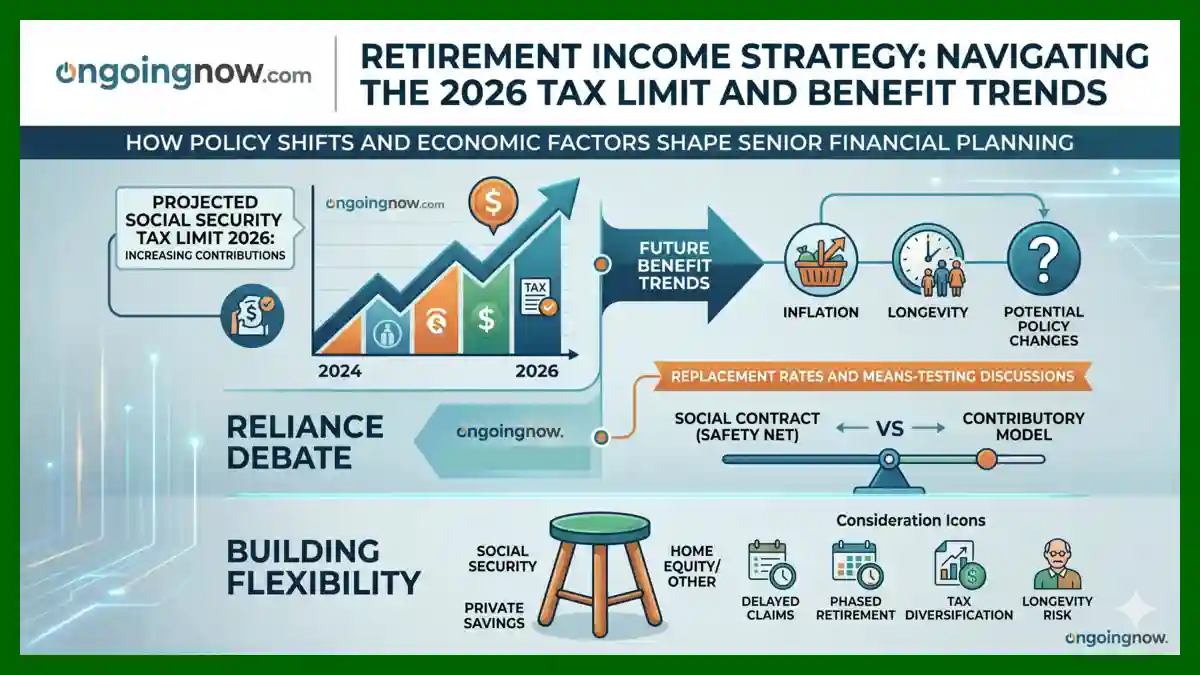
For decades, the “three-legged stool” of retirement—Social Security, private pensions, and personal savings—has been the standard model for financial security. However, as private pensions become less common, the retirement income strategy for the average worker has shifted toward a greater reliance on defined-contribution plans and federal benefits. This shift places a higher premium on understanding the mechanics of how benefits are calculated and the factors that might limit them in the future.
The Social Security Administration (SSA) uses a formula based on an individual’s highest 35 years of indexed earnings to determine the Primary Insurance Amount (PIA). Because the system is designed to be progressive, replacing a higher percentage of income for lower earners than for higher earners, those in the upper-income brackets often find that Social Security covers a smaller fraction of their pre-retirement expenses. This reality necessitates a more nuanced approach to managing supplemental funds to bridge the gap.
Current trends suggest that more retirees are delaying their claims to maximize their monthly checks. Waiting until age 70 can increase the monthly benefit by approximately 8% for each year past the full retirement age. This behavior reflects a growing awareness that a robust retirement income strategy often prioritizes the guaranteed, inflation-adjusted nature of Social Security over the immediate liquidity of early claims, especially as life expectancy trends upward.
Understanding the Social Security Tax Limit 2026
A critical component of the federal benefit system is the “taxable maximum,” which is the amount of annual earnings subject to the Social Security payroll tax. As we approach the social security tax limit 2026, many workers and employers are observing how these adjustments affect take-home pay and future benefit accrual. Each year, the SSA adjusts this limit based on changes in the national average wage index, ensuring the system’s revenue scales with economic growth.
For 2026, the projected adjustments reflect the ongoing trend of wage inflation. When the tax limit increases, high-income earners contribute more to the system, which in turn can lead to a higher maximum benefit upon retirement. However, because the benefit formula has a “bend point” structure, the additional credits earned on income near the tax ceiling provide a lower rate of return compared to credits earned on the first few thousand dollars of monthly income.
This tax structure is often a focal point for policy discussions regarding the long-term solvency of the Social Security Trust Funds. Some proposals suggest raising or even eliminating the cap entirely to bolster the system’s finances. For those currently in the workforce, the social security tax limit 2026 serves as a reminder that the ceiling on contributions also acts as a ceiling on the benefits the system will eventually provide, necessitating external savings for those with higher income levels.
The Context of a $50000 Social Security Cap
In recent policy debates, the concept of a $50000 social security cap has surfaced as a point of discussion among economists and legislators. While not currently a law, the idea of capping annual benefits—or, conversely, changing how high-income earnings are taxed—represents a shift in how the government might manage the program’s sustainability. A cap at this level would primarily affect those who have consistently earned at or above the taxable maximum throughout their careers.
The introduction of a $50000 social security cap would fundamentally alter the “replacement rate” for high-income retirees. Currently, the maximum possible benefit for someone retiring at age 70 in 2024 is approximately $58,476 annually. If a cap were set lower, individuals who contributed the maximum into the system might receive a lower return on those contributions than they originally anticipated. This highlights the importance of diversifying income sources beyond federal programs.
What this trend shows is a movement toward means-testing or benefit-trimming for the wealthiest recipients to preserve the program for those who rely on it most. While these discussions are often speculative, they influence consumer behavior today. High earners are increasingly looking toward tax-advantaged accounts, such as 401(k)s and IRAs, as a hedge against potential future legislative changes that could limit the scope of their federal benefits.
High Income Retirement Planning and Benefit Limits
For those categorized under high income retirement planning, the reliance on Social Security is typically much lower than the national average. However, the “MAX” benefit still represents a significant, COLA-adjusted income stream that provides a “floor” for a household’s budget. When proposals like the $50000 social security cap are discussed, it forces these households to re-evaluate their withdrawal rates from private portfolios.
The primary challenge in high income retirement planning is the impact of taxes and Medicare premiums. High Social Security benefits can trigger the “tax torpedo,” where a large portion of the benefit becomes taxable, and can also lead to higher Medicare Part B and Part D premiums through the Income Related Monthly Adjustment Amount (IRMAA). These interactions mean that a higher gross benefit doesn’t always translate to the same increase in net spendable income.
Consequently, affluent retirees are increasingly focusing on the timing of their income. By managing the mix of taxable, tax-deferred, and tax-free assets, they aim to stay below certain thresholds that would trigger higher costs. The potential for a $50000 social security cap adds another layer of complexity, as it suggests that the “guaranteed” portion of a high-earner’s income could be subject to more stringent limits than previously expected.
Managing Retirement Funds in a Changing Landscape
Effective managing retirement funds requires a balance between liquidity for immediate needs and growth for future protection against inflation. As policy discussions evolve, the “bucket approach” has gained popularity. This involves segmenting assets into short-term cash, mid-term fixed income, and long-term equities. In this model, Social Security acts as a recurring cash infusion that reduces the amount needed to be withdrawn from the “growth” buckets during market downturns.
The uncertainty regarding a $50000 social security cap or changes to the social security tax limit 2026 emphasizes the need for flexibility. If the federal benefit ceiling remains stagnant or is lowered in real terms, the “gap” that must be filled by personal savings grows. Consumers are responding by being more conservative with their initial withdrawal rates, often moving away from the traditional 4% rule toward more dynamic spending strategies that adjust based on market performance and legislative outlooks.
Furthermore, managing retirement funds today involves a deeper look at longevity risk. With more Americans living into their 90s, the concern isn’t just about the first ten years of retirement, but the third decade. A fixed benefit like Social Security is invaluable in these later years, but if it is capped or reduced for higher earners, the burden of funding extreme longevity falls entirely on private savings and long-term care insurance.
Personal Finance for Seniors: The Behavioral Shift
The landscape of personal finance for seniors is currently defined by a “wait and see” mentality. Many are delaying major life changes, such as downsizing their homes or making large gifts to heirs, until there is more clarity on federal tax and benefit policies. This cautious behavior is a direct reaction to the volatility of the post-pandemic economy and the looming adjustments to the social security tax limit 2026.
We are also seeing a trend toward “phased retirement,” where individuals continue to work part-time well into their 60s or 70s. This isn’t always driven by a lack of savings, but rather a desire to keep the retirement income strategy flexible. By earning a small income, seniors can delay taking Social Security, thereby increasing their future monthly check and reducing the immediate drain on their invested capital.
This behavioral shift also includes a more rigorous focus on healthcare costs. According to recent surveys, healthcare remains the top financial concern for retirees. The interaction between Social Security benefits and Medicare costs means that any change in the benefit structure—like a $50000 social security cap—could have a “double-whammy” effect on a senior’s discretionary income if healthcare premiums continue to rise.
Financial Insight: Why the $50000 Threshold Matters
The discussion of a $50000 social security cap is more than just a fiscal exercise; it represents a debate over the “social contract” of the program. For years, the system was sold as a “contributory insurance” model where you get out what you put in. A hard cap would move the system closer to a “social safety net” model.
Replacement Rates: For an average earner, Social Security replaces about 40% of pre-retirement income. For a high earner, a $50000 social security cap could drop that replacement rate significantly below 20%.
Political Feasibility: Capping benefits for the “wealthy” is often more politically palatable than raising taxes on the middle class, which is why these proposals persist in policy circles.
Economic Impact: If benefits are capped, it may reduce the overall consumption of high-income retirees, who often drive significant economic activity in the travel and leisure sectors.
What to Consider for the Future
When looking ahead to the social security tax limit 2026 and potential benefit changes, there are several environmental factors for households to keep in mind. The stability of one’s retirement income strategy often depends on how well it can absorb shocks—whether those shocks are market-based or policy-based.
Legislative Risks: Policies regarding Social Security are subject to the political climate. While drastic changes are rare, incremental shifts in the social security tax limit 2026 or benefit formulas are common.
Inflation Protection: Social Security is one of the few income sources with a built-in Cost of Living Adjustment (COLA). Any cap, such as a $50000 social security cap, must be evaluated based on whether it would also be indexed for inflation.
Diversification: Over-reliance on any single source of income—whether it’s a federal benefit or a specific stock—increases vulnerability. A balanced retirement income strategy considers multiple “income floors.”
Key Takeaways
Policy Awareness: Understanding the social security tax limit 2026 helps high earners anticipate their future benefit maximums and current tax liabilities.
Strategy Integration: A successful retirement income strategy treats Social Security as one piece of a larger puzzle, rather than the sole solution.
Behavioral Adaptation: Rising uncertainty is leading more individuals to delay benefit claims and maintain part-time employment to preserve capital.
Cap Consequences: Discussions around a $50000 social security cap highlight a potential shift toward a more safety-net-focused benefit structure for high-income earners.
Longevity Focus: Managing funds for a 30-year retirement requires accounting for healthcare inflation and potential legislative benefit adjustments.
As the economic landscape continues to shift, the way we think about personal finance for seniors must also evolve. The days of “set it and forget it” retirement planning are largely over, replaced by a need for active monitoring of tax limits and benefit proposals. By staying informed about trends like the social security tax limit 2026 and the potential for a $50000 social security cap, individuals can better position themselves for a stable and predictable financial future.
This is for informational purposes only and not personalized financial advice. Consult a licensed professional for your specific situation.
Stay sharp with Ongoing Now!
Source and Data Limitations: This article is based on publicly available data from the Social Security Administration (SSA), including the Annual Report of the Board of Trustees and the 2025/2026 projected wage index adjustments. Policy discussions regarding benefit caps are sourced from congressional budget proposals and non-partisan think-tank analyses of Social Security solvency. Please note that legislative proposals are subject to change and may not result in law. Data regarding “high income retirement planning” is based on general economic trends and may not reflect specific regional or individual variations. All financial projections are based on current laws and historic inflation averages, which are subject to future volatility.