2026 Tax Interest Rates: Why Daily Compounding Stuns
A guide to the shifting interest landscape, daily compounding mechanics, and the long-term impact of tax debt accumulation.
Quick Takeaways: The 2026 Tax Landscape
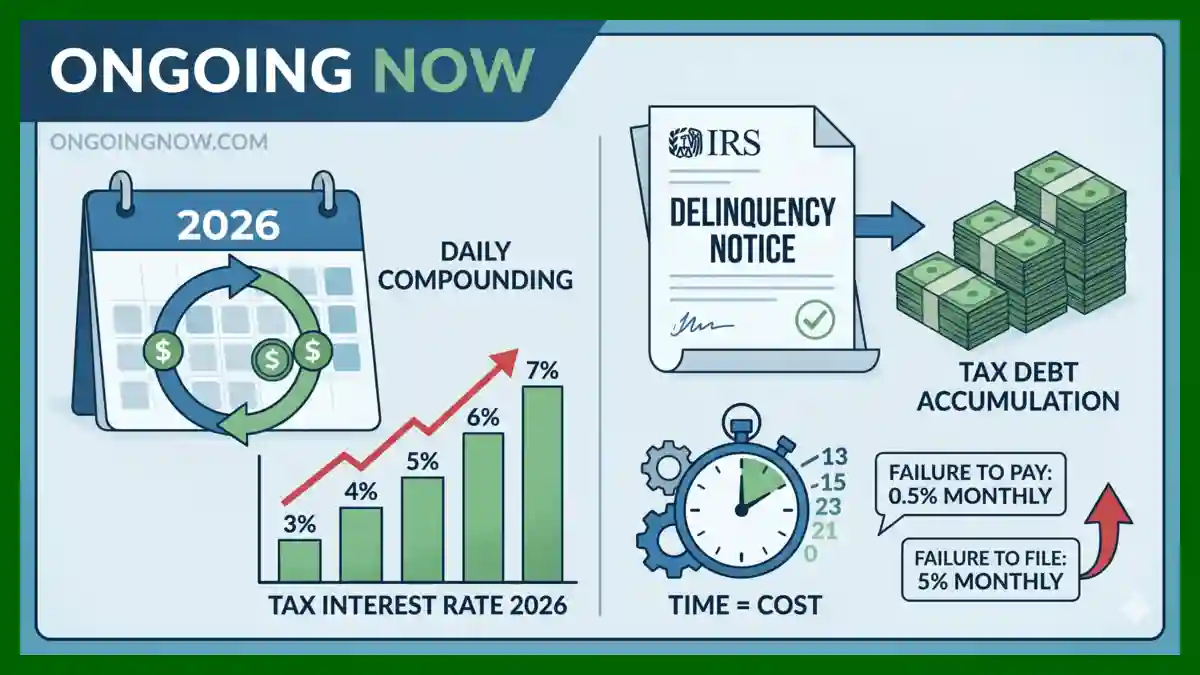
Quarterly Adjustments: The Internal Revenue Service (IRS) interest rate for individual underpayments sits at 7% for the first quarter of 2026 and shifts to 6% for the second quarter.
The Penalty Floor: For returns more than 60 days late, the minimum penalty for late taxes is the lesser of $525 or 100% of the tax owed.
The Compounding Factor: Unlike many consumer loans, tax interest involves daily compounding interest 2026 cycles, meaning the debt grows every 24 hours.
Filing vs. Paying: The penalty for failing to file a return is generally ten times higher than the penalty for failing to pay the balance.
The Mechanics of 2026 Tax Interest Rates
In the current economic environment, the Internal Revenue Service (IRS) adjusts its interest rates quarterly based on the federal short-term rate. For the opening months of 2026, taxpayers face a dual-rate environment. According to Revenue Ruling 2026-5, the interest rate for individual underpayments began the year at 7% (Q1) before adjusting to 6% for the second quarter beginning April 1.
These rates are not arbitrary. Under Section 6621 of the Internal Revenue Code, the underpayment rate is calculated by taking the federal short-term rate—which was rounded to 3% in early 2026—and adding three percentage points for individuals. For large corporate underpayments exceeding $100,000, the stakes are higher, with rates reaching 8% in the second quarter.
Understanding these shifts is vital because tax interest is not static. When a taxpayer receives an IRS delinquency notice, the balance reflected is a snapshot in time. Because of daily compounding interest 2026 protocols, the amount required to satisfy the debt changes daily, often leading to a “moving target” effect for those attempting to settle older balances.
Breaking Down the Minimum Penalty for Late Taxes
For many Americans, the financial weight of a late return is felt most acutely through the minimum penalty for late taxes. The tax code provides a specific “floor” for those who delay filing by more than 60 days. For returns required to be filed in 2026, this minimum is $525 or 100% of the unpaid tax, whichever is smaller.
This fixed minimum ensures that even small balances can incur significant costs if the administrative requirement of filing is ignored. It reflects a broader institutional priority: the Department of the Treasury emphasizes timely documentation as much as timely payment.
Comparison of 2026 Penalty Thresholds
| Penalty Type | Rate/Amount | Maximum Cap |
| Failure to File (FTF) | 5% per month | 25% of unpaid tax |
| Failure to Pay (FTP) | 0.5% per month | 25% of unpaid tax |
| Combined Penalty | 5% total per month | 25% total for that period |
| 60+ Day Late Filing | Lesser of $525 or 100% tax | N/A (Fixed Floor) |
The Anatomy of Tax Debt Accumulation
The process of tax debt accumulation is often described by financial professionals as a “quiet multiplier.” It is rarely a single penalty that creates a burden; rather, it is the synchronization of multiple charges. When a taxpayer fails to both file and pay, the IRS applies a combined penalty and interest structure.
In months where both the failure-to-file and failure-to-pay penalties apply, the 5% failure-to-file penalty is reduced by the 0.5% failure-to-pay penalty. This results in a 4.5% charge for filing late and a 0.5% charge for paying late, totaling 5% for the month. While this prevents “double-dipping” on the monthly percentage, it does not stop the separate accrual of daily interest on the entire balance.
The Role of Daily Compounding
One of the most misunderstood aspects of tax debt is how daily compounding interest 2026 functions. Most consumer credit cards compound monthly, but the IRS compounds interest daily on the tax due, as well as on any assessed penalties.
This creates a “cascading” effect:
Month 1: A penalty is assessed on the original tax owed.
Day 2: Interest is charged on the original tax plus the first day’s interest.
Month 2: A new monthly penalty is added. Now, interest begins to accrue on the original tax, the previous month’s penalty, and all accumulated interest.
This mathematical reality is why an IRS delinquency notice can show a balance significantly higher than the original tax liability in a relatively short period.
Failure to Pay vs. Failure to File: Why the Distinction Matters
The difference between failure to pay vs. failure to file is one of the most critical distinctions in personal finance journalism. The penalty for not filing is ten times greater than the penalty for not paying (5% vs 0.5% monthly).
From a behavioral standpoint, many taxpayers avoid filing because they do not have the funds to pay the resulting bill. However, the data suggests this is the more expensive path. By filing a return—or an extension—the taxpayer can eliminate the 5% monthly penalty entirely, leaving only the 0.5% failure-to-pay penalty and the prevailing 2026 tax interest rates.
What to Consider: Navigating the Delinquency Notice
When a taxpayer receives an IRS delinquency notice, such as a CP14 or CP501, it serves as the formal start of the collection process. These documents outline the specific amount of tax debt accumulation and provide a deadline for response.
Key considerations for readers include:
Verification of Accuracy: Errors can occur in transcript processing. Official statistics from the National Taxpayer Advocate suggest that a meaningful percentage of notices can be resolved through clarifying documentation.
Interest vs. Penalties: While the IRS has the authority to abate (waive) penalties for “reasonable cause” (such as a natural disaster or serious illness), it rarely has the legal authority to waive interest. Interest is viewed as the “cost of money” and generally continues to accrue as long as a balance exists.
Payment Priority: When a payment is made, the IRS typically applies it to the tax principal first, then to penalties, and finally to interest. This is mathematically advantageous for the taxpayer, as reducing the principal slows the rate of future interest accrual.
Economic Trends and Consumer Behavior
The rise in 2026 tax interest rates to the 6–7% range reflects a broader economic trend of “higher for longer” interest rates across the U.S. economy. For the past decade, tax interest remained near 3%, making tax debt a secondary concern for many. At 7%, however, tax debt now carries a cost similar to many personal loans or high-yield savings accounts, changing the “opportunity cost” of carrying a balance.
Economic data from the Federal Reserve and the Bureau of Economic Analysis shows that as borrowing costs rise, consumers must be more strategic about which debts they carry. Tax debt is unique because it is often “unsecured” yet carries significant collection powers, including the ability to levy bank accounts or garnish wages—actions typically preceded by multiple notices and a formal “Intent to Levy.”
Long-Term Financial Thinking
Managing a relationship with the IRS requires a shift from “avoidance” to “administration.” The goal of the penalty and interest structure is to encourage compliance with the system’s deadlines. In 2026, the cost of non-compliance has reached a point where it can meaningfully impact a household’s long-term savings goals or retirement planning.
Thoughtful money thinking involves recognizing that a tax return is a legal document, while the tax payment is a financial obligation. Keeping them separate in one’s mind—filing the document even when the funds for the obligation are missing—is a proven strategy to mitigate the most aggressive penalties.
Key Takeaways
Rate Awareness: Be mindful that 2026 tax interest rates are currently between 6% and 7% for individuals, compounding daily.
The 60-Day Rule: Crossing the two-month mark without filing triggers the minimum penalty for late taxes, which can be over $500 even for tiny balances.
Prioritize Filing: If funds are low, filing the return is the most effective way to stop the 5% “failure to file” penalty from mounting.
Compounding Debt: Understand that interest is charged on the penalties themselves, making early action more impactful than late action.
Professional Guidance: While interest is generally firm, penalty abatement may be possible for those with a valid reason for their delay.
The financial environment of 2026 demands a higher level of vigilance regarding tax deadlines. As interest rates remain elevated, the cost of delay is no longer just a minor fee—it is a significant drain on personal net worth.
Stay sharp with Ongoing Now!
Source and Data Limitations: This article is based on Internal Revenue Bulletin (IRB) 2026-8, Revenue Ruling 2026-5, and IRS procedural documents regarding Section 6621 and 6651 of the Internal Revenue Code. Data regarding interest rates for the third and fourth quarters of 2026 is not yet released by the Department of the Treasury and is subject to change based on federal short-term rate adjustments. All figures, including the $525 minimum penalty, are based on 2026 inflation-adjusted figures provided by official IRS communications. This content is for informational purposes only and does not constitute legal or financial advice. Readers should consult with a qualified tax professional or the official IRS website (irs.gov) for the most current regulations and personal applications.