How Early Retirees Can Protect Savings as the ACA Subsidy Cliff Reemerges
As enhanced federal marketplace healthcare assistance expires, pre-Medicare retirees face steep premium spikes without strict income optimization.
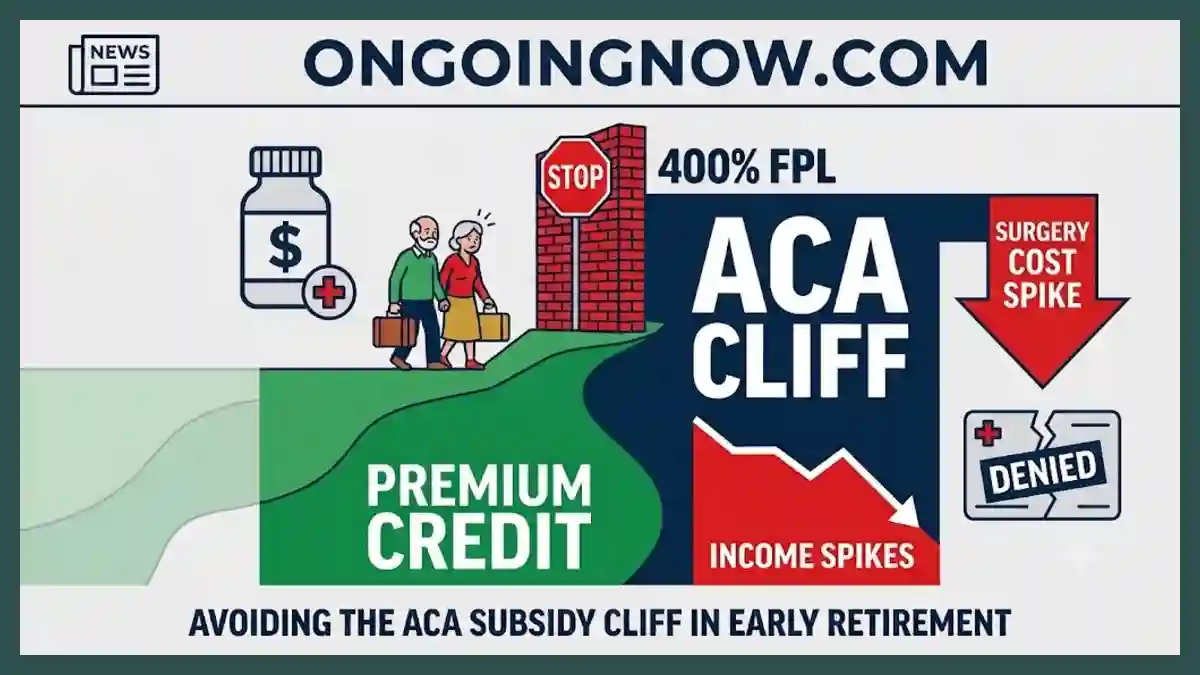
For individuals navigating healthcare costs early retirement planning, avoiding the aca subsidy cliff has become critical following the expiration of enhanced subsidies. Understanding aca federal poverty level thresholds 2026 is central to early retiree health insurance strategies as federal rules revert to original statutory caps. Utilizing tools like a health insurance marketplace calculator kff helps in managing taxable income before age 65 to prevent full-price exposure. Without proactive health insurance premium optimization, households face steep affordable care act premium spikes 2026. This comprehensive regulatory update explores the mechanics of aca premium tax credits early retirement structures and the structural early retirement healthcare subsidy phase out affecting pre-Medicare enrollees across the United States.
According to data compiled by the Centers for Medicare & Medicaid Services (CMS) and analyzed by the Urban Institute, the expiration of temporary premium caps has drastically altered the individual health coverage market. The National Association of Insurance Commissioners (NAIC) has noted that state insurance departments are closely tracking the stability of individual risk pools. Financial analysts at the Congressional Budget Office (CBO) and the Internal Revenue Service (IRS) have confirmed that federal subsidy eligibility formulas have returned to their pre-2021 baseline. Consequently, health insurance premium optimization requires a precise understanding of modified adjusted adjusted gross income (MAGI) to maintain affordability.
The Reemergence of Statutory Income Caps
The regulatory landscape governing the individual health insurance market shifted fundamentally on January 1, 2026. The temporary federal subsidy expansions enacted under the American Rescue Plan Act (ARPA) and extended by the Inflation Reduction Act (IRA) officially expired at the end of 2025. These temporary provisions had eliminated the strict income eligibility ceiling and capped benchmark silver plan premiums at 8.5% of an applicant’s household income.
With the expiration of these temporary expansions, the federal government reinstated the original statutory limits established under the 2010 Affordable Care Act. Financial assistance is once again restricted to households earning between 100% and 400% of the federal poverty level. For early retirees who rely on the marketplace to bridge the gap between their employment years and Medicare eligibility at age 65, this shift represents a substantial regulatory change.
The return of the structural cutoff means that earning even a single dollar over the 400% limit completely eliminates federal premium assistance. This sudden loss of financial aid forces many consumers to pay the full, unsubsidized retail price for their health insurance coverage. As a result, exact income monitoring has reemerged as the primary variable determining the economic feasibility of pre-Medicare retirement.
Analysis: Why Avoiding the ACA Subsidy Cliff Governs Modern Retirement Planning
An objective evaluation of individual market data reveals that the structural design of the reinstated subsidy framework disproportionately impacts older adults. Because health insurance issuers are legally permitted to charge older applicants up to three times more than younger applicants, the unsubsidized cost of coverage rises sharply with age. Consequently, a 60-year-old enrollee faces significantly higher baseline premiums than a 30-year-old enrollee with the identical household income.
When federal subsidies disappear at the 400% threshold, older individuals face an immediate financial dislocation. The KFF analysis of the individual market indicates that middle-income individuals represent a disproportionately larger share of those who dropped coverage during the recent open enrollment period. “Middle-income individuals represent a disproportionately larger share of those who dropped ACA Marketplace coverage,” noted the KFF analysis, highlighting the vulnerability of households positioned just above the statutory cutoff.
As illustrated by historical premium trends, the net cost of coverage remains closely tied to income up to the 400% FPL boundary. The sudden vertical spike in the 2026 premium baseline highlights the economic barrier created by the return of the statutory ceiling. For early retirees, an unmanaged spike in taxable income can quickly erase thousands of dollars in annual household savings.
Regulatory Boundaries: Reverting to the ACA Federal Poverty Level Thresholds 2026
The operational boundaries of the individual marketplace are determined by the annual poverty guidelines published by the Department of Health and Human Services (HHS). For the 2026 coverage year, these calculations utilize the 2025 federal poverty guidelines to establish the exact dollar limits for subsidy eligibility. The IRS enforces these boundaries during the annual tax reconciliation process using Form 8962.
The baseline contribution schedules now require higher out-of-pocket payments across all eligible income bands. Under the previous enhanced structure, lower-income households qualified for zero-premium silver plans, while middle-income households were protected by a universal percentage cap. The current regulatory framework reintroduces a sliding scale where the required premium contribution increases progressively up to the 400% mark.
| Income Tier (% of FPL) | 2025 Enhanced Premium Cap | 2026 Reverted Baseline Premium Cap | Regulatory Outcome Above Tier |
| 100% – 133% | 0.0% of Income | 2.0% of Income | Subsidized Coverage Maintained |
| 133% – 150% | 0.0% of Income | 3.0% – 4.0% of Income | Subsidized Coverage Maintained |
| 150% – 200% | 0.0% – 2.0% of Income | 4.0% – 6.3% of Income | Subsidized Coverage Maintained |
| 200% – 250% | 2.0% – 4.0% of Income | 6.3% – 8.05% of Income | Subsidized Coverage Maintained |
| 250% – 300% | 4.0% – 6.0% of Income | 8.05% – 9.5% of Income | Subsidized Coverage Maintained |
| 300% – 400% | 6.0% – 8.5% of Income | 9.5% of Income | Subsidized Coverage Maintained |
| Over 400% | 8.5% of Income | No Subsidy (Full Cost) | Reemergence of Subsidy Cliff |
Note: These figures reflect the standard federal applicable percentage tables. Actual individual out-of-pocket expenses vary based on localized benchmark silver plan pricing and specific household age demographics.
Strategic Adjustments: Achieving Health Insurance Premium Optimization Before Age 65
To navigate this strict regulatory structure, early retirees are focusing on precise income insulation techniques. Because eligibility for premium tax credits relies on a specific definition of modified adjusted gross income, controlling the timing and structure of financial withdrawals is critical. Financial planners emphasize that minimizing provisional income represents the most effective mechanism for optimizing health insurance costs.
The strategic utilization of diverse asset types allows households to maintain their desired lifestyle while keeping their reported marketplace income low. Withdrawals from standard taxable brokerages or Roth IRA accounts do not expand an applicant’s MAGI in the same manner as traditional 401(k) distributions. By balancing cash flow needs across different asset classes, early retirees can manage their modified adjusted gross income to remain safely below the 400% FPL ceiling.
Additionally, pre-tax contributions to Health Savings Accounts (HSAs) provide a direct mechanism to lower an applicant’s current-year taxable income. For the 2026 calendar year, expanded HSA guidelines allow eligible individuals to reduce their adjusted gross income right up until the tax filing deadline. These targeted financial adjustments demonstrate that structural premium optimization requires ongoing balance-sheet management.
Market Trends: Insurer Repricing and Affordable Care Act Premium Spikes 2026
The expiration of the federal subsidy enhancements has triggered widespread adjustments across the broader health insurance industry. Actuarial filings submitted to state regulators show that commercial insurance carriers increased base premiums to counteract projected declines in marketplace participation. The withdrawal of healthier, middle-income enrollees from the marketplace has altered the underlying risk composition of the individual enrollment pools.
According to a comprehensive individual market analysis published by KFF, average individual premium payments grew by 58% this year, moving from a national average of $113 up to $178 per month. This sharp increase reflects both the reduction in federal subsidy percentages and a widespread migration toward higher-deductible plan tiers. To maintain stable monthly costs, millions of enrollees dropped down from Silver plans to lower-tier Bronze plans.
“The return of the pre-2021 rules means eligibility once again terminates abruptly at the statutory ceiling,” noted an IRS technical report on individual market tax administration.
This behavioral shift has pushed individual marketplace deductibles up by an average of 37%, reaching a record national high of $3,786 per person in 2026. Actuarial experts warn that while choosing lower-tier plans keeps monthly premiums manageable, it exposes households to greater out-of-pocket expenses if they require medical care. The resulting market equilibrium presents a complex landscape for individuals balancing long-term risk management.
Societal Impact: The Practical Effects of the Early Retirement Healthcare Subsidy Phase Out
The structural reemergence of the income threshold has clear socioeconomic consequences for pre-Medicare households across the country. In states that have chosen not to expand their baseline Medicaid programs, the interaction between federal thresholds and local policy creates distinct coverage gaps. Older citizens who reside in these regions frequently face compressed options when attempting to secure affordable bridge coverage.
A joint economic report issued by Human Rights Watch and Oxfam America highlighted the broad societal strain caused by the expiration of these federal investments. The loss of purchasing power extends beyond individual families, directly impacting localized healthcare delivery systems. “Loss of income forces health care providers and other businesses to reduce their workforces,” stated a Commonwealth Fund economic brief analyzing the systemic ripple effects of the subsidy expiration.
Furthermore, an NAIC market security memorandum noted the structural risks facing the individual market: “Unless alternative structural adjustments are enacted, the individual market faces ongoing risk-pool degradation.” These structural strains emphasize that federal healthcare policy remains deeply intertwined with the broader financial security of the aging population. As households adapt to these strict rules, the focus remains on careful tax management and preventative risk mitigation.
Stay sharp with Ongoing Now!
Source and Data Limitations:
The data and regulatory details presented in this report are drawn directly from official public records, including the Internal Revenue Service (IRS) Revenue Procedure 2025-36, the Department of Health and Human Services (HHS) 2026 Poverty Guidelines, and published individual marketplace enrollment statistics compiled by the Centers for Medicare & Medicaid Services (CMS) through March 2026. Premium trend analysis, deductible calculations, and demographic shifts are sourced from the Kaiser Family Foundation (KFF) Individual Market Tracking Brief published in May 2026 and the Urban Institute Health Policy Center Analysis from late 2025. This article is intended strictly for general educational and journalistic purposes. It does not constitute personalized financial planning, legal counsel, or insurance recommendations. Individual plan availability, premium rates, and tax obligations depend entirely on localized state rating areas, specific carrier filings, and unique household financial structures. Unverified personal anecdotes and speculative legislative forecasts regarding future health policy changes have been omitted to maintain strict analytical objectivity.


