How New DOT Flight Rules Are Changing the Value of Travel Insurance Protection
Understanding standard protections for delays, cancellations, and interruptions reveals hidden gaps between automated airline refunds and independent travel insurance policies.
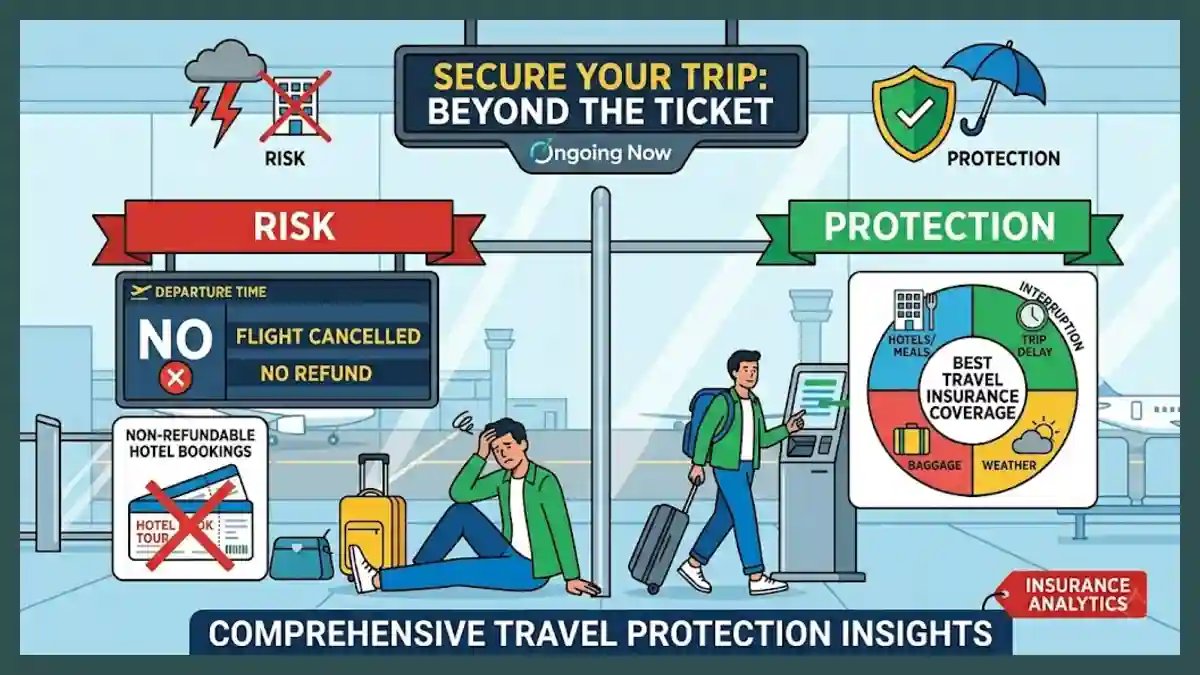
The landscape of modern air travel risk has fundamentally shifted, making an analytical understanding of the best travel insurance for flight delays essential for consumer financial protection. Recent regulatory mandates implemented by the U.S. Department of Transportation (DOT) now enforce automatic cash refunds for significantly disrupted flights. However, these baseline protections do not cover secondary financial losses, such as prepaid lodging, missed tour bookings, or essential out-of-pocket expenses.
To achieve comprehensive protection, travelers rely on an overlapping ecosystem of corporate insurance products and credit-based safety nets. Maximizing recovery requires analyzing how a traditional trip interruption coverage policy integrates with credit card flight cancellation protection. Understanding how standalone options—such as the Allianz travel insurance claim process—handle systemic delays provides a predictable roadmap for risk mitigation.
Furthermore, calculating the comprehensive travel insurance cost against the likelihood of holiday weekend travel delay insurance claims can prevent significant out-of-pocket losses. When severe weather hits, knowing the limits of weather related trip cancellation reimbursement and baggage delay insurance coverage allows policyholders to navigate claims with clear regulatory backing. Ultimately, leveraging premium credit card travel benefits alongside specialized nonrefundable flight insurance options forms a robust barrier against systemic airline disruptions.
The New Regulatory Baseline: DOT Mandates vs. Private Protection
The federal regulatory framework underwent its most significant transformation in years when the U.S. Department of Transportation finalized its automatic refund rule under the FAA Reauthorization Act. This mandate requires commercial air carriers to issue prompt cash reimbursements directly to a passenger’s original form of payment when a flight is canceled or significantly altered, provided the traveler rejects the alternative transportation offered.
Key Regulatory Standard: The DOT explicitly defines a “significant delay” as an arrival time trailing the original schedule by three hours or more for domestic flights, and six hours or more for international flights.
While this regulation solves the historical issue of predatory airline vouchers, it leaves an immense operational gap for the consumer. The National Association of Insurance Commissioners (NAIC) notes that while federal rules cover the bare ticket cost, they provide zero recourse for secondary, non-refundable losses. If a flight delay forces a passenger to miss a $400-a-night safari or an expensive holiday cruise departure, the airline bears no legal liability for those costs.
This is where private travel indemnity becomes necessary. Standalone policies and premium card benefits step in precisely where federal authority stops. They transform an airline’s operational failure from a cascading financial loss into a contractually covered insurance claim.
Decoding Policy Mechanics: Delay, Interruption, and Cancellation
Navigating private coverage requires a strict understanding of insurance terminology, as distinct policy clauses activate under entirely different environmental triggers.
+-----------------------------------------------------------------------+
|                       TRAVEL PROTECTION LAYERS                        |
+-----------------------------------------------------------------------+
|                                                                       |
|  [ LEVEL 3: Cancel For Any Reason (CFAR) ]                            |
|    - Optional upgrade; adds ~50% to comprehensive travel insurance cost|
|    - Allows discretionary cancellation up to 48 hours before departure |
|                                                                       |
|  [ LEVEL 2: Trip Cancellation & Interruption Protection ]              |
|    - Activated by defined perils (illness, weather, striking workers) |
|    - Covers prepaid, non-refundable land, air, and sea arrangements   |
|                                                                       |
|  [ LEVEL 1: Flight Delay & Baggage Delay Adjustments ]                |
|    - Triggers at specific hourly thresholds (e.g., 6+ or 12+ hours)    |
|    - Reimburses local meals, lodging, and essential personal items    |
|                                                                       |
+-----------------------------------------------------------------------+
Flight Delay Coverage
This benefit operates on an hourly threshold, typically triggering after a common carrier delay extends past 6 to 12 hours. It provides a fixed daily stipend (frequently capped between $100 and $250 per day) to cover reasonable, unplanned expenditures. Covered expenses include airport meals, ground transportation, and overnight hotel stays necessitated by the disruption.
Trip Interruption Insurance
Unlike delay coverage, trip interruption insurance applies after a journey has commenced. If an insured traveler must cut their trip short or radically alter their itinerary due to a covered peril—such as a sudden family medical emergency or a natural disaster—this policy reimburses the forfeited, non-refundable portions of the land or sea arrangements, alongside the cost of economy-class airfare required to return home.
Trip Cancellation Coverage
This layer safeguards prepaid expenses before departure. It requires a verified, covered reason to activate, such as the sudden sickness of the traveler, a mandatory military deployment, or severe weather that renders the destination uninhabitable.
Credit Card Protection vs. Standalone Travel Insurance
Many consumers assume that the built-in protections found within high-tier credit card agreements remove the need for independent insurance products. While these premium card benefits are financially potent, they operate under much stricter constraints than comprehensive retail policies.
| Protection Variable | Premium Credit Card Benefits | Standalone Retail Policies |
| Primary Payment Rule | Requires 100% of the trip to be charged to the specific card | Accept flexible payment methods (cash, multiple cards, vouchers) |
| Maximum Coverage Limits | Typically capped at $10,000 per person / $20,000 per trip | Customizable caps; can exceed $50,000 for luxury itineraries |
| Medical Evacuation | Often excluded or capped at low limits | Frequently includes $250,000 to $1,000,000 in emergency airlift |
| Discretionary Claims | Strictly forbidden; requires listed perils only | Available via “Cancel For Any Reason” (CFAR) riders |
| Pre-Existing Conditions | Uniformly excluded from coverage | Waived if purchased within 14–21 days of initial deposit |
As demonstrated, premium credit card benefits function excellently as a secondary, baseline layer of defense for standard domestic travel. However, they lack the high limits and medical extensions required for complex, high-value international itineraries.
Anatomy of an Allianz Travel Insurance Claim Process
When systemic travel infrastructure failures occur, the administrative burden shifts entirely to the policyholder. Navigating a major carrier’s claim system requires methodical documentation and a clear understanding of chronological filing windows.
Phase 1: Immediate Evidence Gathering
The moment an operational delay or cancellation occurs, the policyholder must secure official documentation from the common carrier. This includes requesting a formal “Military Letter” or written statement from the airline gate agent detailing the exact cause of the delay (e.g., mechanical failure, air traffic control restrictions, or severe weather).
Phase 2: Preserving the Financial Paper Trail
Every out-of-pocket transaction made during the delay must be documented via an itemized receipt. Standard credit card statements are frequently rejected by claims examiners because they fail to list the explicit items purchased. Policyholders must maintain receipts for hotels, ground transit, and dining.
Phase 3: Digital Submission and Asset Verification
Using modern paperless platforms, claimants upload digital copies of their original itinerary, the airline’s disruption notice, and all itemized expenses.
Important Record-Keeping Rule: While modern claims are processed entirely via digital uploads, major insurers reserve the contractual right to review original physical documents. Policyholders must retain all physical receipts for a minimum of six months post-submission to prevent a retroactive denial.
Market Realities: Projecting the Comprehensive Travel Insurance Cost
The travel insurance sector has experienced substantial premium adjustments driven by climate volatility and fluctuating post-pandemic travel volumes. According to data tracked by the U.S. Travel Insurance Association (USTIA), Americans spent over $5.56 billion on travel protection products over a multi-year baseline, marking a massive 46% increase over historical spending levels.
Comprehensive Travel Insurance Cost Factors:
├── Base Premium Rate: 5% to 10% of total non-refundable trip costs
└── Optional Upgrades
    └── Cancel For Any Reason (CFAR) Rider: Adds ~50% surcharge to base premium
Actuarial models base retail pricing primarily on four core variables:
Total Non-Refundable Trip Cost: The financial liability the insurer assumes.
Age of the Primary Travelers: Premiums scale sharply for individuals over 65 due to medical risk profiles.
Geographic Destination: Countries with private, high-cost healthcare infrastructure (such as the United States) demand higher premium allocations.
Seasonal Risk Factors: Itineraries intersecting known risk windows—such as Caribbean travel during peak Atlantic hurricane season—face structural price adjustments.
Industry Insights: Actuarial Perspectives on Holiday Micro-Peaks
Insurance underwriters view seasonal travel spikes through a lens of concentrated risk. Extended holiday weekends place immense structural stress on commercial aviation networks. This significantly increases the mathematical probability of cascading luggage losses and operational delays.
The Anatomy of a Holiday Disruption Cascade
During standard operational periods, an airline can recover from a localized mechanical delay within a few hours. However, during high-volume periods, aircraft operate at maximum utilization with minimal runway buffers. A single severe convective weather pattern over a major hub like Chicago O’Hare or Atlanta Hartsfield-Jackson can trigger a nationwide system shock.
For this reason, underwriters price specialized holiday travel riders with tighter exclusions. They look closely at a concept known as “consecutive delay hours.” This metric requires an event to persist uninterrupted for a set duration before any contractual payment obligation triggers.
Analytical Review: Structuring a Resilient Risk Portfolio
A professional risk analysis indicates that relying on a single protection mechanism leaves a consumer exposed to unexpected out-of-pocket costs. The most effective approach blends federal regulations, credit card provisions, and standalone insurance products into a coordinated defense.
+-------------------------------------------------------------------------+
|                  OPTIMAL CLAIMS RESOLUTION HIERARCHY                   |
+-------------------------------------------------------------------------+
|                                                                         |
|  [ STEP 1: AIRLINE DIRECT RECUPERATION ]                                |
|    - Invoke DOT rules for immediate cash refund of ticket face value.    |
|    - Request immediate lodging/meal vouchers directly at the airport.   |
|                                                                         |
|  [ STEP 2: PRIMARY INSURANCE ACTIVATION ]                               |
|    - File non-refundable lodging/tour losses under standalone policy.   |
|    - Utilize digital portals to log real-time carrier delay statements. |
|                                                                         |
|  [ STEP 3: CREDIT CARD CREDIT RECOVERY ]                                |
|    - Claim secondary baggage/stipend overages via premium card benefits.|
|    - Initiate chargebacks ONLY if consumer protection laws are breached.|
|                                                                         |
+-------------------------------------------------------------------------+
By understanding this hierarchy, policyholders ensure they never invalidate their coverage by accidentally double-dipping or filing claims in an incorrect sequence. This methodical approach streamlines approvals and secures the maximum reimbursement allowed under your policies.
Related coverage: [Understanding DOT Passenger Refund Mandates], [The Evolution of Credit Card Travel Protections], [Actuarial Trends in Climate-Driven Travel Risks]
Stay sharp with Ongoing Now!
Source and Data Limitations: This analysis relies on public regulatory documentation from the United States Department of Transportation (DOT) Final Rule on Automatic Airline Refunds (14 CFR Parts 259 and 260), market statistics published by the National Association of Insurance Commissioners (NAIC), and historical travel trend reports from the U.S. Travel Insurance Association (USTIA). Claims guidelines, processing details, and exclusions are drawn from standard corporate filing templates from Allianz Global Assistance and major premium credit card benefits guides. This article serves entirely informational purposes and does not constitute formal financial, legal, or personalized insurance advice. Policyholders must review their specific plan text, as state laws and individual underwriting criteria introduce variations across corporate insurance products.