The Evolution of AUKUS Phase 2 Developments
An analytical look at AUKUS Phase 2 developments, BAE Systems submarine contracts, and the shift in trilaterial defense.
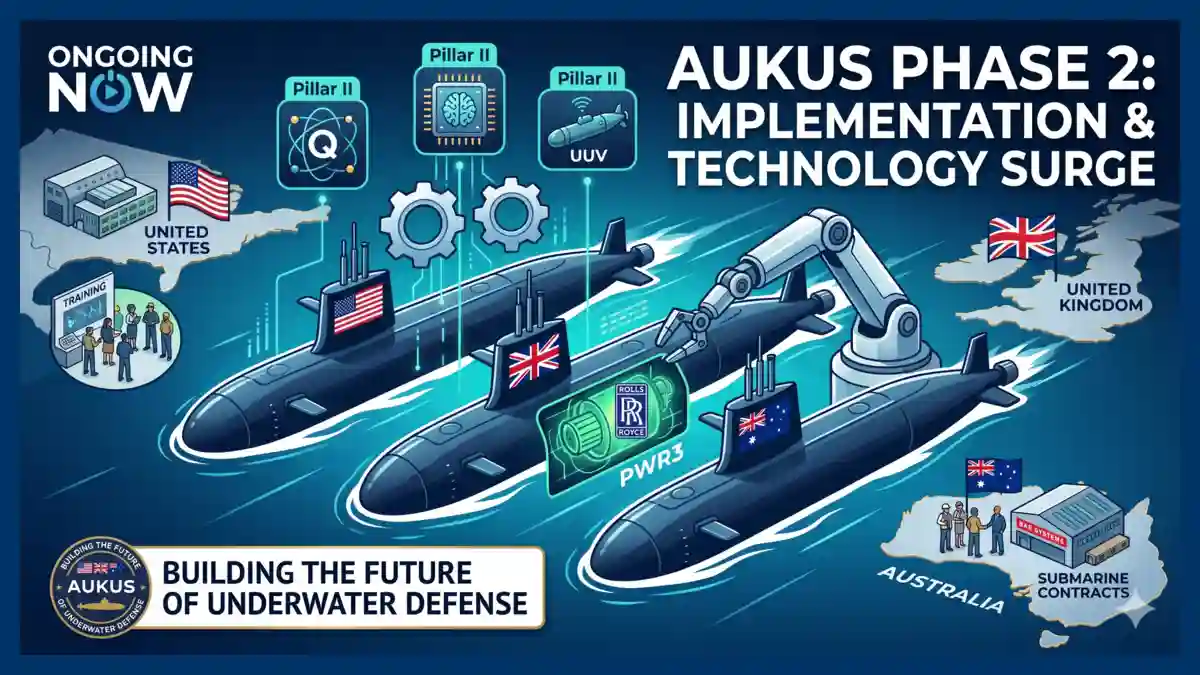
The AUKUS partnership represents a generational shift in geopolitical alignment, fundamentally altering how the US UK Australia defense pact manages maritime security and advanced technology transfer. As of 2026, the focus has transitioned from high-level diplomatic agreements to the industrial execution of AUKUS Phase 2 developments, which emphasize cutting-edge military tech sharing protocols and advanced underwater defense systems. This transition involves significant BAE Systems submarine contracts and the integration of Rolls-Royce nuclear reactors into a new class of vessels. Beyond hardware, the pact hinges on an unprecedented AUKUS workforce training initiative designed to sustain nuclear-powered submarine technology across three continents for the next half-century.
The strategic weight of these developments is underscored by the involvement of the U.S. Department of Defense, the UK Ministry of Defence, and the Australian Department of Defence. Institutional oversight is provided by the AUKUS Joint Steering Groups, while industrial leaders like BAE Systems and Rolls-Royce manage the complex engineering requirements. Experts from the Australian Strategic Policy Institute (ASPI) and the International Institute for Strategic Studies (IISS) note that the success of the pact depends entirely on harmonizing export control regimes, specifically the U.S. International Traffic in Arms Regulations (ITAR).
Industrial Landmarks in AUKUS Phase 2 Developments
The second pillar of the AUKUS agreement has moved into a critical implementation phase, moving beyond the initial acquisition of Virginia-class submarines to the co-development of the SSN-AUKUS. Unlike traditional procurement, AUKUS Phase 2 developments focus on “Pillar II” technologies, which include quantum computing, artificial intelligence, and hypersonic capabilities. These advancements are intended to ensure that the trilaterial alliance maintains a technological edge in increasingly contested environments.
By mid-2026, the focus on underwater defense systems has sharpened. This involves the deployment of uncrewed underwater vehicles (UUVs) that act as force multipliers for the crewed fleet. The integration of these systems requires a shared digital architecture, allowing for seamless data exchange between the three nations. This level of military tech sharing protocols is historically rare, requiring significant legal and regulatory adjustments within each participating country.
The economic footprint of these developments is substantial. Industrial hubs in Adelaide, Barrow-in-Furness, and various U.S. shipyards are undergoing massive infrastructure upgrades. These facilities are being optimized to handle the unique requirements of nuclear-powered submarine technology, which demands higher safety standards and more precise engineering than conventional diesel-electric counterparts.
BAE Systems Submarine Contracts and the SSN-AUKUS Timeline
A cornerstone of the maritime strategy involves the multi-billion dollar BAE Systems submarine contracts. BAE Systems, acting as the lead designer for the SSN-AUKUS, is tasked with merging British submarine design with American propulsion and combat systems. This hybrid approach aims to produce a vessel that is more capable than the current Astute-class but shares commonalities with the U.S. Virginia-class to simplify maintenance and logistics.
The delivery timeline is a multi-decade roadmap. The UK is expected to receive its first SSN-AUKUS in the late 2030s, with Australia following in the early 2040s. To bridge the “capability gap,” Australia will first acquire at least three Virginia-class submarines from the United States. This phased approach ensures that the Royal Australian Navy gains operational experience with nuclear-powered submarine technology well before their domestically built fleet enters service.
Submarine Specifications and Nuclear Integration
The SSN-AUKUS is designed to be the most advanced hunter-killer submarine ever fielded by the UK or Australia. While many details remain classified, the known submarine specifications highlight a focus on stealth and endurance.
| Feature | Specification Detail | Institutional Source |
| Propulsion | Rolls-Royce Nuclear Reactors (PWR3) | UK Ministry of Defence |
| Vertical Launch | Shared US/UK Combat Systems | US Navy / BAE Systems |
| Displacement | Estimated 7,000 – 10,000 tonnes | Defense Industry Analysts |
| Operational Life | 30+ years without refueling | Rolls-Royce Marine |
The Role of Rolls-Royce Nuclear Reactors in Maritime Endurance
The heart of the new fleet lies in the Rolls-Royce nuclear reactors. Specifically, the PWR3 (Pressurized Water Reactor) technology is being adapted for the AUKUS program. These reactors are designed to last the entire life of the ship without the need for mid-life refueling, a significant advantage for long-range patrols in the Indo-Pacific region.
The production of these reactors is centralized at the Rolls-Royce facility in Raynesway, Derby. Under the AUKUS Phase 2 developments, this site is seeing a significant expansion to meet the dual demand of the Royal Navy and the Royal Australian Navy. This centralization ensures a standardized power plant across the fleet, which simplifies the training and certification of nuclear engineers.
The use of nuclear power is a transformative step for the Australian military, which has previously relied on conventional energy sources. This shift necessitates a complete overhaul of domestic regulatory frameworks regarding nuclear safety and waste management. The Australian government has committed to managing all radioactive waste generated by the program on Australian soil, adhering to the highest international non-proliferation standards.
AUKUS Workforce Training and Human Capital
One of the most significant challenges facing the US UK Australia defense pact is the sheer scale of the required labor force. The AUKUS workforce training initiatives are currently scaling up to meet a demand for thousands of highly skilled engineers, technicians, and nuclear physicists. In Australia alone, the program is expected to create 20,000 jobs over the next 30 years.
Educational partnerships have been established between universities in all three nations. For example, Australian students are now enrolling in specialized nuclear engineering programs in the UK and the US. Furthermore, Royal Australian Navy personnel are already embedded within the UK’s Submarine Service and US Navy training pipelines to learn the intricacies of operating nuclear-powered vessels.
“The AUKUS program is not just about building ships; it is about building a sovereign industrial base that can sustain these complex machines for decades,” stated an official report from the UK Ministry of Defence in early 2026.
Military Tech Sharing Protocols and Regulatory Reform
For AUKUS Phase 2 developments to succeed, the “bureaucratic barriers” to innovation must be dismantled. The US UK Australia defense pact has prompted the U.S. Congress to pass legislation easing ITAR restrictions for AUKUS partners. This allows for the rapid transfer of sensitive data and hardware without the months-long delay typical of standard arms exports.
These military tech sharing protocols extend to “Pillar II” domains such as:
AI and Autonomy: Developing shared algorithms for autonomous underwater sensing.
Quantum Technologies: Enhancing navigation and timing in GPS-denied environments.
Hypersonic Weaponry: Testing and evaluating high-speed strike capabilities.
Cyber Defense: Hardening the shared digital backbone of the alliance against state-sponsored intrusions.
The integration of these technologies requires a “security-by-design” approach. Each nation must ensure that its domestic industrial partners meet the rigorous cybersecurity standards mandated by the pact. This has led to a standardized certification process for defense contractors involved in the BAE Systems submarine contracts.
Analyzing the Societal and Economic Implications
The shift toward nuclear-powered submarine technology has profound implications for local economies and international relations. In the UK and Australia, the defense sector is becoming a primary driver of high-tech manufacturing growth. This “AUKUS effect” is revitalizing industrial towns and providing a stable career path for a new generation of workers.
However, the program also faces scrutiny regarding its total cost. Estimates suggest the program will cost Australia between $268 billion and $368 billion (AUD) over three decades. Critics point to the opportunity cost for other social services, while proponents argue that the investment is essential for national security and sovereign industrial capability.
From a geopolitical perspective, the pact is viewed by regional neighbors with a mix of support and caution. While many see it as a stabilizing force that maintains a balance of power, others express concerns about the potential for an arms race. The AUKUS partners have engaged in extensive diplomatic outreach to assure the international community of their commitment to the Nuclear Non-Proliferation Treaty (NPT).
The Path Forward for Underwater Defense Systems
As we look toward the late 2020s, the focus on underwater defense systems will likely shift toward “distributed lethality.” This concept involves a mix of large nuclear-powered submarines and smaller, cheaper autonomous systems. The AUKUS Phase 2 developments are the testing ground for this doctrine.
The success of the BAE Systems submarine contracts will be measured by the ability of the shipyards to stay on schedule and within budget. History shows that large-scale defense projects are prone to delays; however, the trilaterial nature of AUKUS provides a unique redundancy. If one nation faces an industrial bottleneck, the others can provide surge capacity or technical assistance.
Key Milestones and Timeline (2023-2030)
2023: Announcement of the “Optimal Pathway” for submarine acquisition.
2024-2025: Initial BAE Systems submarine contracts for design and long-lead items.
2026: Expansion of AUKUS workforce training programs and commencement of infrastructure upgrades in Australia.
2027: First U.S. Virginia-class submarines begin regular rotations through HMAS Stirling in Western Australia (SRF-West).
2030: Planned commencement of construction for the first Australian-built SSN-AUKUS.
Evidence-Based Editorial Insights
The AUKUS pact is more than a military agreement; it is a structural integration of three economies. The focus on AUKUS Phase 2 developments indicates that the partners are looking beyond the horizon of immediate threats toward a future defined by technological supremacy. By sharing the burden of R&D and production, the US, UK, and Australia are attempting to create a sustainable model for high-end defense capability.
The reliance on Rolls-Royce nuclear reactors and BAE Systems submarine contracts highlights the critical role of the private sector in national security. The success of this endeavor will depend on whether these corporations can navigate the complexities of trilaterial regulation and workforce shortages.
Ultimately, the pact’s long-term viability rests on political consistency. With timelines stretching into the 2040s, AUKUS must survive multiple changes in government across three different capitals. The institutionalization of the pact through AUKUS Phase 2 developments—creating thousands of jobs and deep-rooted industrial ties—is perhaps the strongest safeguard against future political shifts.
Stay sharp with Ongoing Now!
Source and Data Limitations: This analysis is based on official government communiqués from the AUKUS Joint Steering Groups (2023-2026), UK Ministry of Defence “Defence Equipment & Support” (DE&S) reports, and the U.S. Congressional Research Service (CRS) briefings on AUKUS Pillar II. Technical specifications for submarine technology and Rolls-Royce reactors are derived from public disclosures by BAE Systems and Rolls-Royce Marine. Data regarding workforce numbers and economic impact are sourced from the Australian Department of Defence’s AUKUS workforce strategy papers. This report excludes speculative claims regarding the specific deployment locations of future vessels or classified acoustic performance metrics. All information is verified as of April 2026.