Geneva Nuclear Talks Failure 2026: Diplomacy Stalls
Persistent gaps in Geneva nuclear talks failure 2026 heighten regional tensions as US military presence expands.

Strategic Gaps Hinder Diplomatic Progress in Geneva
High-level diplomatic efforts to address the Iranian nuclear program reached a critical impasse on February 17, 2026, as the latest round of indirect negotiations in Geneva concluded without a breakthrough. The Geneva nuclear talks failure 2026 represents a significant setback for international efforts to curb Tehran’s enrichment activities through non-kinetic means.
United States and Iranian negotiators remain divided over several foundational issues, specifically regarding the scale of uranium enrichment and the scope of sanctions relief. While Iranian Foreign Minister Abbas Araghchi characterized the discussions as “serious,” he acknowledged that drafting a functional agreement remains a difficult task. The United States has maintained that any deal must address Iran ballistic missile program 2026 developments and regional security concerns, which Tehran continues to designate as non-negotiable red lines.
The diplomatic stalemate occurs against a backdrop of domestic instability in Iran and an unprecedented buildup of American naval and air power in the Persian Gulf. White House Press Secretary Karoline Leavitt confirmed on February 18 that while diplomacy remains the “first option,” the administration is evaluating all contingencies. The international community now watches for a potential Iranian response within the next two weeks, as mediators from Oman attempt to preserve a path for a third round of talks.
Escalation and the US Military Buildup Reasons
The US military buildup reasons in early 2026 are multifaceted, primarily centered on deterring Iranian retaliation following the Geneva nuclear talks failure 2026. The Pentagon has deployed a second carrier strike group, led by the USS George H. W. Bush, to join the USS Abraham Lincoln already stationed in the region. This deployment includes twelve warships and hundreds of advanced fighter aircraft, including F-22 Raptors and F-35 stealth jets.
Officials in Washington have cited the need to protect strategic shipping lanes and support regional allies as primary drivers for the increased presence. The buildup also serves as a direct response to the IRGC naval response news regarding increased activity in the Persian Gulf. Defense Secretary Pete Hegseth and General Dan Caine have briefed the House Appropriations Subcommittee on the necessity of “integrated deterrence” to prevent a wider conflict while diplomatic channels remain strained.
Current US Military Posture: February 2026
| Asset Category | Specific Units Deployed | Strategic Objective |
| Carrier Strike Groups | USS Abraham Lincoln, USS George H. W. Bush | Power projection and aerial dominance |
| Guided Missile Destroyers | USS Pinckney, USS McFaul (DDG 74) | Escort duty and missile defense |
| Strategic Bombers | B-2 Spirit Stealth Bombers | Long-range strike capability |
| Fighter Wings | F-22 Raptors, F-16 Fighting Falcons | Air superiority and escort |
“Diplomacy is always his first option, and Iran would be very wise to make a deal with President Trump and with this administration,” stated White House Press Secretary Karoline Leavitt during a February 18 briefing.
Analysis: The Impact of Domestic Unrest on Negotiations
A critical factor influencing the Geneva nuclear talks failure 2026 is the internal pressure facing the Iranian leadership. The 2025-2026 Iranian protests impact has been profound, with nationwide demonstrations initially sparked by economic grievances in late December 2025. The Iranian rial plummeted from 1.07 million per US dollar in November 2025 to 1.4 million by late December, leading to widespread strikes by bazaar merchants and wage earners.
Human rights organizations, including Amnesty International, have documented an unprecedented crackdown by security forces. Reports indicate that thousands of individuals were killed during the deadliest period of repression in January 2026. These domestic challenges have left the Iranian government in a precarious position, seeking significant sanctions relief to stabilize the economy while refusing to concede on Iran enrichment red lines.
The regime’s reliance on “containment governance”—a mixture of selective coercion and internet shutdowns—has maintained a semblance of order but has not addressed the underlying structural failures. This internal volatility complicates the “Trump Iran policy 2026 explained” by analysts, as the US administration balances support for protesters with the strategic goal of a nuclear agreement.
Maritime Security and Strait of Hormuz Tensions Cause
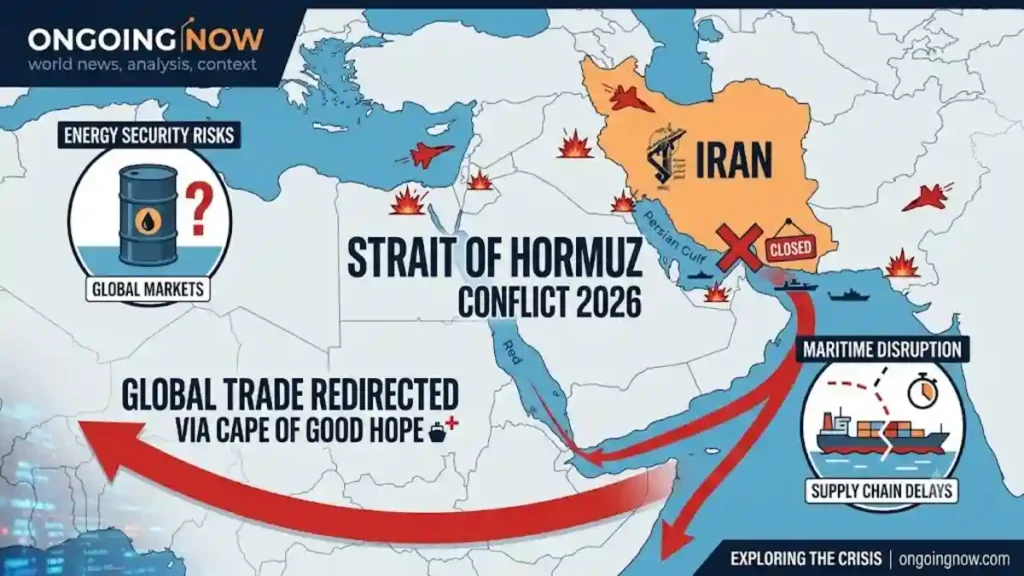
The Strait of Hormuz tensions cause significant concern for global energy markets, as approximately 80 oil tankers and container ships pass through the waterway daily. Following the Geneva nuclear talks failure 2026, the Islamic Revolutionary Guard Corps (IRGC) launched the “Smart Control” military exercise, which briefly closed portions of the strait.
IRGC Navy Chief Rear Admiral Alireza Tangsiri announced that Iranian forces maintain “24-hour intelligence dominance” over the passage. On February 3, 2026, six IRGC gunboats reportedly attempted to intercept the US tanker Stena Imperative, which was eventually escorted to safety by the USS McFaul. These maneuvers are widely viewed by maritime analysts as a signaling mechanism intended to demonstrate Tehran’s ability to disrupt global oil supplies if military pressure continues to mount.
Historical Comparison: 2025 vs. 2026
The current situation bears similarities to the “Twelve Day War” of June 2025, where direct hostilities between Israel and Iran led to the destruction of various Iranian air defense systems. However, the 2026 context is distinguished by the increased sophistication of the Iran ballistic missile program 2026 and the intensified US naval presence. Unlike previous escalations, the current standoff involves a more direct threat to US naval assets, as emphasized by Supreme Leader Ali Khamenei’s recent warnings regarding “weapons that can sink warships.”
Why This Matters: The Ballistic Missile Stumbling Block
The Iran ballistic missile program 2026 has emerged as the primary “deal-breaker” in the Geneva negotiations. While the US and its allies insist that any comprehensive agreement must limit Tehran’s missile capabilities, Iranian officials maintain that the program is strictly defensive and outside the mandate of nuclear talks.
Evidence-based insights from the Middlebury Institute’s James Martin Center for Nonproliferation Studies suggest that Iran is actively rehabilitating its missile infrastructure following the damage sustained in 2025. This includes the establishment of sanctions-bypassing supply chains to replenish solid fuel stocks. The persistence of this program, combined with the Geneva nuclear talks failure 2026, heightens the risk of a “kinetic solution” if diplomacy is deemed exhausted.
Verified Metric: On the eve of the June 2025 conflict, Iran’s missile inventory was estimated at 2,500 to 3,000 units.
Reconstruction Status: Current intelligence suggests Iran is accelerating work at the “Pickaxe Mountain” facility to protect its remaining nuclear and missile assets deep underground.
What the Data Shows: Regional Instability Factors
The broader Middle East regional instability factors extend beyond the immediate US-Iran standoff. The region is navigating the aftermath of the fall of the Assad regime in Syria and the continued fragility of ceasefires in Gaza.
Economic Volatility: Lower energy prices and rising debt are forcing Gulf states to prioritize domestic investments over regional security subsidies.
Resource Scarcity: Water shortages in Tehran and surrounding provinces have become a new driver for social unrest, moving beyond political demands to basic survival needs.
Military Readiness: Israel has declared a state of “maximum alert,” with the IDF Home Front Command preparing for potential retaliatory strikes in the event of a joint US Israel joint strike plan being activated.
The Pentagon Iran strike briefing provided by Secretary Hegseth highlighted that Operation Midnight Hammer in June 2025 successfully targeted three major nuclear sites, including Fordow and Natanz. However, leaked reports suggest that while the damage was severe, the program was delayed by months rather than years, leading to the current debate over a “Trump military strike decision 2026.”
Human Impact and Community Resilience
Behind the geopolitical maneuvering, the Iranian civilian population faces a compounding crisis of economic hardship and state violence. The 2025-2026 Iranian protests impact is felt most acutely in urban centers like Tehran, Kermanshah, and Alborz, where nighttime curfews and checkpoints have become commonplace.
Verified accounts from within the country describe a community under extreme duress, with many families struggling to access basic services due to infrastructure failures and sanctions-induced inflation. Despite these challenges, there is a noted resilience among advocacy groups who continue to demand justice for those detained or killed during the January crackdown. The dignity of these underrepresented voices remains a central theme in the international human rights response, even as the global focus remains on the Geneva nuclear talks failure 2026.
Stay sharp with Ongoing Now!
Related Coverage:
Source and Data Limitations: This report is based on verified news dispatches from Reuters, the Washington Post, and the Associated Press as of February 19, 2026. Data regarding Iranian casualties and internal protest logistics are provided by Amnesty International and the Institute for the Study of War; however, ongoing internet shutdowns in Iran may cause reporting delays or limit the verification of specific local incidents. Information regarding the “Operation Midnight Hammer” strikes of June 2025 is derived from official Pentagon briefings and published congressional testimony. This analysis excludes anonymous social media rumors and speculative forecasts regarding specific military timelines not confirmed by the Department of Defense or the White House.