Spirit Airlines Shutdown: Why the Rescue Deal Failed
Failed $500 Million Federal Bailout and Record Jet Fuel Costs Lead to Immediate Liquidation of Ultra-Low-Cost Carrier
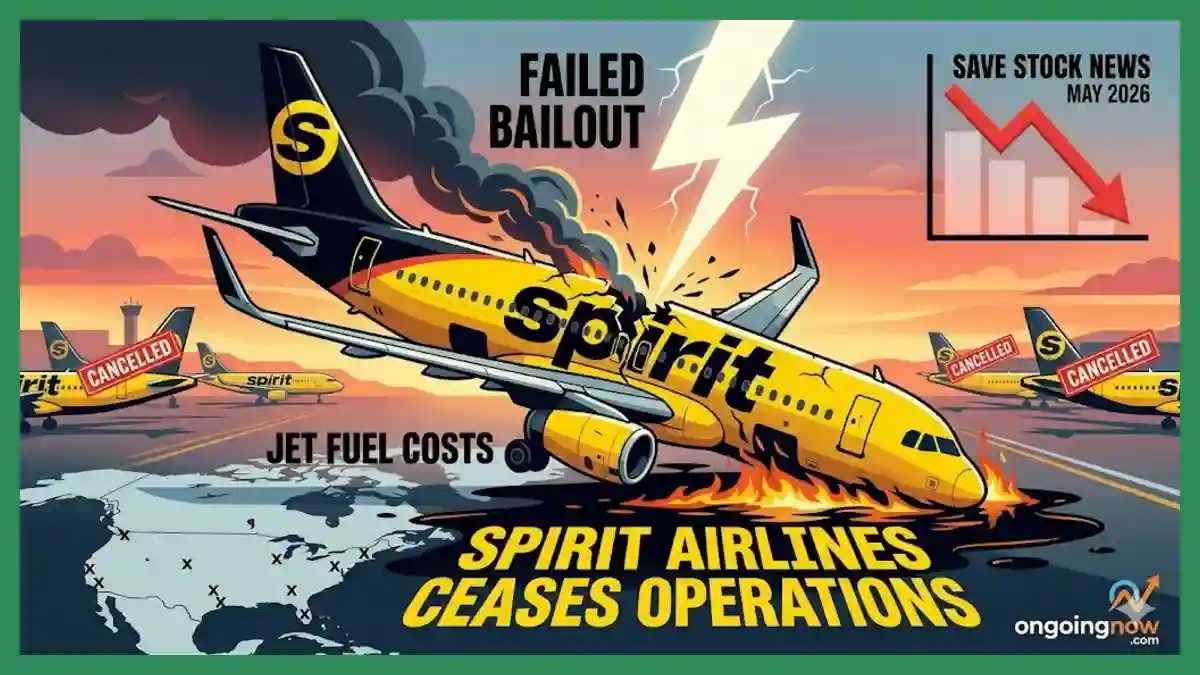
MIRAMAR, FL — Spirit Airlines is preparing to cease all flight operations effective 3:00 am ET on Saturday, May 2, 2026, following the collapse of high-stakes negotiations for a $500 million government rescue package. The Florida-based carrier, which has been operating under Chapter 11 bankruptcy protection for over a year, reached a critical liquidity crisis after a joint U.S.-Israeli military action in Iran triggered a 100% surge in jet fuel prices. Despite receptive initial talks with the Trump administration, a final deal stalled as key bondholders and Department of Transportation officials, led by Secretary Sean Duffy, failed to agree on terms regarding a proposed 90% government equity stake.
The shutdown marks the end of the “Spirit effect,” a decade-long economic phenomenon where the airline’s aggressive pricing forced legacy competitors to lower domestic fares. As of today, the airline’s 12,000 monthly flights are being phased out, with the company moving toward a full asset liquidation.
The Collapse of a $500 Million Lifeline
The immediate catalyst for the shutdown was the failure of a federal rescue deal intended to provide $500 million in emergency liquidity. The proposed package, which would have granted the federal government warrants for nearly 90% of the company, faced stiff opposition from a coalition of senior bondholders who balked at the dilution of their claims.
Without this capital, Spirit Airlines was unable to unlock $240 million in restricted cash reserves required to maintain daily operations. The airline’s financial position had already been precarious following a failed $3.8 billion merger with JetBlue Airways in 2024, which regulators blocked on antitrust grounds. That decision, intended to preserve competition, ultimately left Spirit without a strategic partner to weather the 2026 energy shock.
Why is Spirit Airlines Shutting Down?
Energy Market Volatility: Jet fuel costs in May 2026 reached approximately $4.00 per gallon, more than doubling since the onset of regional conflict in February.
Liquidity Exhaustion: The carrier reportedly had only hours of cash left by the evening of May 1, 2026.
Restructuring Failure: This marked the airline’s second attempt at Chapter 11 bankruptcy in less than two years, a cycle that exhausted investor patience.
Regulatory Obstacles: Internal divisions within the administration regarding the precedent of a “budget airline bailout” prevented a consensus.
Market Snapshot: The Financial Decline of SAVE
The financial trajectory of Spirit Airlines (SAVE) reflects a steady erosion of market confidence as the airline’s debt-to-equity ratio became unsustainable. By the time of the shutdown, the airline’s market capitalization had dwindled to approximately $737.3 million.
| Metric | Value (As of May 1, 2026) | Note |
| Stock Ticker | SAVE | Listed on NYSE |
| Share Price | $1.08 | 98% decline from 5-year highs |
| Market Cap | ~$737 Million | Reflects distressed valuation |
| Liquidity Gap | $500 Million | Minimum required for survival |
| P/E Ratio | 25.86x | Highly volatile due to net losses |
| Estimated Debt | >$5.0 Billion | Includes lease obligations |
Note: Data based on final market filings and GuruFocus financial signals prior to the suspension of trading.
Impact of Spirit Airlines Failure on Aviation Industry
The liquidation of Spirit Airlines is expected to have a profound impact on the domestic aviation market. Industry analysts at Cirium and the New York Times note that Spirit’s capacity had already dropped from 25,000 monthly flights in 2024 to just 12,000 by April 2026. The total removal of this capacity is projected to lead to an immediate rise in domestic airfares.
“Any time you have a reduction in capacity and demand increases, airfares have nowhere to go but up,” noted industry experts in a recent CBS News analysis.
The “Spirit effect” served as a price ceiling for the industry. Without a major ultra-low-cost carrier (ULCC) to undercut the market, legacy carriers like American Airlines and United Airlines may face less pressure to maintain “Basic Economy” tiers at current price points. Furthermore, the Spirit Airlines assets liquidation will see nearly 200 Airbus A320-family aircraft enter a secondary market already strained by engine maintenance delays.
The Role of Geopolitical Conflict and Fuel Costs
The Iran war jet fuel price spike proved to be the final blow to Spirit’s recovery plan. Unlike many European counterparts that utilize extensive fuel hedging, U.S. carriers like Spirit were largely exposed to spot-market fluctuations.
Jet fuel prices May 2026 reached levels that rendered Spirit’s low-margin business model obsolete. While larger carriers attempted to offset these costs by raising fares by $50 to $100 per segment, Spirit’s price-sensitive customer base proved unable or unwilling to absorb such steep increases. The airline’s inability to recapture elevated fuel prices led to a burn rate that outpaced all restructuring efforts.
Operations Update: Is Spirit Airlines Still Flying Today?
For passengers asking is Spirit Airlines still flying today, the answer is transitioning rapidly. While planes remained in the air through the evening of May 1, 2026, the official Spirit Airlines shutdown schedule indicates a cessation of all activity by early Saturday morning.
Flight Status: Passengers are advised to check their flight status immediately via the Spirit mobile app or website, though systems may become unresponsive as the company enters liquidation.
Refunds and Credits: Under federal law, passengers on canceled flights are entitled to a full refund. However, with the airline entering a full asset liquidation, the processing of these refunds may be subject to bankruptcy court oversight.
Stranded Passengers: Competing airlines are reportedly in discussions with the Department of Transportation regarding “rescue fares” for travelers stranded at major hubs like Fort Lauderdale (FLL), Las Vegas (LAS), and Orlando (MCO).
Analysis: Why the Restructuring Failed
The Spirit Airlines financial crisis was a multifaceted failure of corporate strategy and macroeconomic timing. The airline attempted to pivot toward a more “premium” model—introducing “Spirit First” and more comfortable seating—to increase revenue per passenger. This move aimed to shed its “cheap at any cost” reputation and better compete with the basic economy offerings of major carriers.
However, a smaller fleet meant fixed costs were spread across fewer seats. The decision by the bankruptcy court and bondholders to move toward liquidation suggests that the “agreement in principle” reached in February 2026 was no longer viable under the new energy price regime. The Spirit Airlines bondholder vote results confirmed a lack of appetite for further risk, effectively ending the company’s 46-year history.
Impact
The shutdown represents a significant blow to the South Florida economy, where Spirit is headquartered, and puts thousands of jobs at risk. While the airline had recently recalled 500 furloughed flight attendants to prepare for spring demand, those employees now face an uncertain future.
For consumers, the loss of Spirit Airlines reduces travel accessibility for lower-income households. The airline frequently served secondary markets that larger carriers avoided, providing a critical link for regional economies. As the budget airline market share 2026 shifts toward remaining ULCCs like Frontier or Allegiant, the lack of Spirit’s volume is expected to create a temporary supply-side vacuum in the U.S. travel market.
Stay sharp with Ongoing Now!
Source and Data Limitations: This report is based on bankruptcy court filings from the District of Florida, official statements from the Trump administration’s Department of Transportation, and market data from the New York Stock Exchange and GuruFocus as of May 1-2, 2026. Information regarding the $500 million bailout collapse was first reported by The Wall Street Journal and verified through secondary reporting by Reuters and CBS News. Flight capacity data was sourced from Cirium. Due to the rapid nature of liquidation proceedings, real-time flight status and SAVE stock delisting dates are subject to change based on immediate regulatory actions by the SEC and FAA.