Inside the Ark Innovation ETF Rebalancing Strategy Pulling Millions Out of Mega Chip Stocks
Capital Realignment Follows Explosive Artificial Intelligence Infrastructure Rally
The global asset management landscape is witnessing a significant structural realignment as early investors in the artificial intelligence infrastructure cycle adjust their institutional footprints. According to recent Ark Invest daily trade disclosures 2026, the investment house guided by founder and CEO Cathie Wood has executed consecutive tranches of equity liquidations within its core hardware holdings. This capital reallocation pattern focuses heavily on mature semiconductor enterprises that have experienced exponential valuation gains over the preceding twenty-four months.
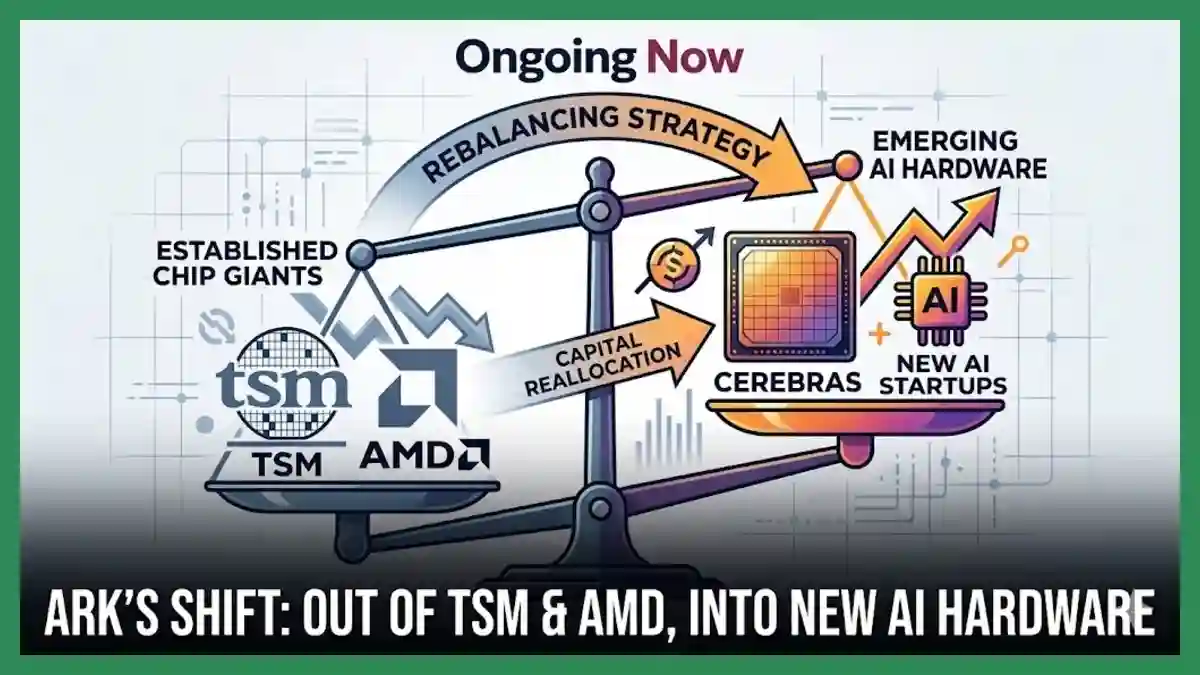
Rather than signaling a systemic retreat from the broader technology ecosystem, the Ark Innovation ETF rebalancing strategy represents a deliberate transition from established hardware layers to emerging, specialized architectures. The daily trading records indicate that the fund is shifting its asset density away from large-cap foundry operations and secondary microchip designers. The proceeds are being immediately funneled into newly public, high-growth entities positioned to challenge traditional market leaders. This tactical shifting highlight the operational friction between managing liquidity and capturing early-stage corporate growth curves.
Tracking the May 2026 Semiconductor Divestments
The scale of the asset rotation is clearly outlined in institutional trade logs filed with financial regulators. During mid-May 2026, Ark Invest systematically dismantled portions of its highly liquid tech exposure to fund specific primary-market and secondary-market updates.
Institutional Trade Aggregates: May 14–15, 2026
The following structured block outlines the exact transaction metrics executed across the ARK Innovation ETF (ARKK) and the ARK Next Generation Internet ETF (ARKW), based on official post-close disclosures.
| Ticker | Company Name | Shares Traded | Transaction Direction | Estimated Capital Value (USD) | Portfolio Impact Status |
| TSM | Taiwan Semiconductor Manufacturing Co Ltd | -100,549 | Liquidated (Multiple Tranches) | $41,256,931 | Systematic Reduction |
| AMD | Advanced Micro Devices Inc | -24,658 | Position Reduction | $11,040,360 | Sustained Trimming |
| TER | Teradyne Inc | -57,609 | Capital Withdrawal | $20,694,682 | Multi-Day Divestment |
| CBRS | Cerebras Systems Inc | +254,792 | Capital Reallocation | $51,254,206 | Rapid Position Entry |
Note on Data Limitations: Capital values are calculated based on approximate closing prices on the respective trade dates (May 14 and May 15, 2026). Actual execution prices vary intraday across individual exchange books. Portfolio impact percentages are subject to dynamic net asset value (NAV) fluctuations.
The primary operational anchor of this structural update is the Cathie Wood semiconductor profit taking methodology. By executing a Cathie Wood TSM stock sale of more than 100,000 shares across a 48-hour window, the fund extracted over $41 million from the world’s premier dedicated independent semiconductor foundry. This occurred precisely as Taiwan Semiconductor Manufacturing Co reached historic technical peaks, trading above $420 per share. Simultaneously, an Advanced Micro Devices position reduction cleared out more than $11 million from the fund’s x86 microprocessor and graphics processing unit exposure.
Why Is Ark Selling Chip Stocks Right Now?
The core question preoccupying global macro desks is elementary: why is Ark selling chip stocks during a sustained phase of enterprise technology procurement? The answer lies within the foundational principles of Ark Invest’s active mandate, which prioritizes non-linear, multi-technology convergence over cyclical industrial expansion.
[Liquidated Megacap Assets] ---> [Capital Reallocation Hub] ---> [Emerging AI Hardware (CBRS)]
      (TSM, AMD, TER)                                                 (Wafer-Scale Integration)
From an institutional portfolio engineering perspective, the asset manager is responding to valuation maturity. Large-cap semiconductor equities have transitioned from speculative, under-allocated growth names to highly institutionalized, heavily weighted consensus long positions. For a fund structured to deliver outsized capital gains via early-phase disruptions, holding highly consolidated companies at all-time highs reduces long-term alpha potential.
The tech stock reallocation capital gains harvested from these tranches provide the necessary cash balances to finance highly concentrated entry points elsewhere. In this instance, the liquidations directly funded the aggressive accumulation of Cerebras Systems Inc (CBRS). Cerebras debuted on public markets on May 13, 2026, with an initial public offering price of $185, launched trading at $350, and settled into a market capitalization bracket of approximately $49 billion to $67 billion. By purchasing over 254,000 shares of Cerebras within 48 hours of its listing, Wood rotated capital from a distributed foundry infrastructure into a pure-play, wafer-scale AI processing system designer.
Rebalancing Amid Intense Semiconductor Sector Market Momentum
The timing of Ark’s adjustments highlights a divergence between passive index-tracking strategies and active thematic management. The broader semiconductor sector market momentum has remained robust, driven by cloud service providers expanding their hyperscale data centers.
Passive instruments, such as the iShares Semiconductor ETF (SOXX) and the VanEck Semiconductor ETF (SMH), are structurally mandated to maintain or increase their exposure to market-cap leaders like Nvidia, Broadcom, and Taiwan Semiconductor. These traditional indices require quarterly structural adjustments, meaning new market entries like Cerebras Systems are unlikely to achieve inclusion until scheduled index reviews in late June or September 2026.
By contrast, active managers operate free from the temporal constraints of index providers. Ark’s rapid entry into alternative hardware architectures represents an effort to exploit this technical window before passive institutional capital flows automatically inflate the valuation of new listings. This strategy accepts high short-term asset volatility in exchange for acquiring significant equity stakes before a company undergoes broad index adoption.
What the Numbers Show: A Comparative Cycle Assessment
To evaluate the long-term viability of this portfolio rotation, it is useful to compare it with previous asset reallocation cycles executed by Ark Invest over the past five years.
The Nvidia Pre-Run Divestment (2023): Ark famously trimmed its core Nvidia (NVDA) holdings immediately prior to the stock’s historic multi-trillion-dollar valuation ascent. The capital was redistributed into software-as-a-service (SaaS) and genomic platforms. This move limited the flagship fund’s ability to fully capture the initial hardware-driven equity boom.
The Digital Asset Pivot (Early 2026): In the opening quarter of 2026, Ark harvested profits from cyclical tech extensions to fund massive, $50 million block purchases of Robinhood Markets (HOOD) and Coinbase (COIN). This rebalancing leveraged structural pullbacks in fintech to build high-conviction positions ahead of retail volume recoveries.
The Wafer-Scale Transition (May 2026): The current liquidation of TSM and AMD assets represents a intermediate strategy. The fund remains structurally committed to artificial intelligence hardware, but it is moving down the market-capitalization spectrum to back unconventional processing designs over standard foundry business models.
This historical context demonstrates that the firm routinely sacrifices the stability of large-cap tech holdings to maintain a continuous exposure to early-stage, potentially exponential corporate growth profiles.
Corporate Strategy: The Shift to Early-Stage Architecture Challenge
The underlying asset reallocation is heavily tied to changing dynamics in chip design. Taiwan Semiconductor serves as the foundational manufacturer for almost all leading fabless designers, including Apple, Nvidia, and Advanced Micro Devices. Trimming TSM is a structural declaration that the highest rate of equity appreciation may no longer reside at the foundational manufacturing tier, but rather within alternative compute paradigms.
Cerebras Systems has attracted significant institutional attention due to its radical engineering approach. Instead of cutting a large silicon wafer into hundreds of individual microchips, Cerebras utilizes an entire wafer as a single, massive processor. This design significantly reduces latency and increases data throughput for training large language models. Backed by commercial partnerships with Amazon Web Services and specialized deployments alongside OpenAI, the company represents a direct challenge to the traditional graphic processing unit frameworks championed by Nvidia and powered by AMD.
By reallocating capital to this architecture, Ark is positioning its portfolio for a secondary wave of AI hardware competition. This strategy assumes that the initial monoculture of traditional graphic processing unit clusters will eventually give way to highly specialized, custom-built AI fabrics.
Human, Labor, and Global Supply Chain Impacts
While institutional portfolio adjustments occur instantly on electronic exchanges, the underlying physical assets govern real-world supply chains, regional labor forces, and sovereign economic policies. The ongoing redistribution of capital among hardware designers highlights the shifting pressures on global technology infrastructure.
Real-World Structural Variables
Geopolitical Concentration Risk: Foundries operated by Taiwan Semiconductor remain heavily concentrated geographically, keeping the global tech economy exposed to cross-strait political volatility. Institutional capital shifts reflect a growing awareness of these localized production risks.
High-Skill Labor Reallocation: The rise of alternative chip architectures is intensifying the global competition for elite silicon design engineers. Startups armed with fresh public capital are competing directly against legacy firms for specialized talent in physical layout design and compiler optimization.
Data Center Power Constraints: Next-generation processing hardware focuses heavily on energy efficiency. As regional electrical grids face constraints from massive data center buildouts, chip designs that deliver superior compute-per-watt performance are seeing rapid shifts in commercial demand.
These real-world dynamics show that portfolio rebalancing is more than just a financial exercise; it reflects the physical limitations of energy grids, human talent pools, and global shipping lanes.
Macroeconomic and Sovereign Policy Implications
The corporate rebalancing strategies executed by major asset managers are occurring alongside a broader re-shoring of global technology manufacturing. Sovereign states are increasingly treating semiconductor manufacturing capacity as a matter of national security rather than simple industrial output.
Programs like the United States CHIPS and Science Act and corresponding European Union industrial subsidies have funneled billions in public capital into building localized fabrication facilities. However, these infrastructure projects require years to become operational. In the interim, the global technology sector remains heavily dependent on existing global supply networks.
When active investment funds reduce exposure to foundational manufacturers like TSM, it underscores a complex investment climate: corporate valuations are at record highs due to immediate demand, yet long-term capital must navigate rising capital expenditure requirements and a fragmented regulatory landscape. As central banks maintain a cautious approach to liquidity, asset managers are forced to find investable growth within specific corporate innovations rather than relying on broad macroeconomic expansion.
Portfolio Realignment as an Operational Guide
For institutional observers, corporate strategists, and enterprise technology buyers, Ark Invest’s multi-day transaction pattern provides several actionable insights into the current state of technology valuations:
Monetizing the Infrastructure Layer: The execution of systematic profit-taking on TSM and AMD signals that the first phase of the infrastructure cycle—the universal buildout of basic compute capabilities—is reaching maturity. Companies that scale through pure volume are giving way to optimization plays.
Accepting Liquidity Discounts for Growth Potential: Rotating out of highly liquid, mega-cap equities into newly public vehicles with high initial price volatility shows a willingness to accept near-term trading friction in pursuit of long-term capital appreciation.
The Shift Toward Specialized AI Architectures: Enterprise buyers should anticipate an increasingly diverse hardware ecosystem. The capital flows targeting wafer-scale and custom application-specific integrated circuit (ASIC) systems suggest that the industry is moving away from a one-size-fits-all hardware approach.
Ultimately, these portfolio adjustments demonstrate that active asset management requires constant adaptation. Navigating the next phase of global technological convergence means balancing the reliable returns of established market leaders against the growth potential of emerging innovations.
Stay sharp with Ongoing Now!
Source and Data Limitations: This analysis relies exclusively on public institutional disclosures, including Ark Invest’s daily trade transparency releases dated May 14, 2026, and May 15, 2026. Supplemental market capitalization, initial public offering pricing details, and historical stock performance data were verified via financial data engines and official stock exchange records from the New York Stock Exchange (NYSE) and NASDAQ. This report strictly avoids forward-looking earnings projections, speculative price targets, or unverified rumors regarding corporate partnerships. All portfolio weightings and asset values are approximations based on public closing metrics and are subject to regulatory revisions and standard market volatility. This article is prepared solely for informational and journalistic purposes and does not constitute formal financial, investment, legal, or tax advice.