How the West Asia crisis deadlock is driving global trade and oil disruptions
Diplomatic efforts falter as unresolved maritime restrictions in the Strait of Hormuz pressure global commodity markets.
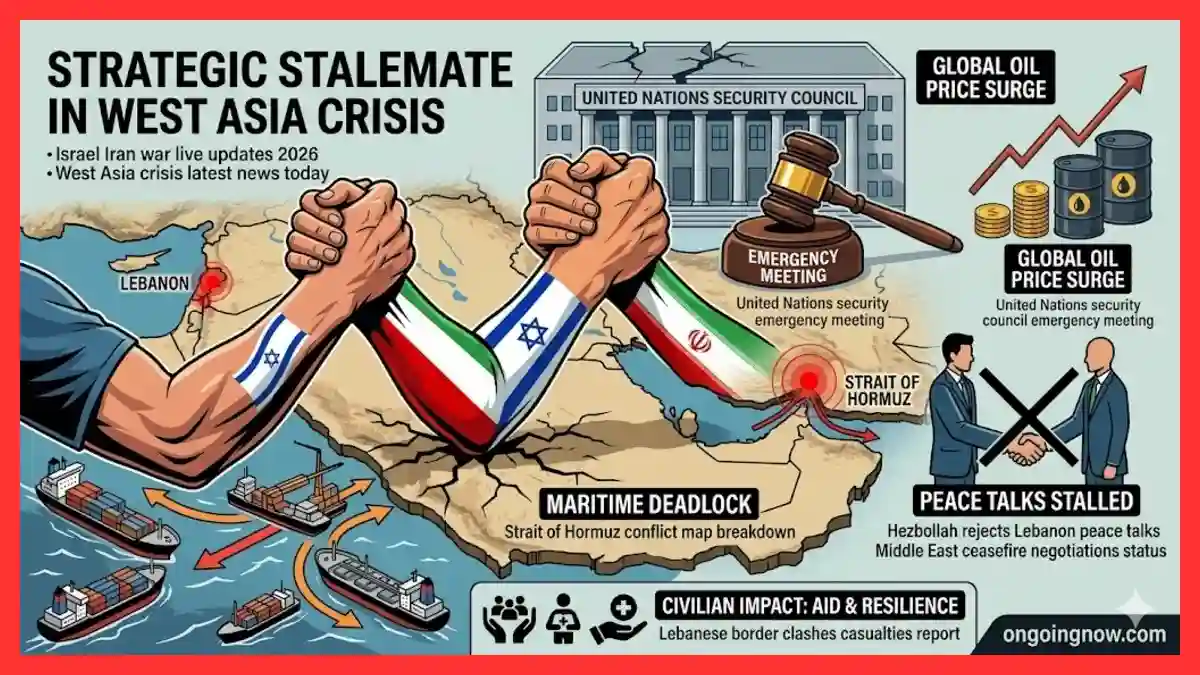
Strategic Stalemate as Regional Initiatives Face Impasse
The geopolitical landscape of the Middle East remains tense following significant diplomatic and military developments. High-stakes negotiations have reached a critical juncture as multi-party diplomatic frameworks encounter profound resistance from key regional actors. The ongoing strategic frictions involve a broad spectrum of state and non-state entities, affecting maritime security corridors, energy markets, and civilian populations across international borders.
The international community continues to monitor the West Asia crisis latest news today, which has seen direct military cross-currents and a complex overlay of diplomatic initiatives. While formal channels remain active in international venues, the alignment of security demands on the ground has prevented the consolidation of a sustainable regional framework. Observers note that the integration of separate theater dynamics into a singular strategic problem has complicated conventional mediation tracks, leading to an extended period of friction.
Diplomatic Standoff and the Realities of the Lebanese Border
In a major development, diplomatic efforts to decouple local tensions from the wider regional theater faced a severe setback. Hezbollah explicitly rejected conditional truce proposals put forward during multi-party talks, rendering the Middle East ceasefire negotiations status highly fragile. The proposed framework, developed through coordination between envoys from the United States, Israel, and the Lebanese government under Prime Minister Nawaf Salam and President Joseph Aoun, called for a cessation of hostilities contingent on the withdrawal of armed personnel north of the Litani River.
The Lebanese government had positioned these diplomatic contacts, including recent high-level meetings chaired by international mediators in Washington DC, as a vital opportunity to restore comprehensive state sovereignty and deploy the Lebanese Armed Forces (LAF) to the southern border regions. However, Hezbollah Secretary-General Naim Qassem officially dismissed the terms, stating that compliance with the proposed withdrawal conditions would amount to strategic capitulation. The group continues to demand an unconditional, comprehensive ceasefire and a full withdrawal of foreign forces as prerequisites for any structured security arrangement.
The ongoing diplomatic impasse has directly translated into sustained operational volatility along the UN-demarcated Blue Line. Security reports indicate that the unilateral enforcement of security zones has led to frequent exchanges of fire, resulting in steady casualties on both sides of the border. According to the Lebanese border clashes casualties report, the humanitarian and operational impact extends to international personnel tasked with peacekeeping duties under United Nations mandates.
Operational Warning: On June 3, 2026, a mortar shell struck a United Nations Interim Force in Lebanon (UNIFIL) position near Marji’yun in Sector East, resulting in the death of a Serbian peacekeeper, Sergeant Milovan Jovanovic, and injuries to personnel from Spain and El Salvador. The incident drew sharp international condemnation and highlighted the severe hazards confronting non-combatant monitoring missions within the active theater.
Maritime Trade Realities and the Energy Supply Corridor
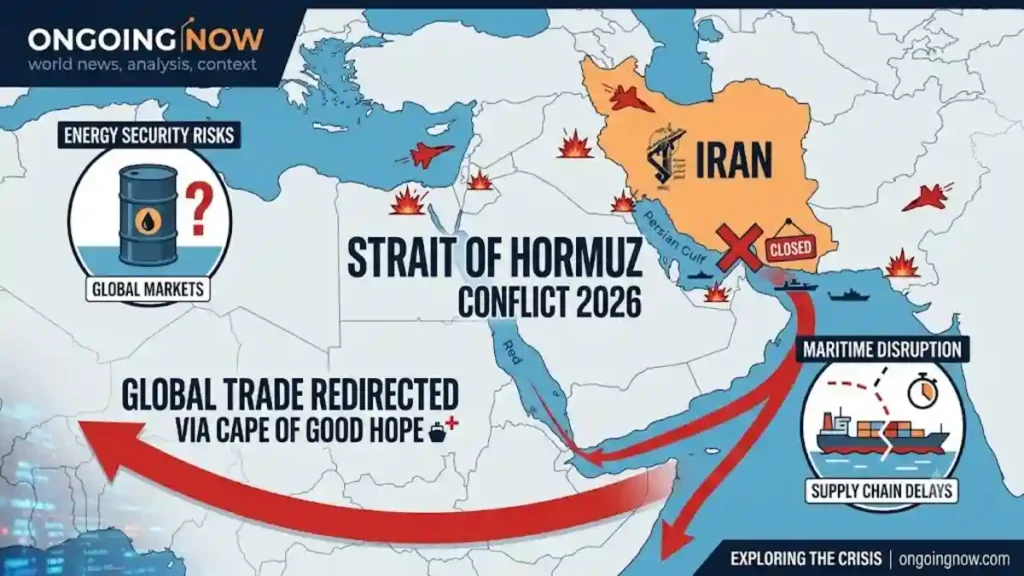
Beyond the immediate territorial friction points, the focus of the international community has increasingly shifted toward vital global trade arteries. The implementation of a restrictive maritime regime has severely limited conventional shipping traffic through critical chokepoints, as illustrated in the current Strait of Hormuz conflict map breakdown. Iranian authorities have sought to establish regulatory authority over the passage, with Deputy Foreign Affairs Minister Kazem Gharibabadi claiming alignment with international sea laws under the premise of providing security and navigational assistance to commercial vessels within territorial waters.
Despite these official assertions, international maritime bodies and trade analysts view the restricted access as a major disruption to global supply chains. The physical limitation of transit through the strait, which conventionally accommodates approximately one-fifth of global petroleum consumption, has forced shipping conglomerates to re-route assets, incurring higher freight and insurance premiums. The resulting market friction has introduced a permanent risk premium to international commodities trading.
The broader global oil price surge war impact became explicitly evident in early June 2026 as energy markets reacted to the combined effects of diplomatic deadlock and infrastructure vulnerabilities. International benchmarks showed Brent crude futures trading firmly at $95.36 per barrel, while U.S. West Texas Intermediate (WTI) hovered near $93.06 per barrel. While these figures represent a correction from the historical peaks of $120 to $126 per barrel recorded immediately after the outbreak of wider hostilities on February 28, they remain nearly 30 percent higher than pre-conflict baselines.
The vulnerability of regional energy infrastructure was further emphasized following a localized disruption at a major regional transit hub. Oman’s Mina al Fahal terminal was forced to suspend oil loading operations at its single-buoy mooring berths on June 5, 2026, following an explosion attributed to an uncrewed aerial vehicle (UAV) impact. This incident immediately halted supertanker loadings, underscoring the precarious balance between global supply security and regional operational risks.
Institutional Discourse at the United Nations Security Council
The persistent instability and geographical expansion of the conflict have prompted repeated international interventions. The United Nations Security Council emergency meeting convened in New York underscored the deep diplomatic divisions among global powers attempting to formulate a cohesive international response. UN Secretary-General António Guterres opened the session by issuing an explicit warning regarding the grave risks posed to international peace and security, noting that the conflict has already inflicted significant civilian casualties across multiple urban centers in the region, including Tehran, Isfahan, and border areas in Lebanon and northern Israel.
+-----------------------------------------------------------------------+
|                       NEWSROOM CLEAN GRID VIEW                        |
+------------------------------------+----------------------------------+
| Diplomatic Vector                  | Core Institutional Position       |
+------------------------------------+----------------------------------+
| United Nations Secretariat         | Demands immediate de-escalation,  |
| (Sec-Gen António Guterres)        | adherence to international law,  |
|                                    | and revival of nuclear diplomacy.|
+------------------------------------+----------------------------------+
| United States Representation       | Focuses on dismantling hostile   |
| (Ambassador Mike Waltz)            | missile capabilities and naval   |
|                                    | infrastructure in regional waters|
+------------------------------------+----------------------------------+
| Israeli Representation             | Asserts necessity of self-defense|
| (Ambassador Danny Danon)           | against non-state proxies and    |
|                                    | localized military structures.   |
+------------------------------------+----------------------------------+
| Lebanese State Authorities         | Seeks enforcement of UN          |
| (President Joseph Aoun)            | Resolution 1701 and deployment   |
|                                    | of national army to the south.   |
+------------------------------------+----------------------------------+
Note: This data summary reflects official state positions delivered during the June 2026 emergency sessions. Inter-council divisions continue to restrict the issuance of binding enforcement resolutions.
During the open debates, United States Ambassador Mike Waltz defended defensive military actions, characterizing them as targeted operations intended to degrade strategic missile capabilities and protect international shipping lanes from persistent regional aggression. Conversely, opposing state delegations and regional representatives criticized the operations, alleging violations of territorial sovereignty and a disproportionate impact on civilian socio-economic infrastructure. The ongoing divisions within the 15-nation council have limited the body’s ability to enforce comprehensive compliance mechanisms, leaving diplomatic resolution dependent on fragmented, indirect bilateral tracks.
Comparative Geopolitical Analysis: 1983 vs. 2026
The structural complexity of the 2026 Israel-Lebanon diplomatic track presents striking historical parallels to the failed May 17 Agreement of 1983. In both instances, international mediators attempted to establish a formal security framework between the Lebanese state and Israel amid the presence of powerful, well-armed domestic factions backed by external regional patrons. The 1983 accord ultimately collapsed because the central government in Beirut lacked the independent military authority to enforce the terms on the ground against armed opposition groups, leading to decades of structural instability along the southern border.
The primary divergence in 2026 is the far greater degree of regional integration. While the 1983 crisis was largely confined to the stabilization of Lebanon’s internal territory, the current theater links border demarcations directly to global energy security, international maritime access in the Persian Gulf, and strategic negotiations between global superpowers. The current gridlock demonstrates that localized stabilization agreements can no longer be achieved in isolation from the overarching regional security architecture.
Analysis: The Interconnected Dimensions of Modern Regional Conflict
An objective evaluation of the strategic data indicates that the ongoing impasse is driven by an unprecedented level of operational interdependence across different theaters. The refusal of non-state actors to participate in separate border arrangements is explicitly tied to broader regional goals. Strategic intelligence evaluations indicate that Hezbollah and its external partners view localized military presence as a vital element of leverage within wider international diplomacy, including negotiations regarding economic relief and sanctions modifications.
Consequently, conventional diplomatic separation strategies face diminishing returns. The stabilization of the Lebanese border is functionally tied to the status of international transit routes like the Strait of Hormuz. For energy markets and global manufacturing supply chains, this creates a scenario defined by persistent volatility rather than a singular, sudden supply shock. Industry operators are adjusting to a prolonged baseline of high operational costs, structural re-routing, and elevated risk premiums that are likely to persist until a comprehensive, multi-lateral regional agreement is achieved.
Stay sharp with Ongoing Now!
Source and Data Limitations: This analytical report is synthesized exclusively from verified international journalistic updates, official communiqués from the United Nations Security Council, corporate shipping registries, and official state statements issued up to June 5, 2026. Given the highly volatile operational environment in southern Lebanon and the Persian Gulf, minor discrepancies in initial casualty figures, localized infrastructure damage reports, and commercial maritime transit schedules may occur due to standard reporting delays and military information management protocols. Speculative assessments, unverified claims from social media platforms, and non-attributed political projections have been strictly excluded to preserve absolute factual objectivity.