Trump 2026 SOTU: “Golden Age” Speech Faces Rebuttal
President Donald Trump frames 2026 State of the Union as a historic national turnaround while Democrats warn of affordability gaps and institutional decline.
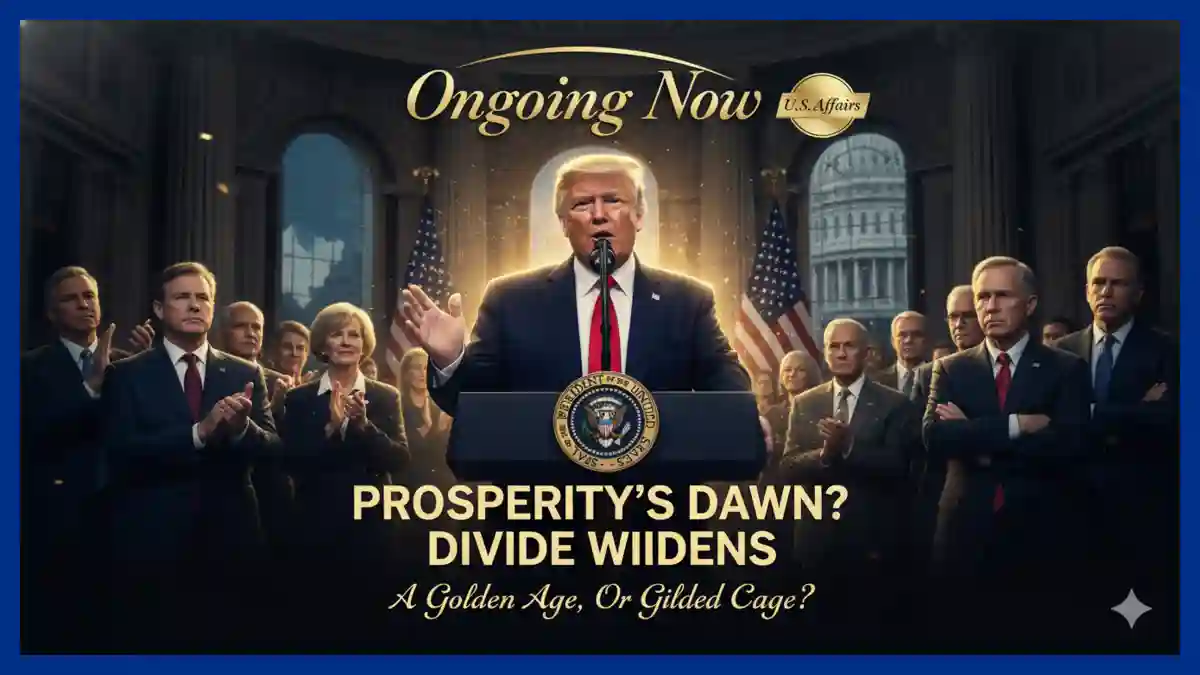
President Donald Trump delivered a 108-minute State of the Union address on February 24, 2026, proclaiming the dawn of a “golden age of America” and a “turnaround for the ages.” Speaking before a joint session of Congress, the President focused on a robust economic narrative, citing a drop in core inflation to 1.7% and a surge in domestic oil production.
The 2026 SOTU served as a dual-purpose event: a formal constitutional report and a strategic launch for the Trump midterm election strategy. While the President highlighted record stock market highs and decreased border crossings, the event was marked by deep partisan divides. Dozens of Democratic lawmakers boycotted the speech to attend the “People’s State of the Union” rally, while Virginia Governor Abigail Spanberger delivered a centrist-leaning Democratic response 2026 that questioned the reality of the President’s economic claims.
Economic Pillars of the 2026 State of the Union
The Trump 2026 SOTU was heavily anchored in “kitchen table” economics, a move widely viewed by analysts as a response to persistent voter anxiety over living costs. Trump credited his administration’s “America First” policies for driving gasoline prices below $2.30 per gallon in many states and overseeing a 56% reduction in fentanyl trafficking.
Central to the Trump economic policies 2026 is a heavy reliance on tariffs. Despite a recent Supreme Court ruling that struck down broad tariff authority, the President used the speech to defend a new 15% global tariff enacted under alternate legal provisions. He argued these levies would eventually “replace the modern-day system of income tax.”
By the Numbers: Reported Economic Indicators
| Indicator | Administration Claim (Feb 2026) | Contextual Note |
| Core Inflation | 1.7% (Q4 2025) | Down from 2024 peaks; food costs remain elevated. |
| Gasoline Prices | Under $2.30/gallon | Reflects increased domestic output and Venezuela imports. |
| Stock Market | 53 Record Highs | Measured since the 2024 election. |
| Fentanyl Flow | 56% Reduction | Attributed to intensified border enforcement. |
The “Golden Age of America” Speech and Policy Directives
During the golden age of America speech, Trump outlined a series of aggressive legislative and executive goals. He formally called on Congress to pass the “Delilah Law,” which would prohibit states from issuing commercial driver’s licenses to undocumented immigrants. He also pushed for the “Save America Act,” a package aimed at mandating proof of citizenship for all voters and restricting mail-in balloting.
The President’s rhetoric remained firm on cultural and institutional shifts. He touted the elimination of diversity, equity, and inclusion (DEI) policies across the federal government and reaffirmed a mandate for all federal employees to return to in-person work or face removal. This “common sense” restoration, as Trump described it, is a cornerstone of his second-term domestic agenda.
Abigail Spanberger and the Democratic Response 2026
The formal Abigail Spanberger Democratic response offered a sharp ideological and factual counter-narrative. Speaking from the historic backdrop of Colonial Williamsburg, Governor Spanberger—a former CIA officer who won a decisive 15-point victory in Virginia—centered her rebuttal on “affordability, safety, and humanity.”
Spanberger challenged the “golden age” framing by posing a series of direct questions to the American public: “Is the president working to make life more affordable for you and your family? Is the president working for you?” She argued that the administration’s tariff regime and cuts to federal programs have squeezed the middle class, specifically citing rising costs in housing, healthcare, and childcare.
Key Themes of the Spanberger Speech
Economic Squeeze: Highlighting that while some macro indicators have improved, household staples remain expensive.
Institutional Stability: Criticizing the use of federal agents in domestic cities and the “mass firings” within federal agencies.
National Security: Alleging a pivot away from traditional alliances toward a more isolationist or “strongman” diplomacy.
Analysis: The Trump Midterm Election Strategy
The SOTU 2026 summary reveals a president fully engaged in shaping the narrative for the upcoming November elections. By focusing on “America at 250,” the administration is attempting to link the country’s upcoming semiquincentennial with a sense of renewed national pride and prosperity.
This strategy aims to consolidate the Republican base while appealing to independents through measurable “win” metrics like lower gas prices. However, the Trump speech 2026 analysis suggests a polarized electorate. Recent polling cited by AP-NORC shows that only 39% of U.S. adults approved of the President’s handling of the economy just prior to the address, suggesting a gap between the administration’s “roaring economy” rhetoric and public sentiment.
Institutional Friction: Boycotts and Protest Rallies
The Democratic boycott SOTU 2026 was one of the largest in recent history, with at least 30 lawmakers, including Senators Chris Murphy and Adam Schiff, opting out of the House chamber. These members instead joined protest rallies in Washington DC, specifically the “People’s State of the Union” on the National Mall.
“Trump is marching America towards fascism, and I refuse to normalize his shredding of our Constitution and democracy,” stated Senator Chris Van Hollen, explaining his decision to skip the event.
In the gallery, the tension was equally visible. Several survivors of Jeffrey Epstein’s sex trafficking ring were invited as guests by Democratic representatives to demand further investigations into the network. This presence transformed the ceremonial event into a platform for a “public moral reckoning,” highlighting the deep-seated distrust between the executive branch and the opposition.
Comparative Insight: SOTU Shifts 2025–2026
Compared to his 2025 address, the 2026 speech was significantly longer and more focused on specific legislative demands like the Save America Act. In 2025, the focus was largely on reversing previous executive actions; in 2026, the focus has shifted toward building a permanent legal framework for “America First” policies.
The progressive SOTU rebuttal, delivered separately by Representative Summer Lee on behalf of the Working Families Party, further illustrated the fragmentation within the opposition. While Spanberger focused on centrist “affordability” themes, Lee characterized the state of the nation as “dire,” focusing on systemic inequality and the impact of federal law enforcement actions in minority communities.
Societal and Regional Impact
The policies highlighted in the Trump 2026 SOTU have had varied regional effects. In the “Rust Belt” and energy-producing states, the focus on domestic oil and deregulation has been met with local economic optimism. Conversely, in border states and major metropolitan areas, the deployment of federal agents and the “Delilah Law” proposal have sparked significant local opposition and legal challenges.
The “human-centric” cost of these policies was a recurring theme in the Democratic response. Spanberger and other leaders highlighted reports of “nursing mothers being ripped from their babies” during immigration enforcement actions, framing the administration’s “safety” measures as a source of community trauma rather than security.
What the Data Shows: A Divided Union
As the United States approaches its 250th anniversary, the 2026 State of the Union highlights a nation in a state of high-stakes transition. While the executive branch reports a “transformation like no one has ever seen,” the legislative opposition and a significant portion of the public remain unconvinced.
The success of the Trump midterm election strategy will likely depend on whether the administration can translate macroeconomic wins—like the 1.7% inflation rate—into a felt sense of prosperity for the average voter before November. Until then, the “Golden Age” remains a subject of intense national debate.
Stay sharp with Ongoing Now!
Related Coverage:
Source and Data Limitations: This report is based on official White House transcripts of the February 24, 2026, State of the Union address, public statements from the Office of the Governor of Virginia, and congressional records regarding the Democratic response. Economic data points (inflation, gas prices) are as cited in the President’s address and verified against current February 2026 market trackers where applicable. Polling data is sourced from AP-NORC and CNN/SRS surveys conducted in early 2026. This analysis excludes speculative commentary on election outcomes, focusing instead on the stated strategies and documented legislative proposals (e.g., Save America Act, Delilah Law) presented during the SOTU proceedings.