Supreme Court Strikes Down IEEPA Tariffs in Landmark Ruling
Ruling curbs executive trade power while President Trump orders a new 10 percent global tariff
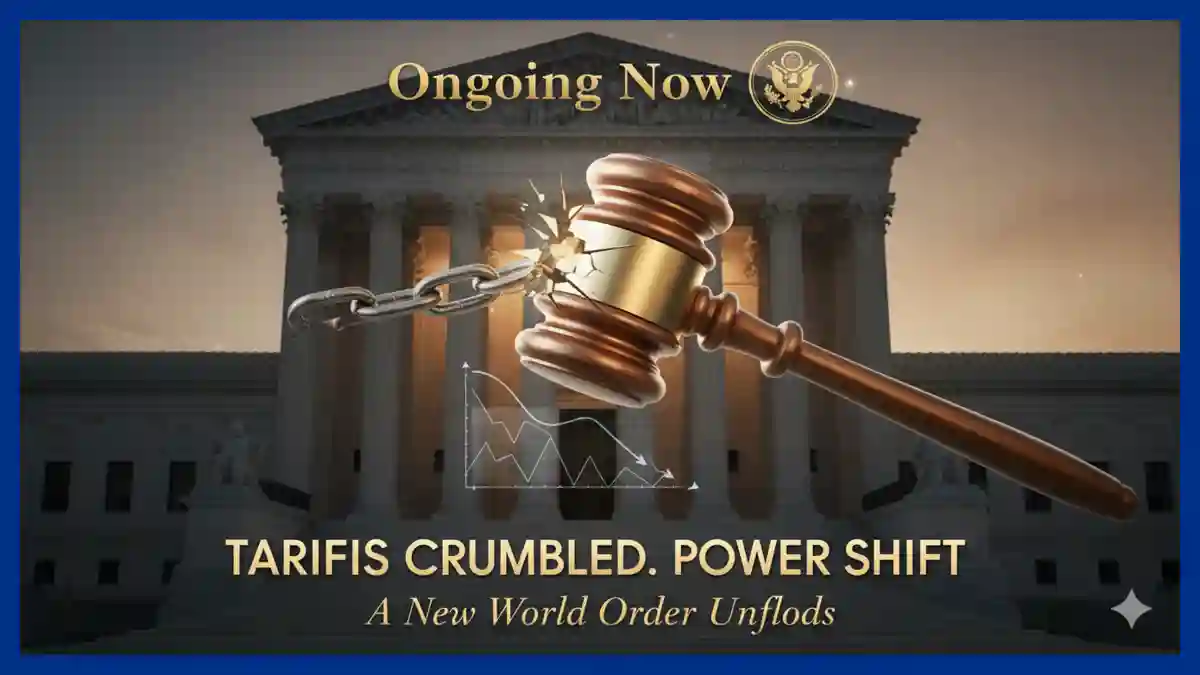
In a significant constitutional rebuke to the executive branch, the U.S. Supreme Court ruled 6–3 on Friday that the International Emergency Economic Powers Act (IEEPA) does not authorize the President to impose broad import duties. The decision in Learning Resources Inc. v. Trump invalidates the “reciprocal” and “emergency” tariffs enacted in 2025, which had targeted nearly all U.S. trading partners. Chief Justice John Roberts, writing for the majority, asserted that the power to levy taxes and tariffs is a “branch of the taxing power” reserved strictly for Congress under Article I of the Constitution. Within hours of the ruling, President Donald Trump responded by signing a new 10 percent global tariff order under the separate Section 122 balance of payments authority, setting the stage for a renewed legal and economic confrontation.
Judicial Limits on Emergency Trade Powers
The Supreme Court’s decision marks a definitive end to the administration’s reliance on IEEPA for its sweeping “Liberation Day” trade policy. The court found that while IEEPA allows the president to “regulate” importation during a national emergency, this language does not grant the authority to unilaterally impose taxes.
Constitutional Authority vs. Executive Orders
The majority opinion emphasized that when Congress delegates its tariff powers, it does so with explicit terms and strict limits. Chief Justice Roberts noted that IEEPA, enacted in 1977, was intended to constrain rather than expand executive power. Justice Brett Kavanaugh, leading the dissent, argued that “regulating importation” should include the power to set duties to address modern economic crises.
Key Figures: The 6-3 Split | Judicial Wing | Justices | | :— | :— | | Majority | Roberts, Gorsuch, Barrett, Sotomayor, Kagan, Jackson | | Dissent | Kavanaugh, Thomas, Alito |
Institutional and Political Reactions
The ruling triggered a sharp Trump vs Roberts 2026 feud, with the President labeling the majority “disloyal” and “unpatriotic.” On Truth Social, the Trump Truth Social SCOTUS reaction included claims that the court was “swayed by foreign interests,” a statement that drew swift criticism from legal scholars. Vice President JD Vance lawlessness comment further intensified the rhetoric, as he characterized the decision as a failure of the court to respect the executive’s role in national security.
Transition to Alternative Trade Enforcement Tools
Following the invalidation of the IEEPA duties, the administration has pivoted to a different statutory framework. The new 10 percent global tariff order relies on Section 122 balance of payments authority, a 1974 law that permits temporary global tariffs of up to 15% for a maximum of 150 days to address significant trade deficits.
Section 122 vs. Section 232 and 301
Legal experts note that the shift from IEEPA to Section 122 introduces new procedural hurdles and time constraints. While IEEPA allowed for indefinite durations, Section 122 requires congressional notification and has a strict expiration date unless extended by the legislature.
Section 122 balance of payments authority: Fast-acting but time-limited (150 days) and capped at a 15% increase.
Section 232 national security vs Section 122: Section 232 requires a lengthy Department of Commerce investigation into whether specific imports (like steel) threaten national security.
Section 301 vs IEEPA: Section 301 is used to combat “unreasonable or discriminatory” practices by specific countries, typically China, but requires formal findings of unfair conduct.
The Lighthizer trade policy comparison suggests that while the administration prefers the speed of IEEPA, the reciprocal trade act vs current law debate will likely move to Congress as the administration seeks permanent legislative authority to match foreign tariff rates.
Analysis: The $142 Billion Refund Challenge
The ruling has created an immediate fiscal and administrative dilemma. According to U.S. Customs and Border Protection (CBP) data, approximately $142 billion was collected under the now-invalidated IEEPA authority throughout 2025.
Steps for Recovering IEEPA Duties
The Supreme Court did not provide a specific mechanism for reimbursements, leaving the process to the CBP protest 2026 instructions and the Court of International Trade (CIT). Importers are advised that recovering IEEPA duties guide follows established customs procedures, but the scale of the potential payouts is unprecedented.
Trump Tariff Reimbursement Steps for Businesses
Inventory Exposure: Identify all entries since February 2025 that were subject to IEEPA-based duties.
Monitor Liquidation Status: Determine if entries are “unliquidated” (still being processed) or “liquidated” (finalized).
File Protests: For liquidated entries, businesses generally have 180 days to file a formal protest with the CBP.
Seek Small Business Trade Litigation Help: Many small firms are joining consolidated lawsuits at the CIT to preserve their rights to interest on the refunds.
“The court’s decision adopts the fundamental principle that the power to tax belongs to the people’s representatives in Congress, not the executive alone.” — Statement from the lead plaintiffs in Learning Resources Inc. v. Trump.
Regional and Economic Impact of the Ruling
The sudden invalidation of the 2025 tariffs is expected to have varied effects across the American landscape. In “Rust Belt” manufacturing hubs, the MAGA reaction to Supreme Court has been one of concern, fearing that the removal of protectionist duties will expose domestic factories to a surge of cheap imports.
Impact on Small Businesses and Consumers
Conversely, retail-heavy regions and small businesses that rely on global supply chains—such as the toy companies and wine importers involved in the litigation—have welcomed the ruling. The public opinion on tariff ruling remains divided, often along sectoral lines.
Manufacturing: Potential loss of competitive edge as IEEPA duties vanish.
Retail/Consumers: Expected relief from “tariff-driven inflation,” though the new 10% Section 122 order may offset these gains.
Agriculture: Relief for farmers who had faced retaliatory tariffs from Canada, Mexico, and China.
Business Tax Credits for Import Duties
As a secondary measure, some lawmakers are discussing business tax credits for import duties to assist companies that cannot immediately recover their cash through the CBP refund process. These credits would aim to provide liquidity to firms whose capital has been tied up in the “tariff war” over the last year.
Why This Matters: The 2026 Political Landscape
The Supreme Court’s decision arrives at a moment of peak political tension. The Trump State of the Union invite snub, where the President reportedly declined to invite the Chief Justice to the 2026 address, underscores the depth of the institutional friction.
What the Data Shows: Trade Stability vs. Executive Agility
Data from the Penn Wharton Budget Model suggests that while the ruling provides a temporary boost to real GDP by reducing costs for importers, the administration’s pivot to alternative trade enforcement tools ensures that trade volatility will continue. The emergence of social media trade war memes reflects a public that is increasingly attuned to the complexities of international trade law.
Key Figures: Economic Forecasts (Post-Ruling)
Estimated Refunds: $134 billion – $175 billion
Average Effective Tariff Rate (without IEEPA): 9.1%
Projected Daily Revenue Loss: $500 million (until Section 122 implementation)
Evidence-Based Political Insights
The ruling reaffirms the “Major Questions Doctrine,” a legal principle that the executive branch cannot act on matters of vast economic significance without clear, specific instructions from Congress. This limits the “imperial presidency” model of trade policy that had become the hallmark of the 2025 agenda.
As legal counsel for tariff recovery becomes a priority for U.S. importers, the administration’s next steps with the Reciprocal Trade Act in Congress will determine if the 2026 trade landscape moves toward legislative consensus or continues to be defined by executive-judicial conflict.
Would you like me to monitor the Federal Register for the official implementation dates of the new Section 122 tariffs?
Stay sharp with Ongoing Now!
Related Coverage:
Source and Data Limitations: This report is based on the Supreme Court of the United States ruling in Learning Resources Inc. v. Trump (February 20, 2026), official statements from the White House and Department of the Treasury, and trade data provided by U.S. Customs and Border Protection. Economic projections are sourced from the Penn Wharton Budget Model and the Yale Budget Lab. Data regarding the $142 billion in collections is current as of December 2025. This article excludes unverified social media claims regarding specific justices’ private motivations and focuses strictly on the legal text of the opinions and the statutory authorities cited in executive orders. Refund processes are subject to pending administrative directives from CBP.