How public university open speech guidelines balance campus safety and free expression
A deep dive into the complex legal frameworks, security cost breakdowns, and jurisdictional boundaries shaping modern campus policy.
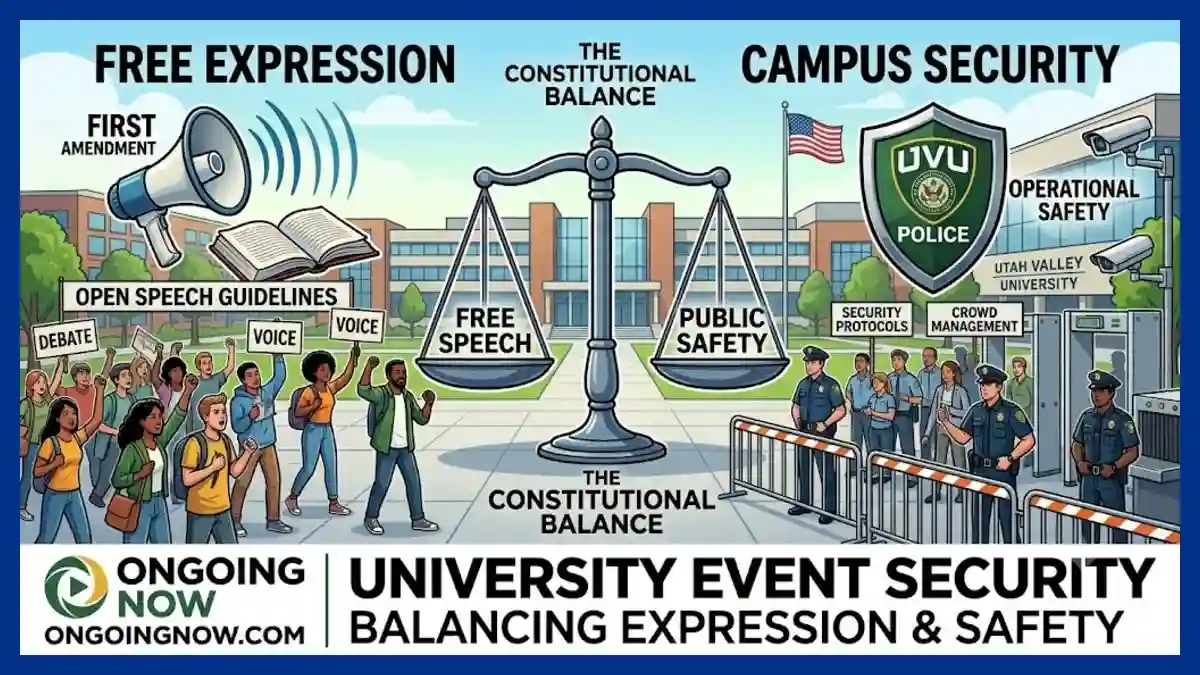
Balancing Free Expression and Public Safety in Higher Education
The intersection of public university open speech guidelines and institutional safety has emerged as a complex administrative challenge across American higher education. At institutions like Utah Valley University, campus security protocols must actively balance the constitutional protections of the First Amendment with the physical preservation of public venues. Managing these competing priorities requires a clear understanding of campus law enforcement jurisdictional boundaries, precise university event security cost breakdowns, and the legal framework governing venue liability for public speakers. As institutions navigate these challenges, federal campus safety grants and state oversight from entities like the Utah Board of Higher Education play a critical role in funding and regulating protective operations during high-profile political events.
                                [CAMPUS PUBLIC SAFETY SYSTEM]
                                              │
                    ┌─────────────────────────┴─────────────────────────┐
                    ▼                                                   ▼
       [Constitutional Compliance]                         [Operational Security]
     ┌──────────────┴──────────────┐                     ┌──────────────┴──────────────┐
     │ • First Amendment Law       │                     │ • UVU Police Dept.          │
     │ • UVU Policy 161            │                     │ • MEAC Event Review         │
     │ • Open Speech Guidelines    │                     │ • Jurisdictional Borders    │
     └─────────────────────────────┘                     └─────────────────────────────┘
The Constitutional Blueprint: Public University Open Speech Guidelines
Public higher education institutions operate as arms of the state, making them directly bound by the First Amendment of the U.S. Constitution. Under long-standing Supreme Court precedents, such as Widmar v. Vincent (1981), public university open speech guidelines must treat campus outdoor areas as public forums where content-based censorship is strictly prohibited. At Utah Valley University (UVU), this constitutional mandate is operationalized through UVU Policy 161 (Freedom of Speech), which explicitly guarantees the right to free expression, peaceful assembly, and academic freedom for students, faculty, and invited external speakers without prior restraint.
However, the constitutional protection of speech is not absolute. Courts have consistently recognized that institutions can enforce narrow, content-neutral time, place, and manner restrictions to prevent the disruption of core educational functions. Under these legal frameworks, demonstrations and speeches are permitted across campus plazas and lawns, provided they do not block building entrances, violate municipal noise ordinances, or interrupt scheduled academic classes. Institutions are legally required to maintain an environment where controversial ideas can be exchanged safely, ensuring that the presence of an unpopular speaker does not serve as a justification for preemptive administrative cancellation.
Operational Triggers: UVU Political Event Protocols
When an event transitions from routine tabling to a high-visibility gathering, specialized operational frameworks take effect. The UVU political event protocols dictate that any planned gathering featuring a public or controversial figure must undergo a formal review process by the Major Events Assessment Committee (MEAC). This committee evaluates the potential impact of the event on normal campus operations and determines whether heightened logistical, crowd management, or safety interventions are required. The administrative trigger for an MEAC review occurs automatically for political activities, concerts, or events where expected attendance introduces distinct physical challenges, regardless of the sponsoring organization’s internal or external status.
The primary objective of this administrative review is to prepare the campus infrastructure without infringing upon the speaker’s message. According to institutional guidelines, the MEAC review must be initiated six weeks prior to the scheduled event date. During this window, logistics coordinators establish specific compliance benchmarks, which include verifying ticketing limits, arranging designated areas for counter-protests, and assessing the physical layout of the venue to prevent fire code violations. If an event is designated as a major gathering, the sponsoring entity must continuously share updated ticketing data with the committee chair to ensure attendance does not exceed the certified capacity of the room or outdoor field.
Financial Dynamics: University Event Security Cost Breakdown
Securing a modern campus during a high-profile political event requires substantial financial and human capital. A standard university event security cost breakdown involves multiple tiers of operational expenses, ranging from physical infrastructure deployment to specialized personnel allocations. Institutions must account for fixed assets such as temporary perimeter fencing, walk-through metal detectors, and specialized screening technology, alongside variable labor costs associated with sworn police officers and trained crowd managers. Institutional regulations frequently mandate a specific staffing ratio, such as requiring two certified crowd managers for the first 250 attendees, with an additional manager required for every subsequent block of 250 people.
+---------------------------------------------------------------------------------+
| Clean Newsroom Grid: Standard Event Security Resource Matrix                    |
+------------------------------------+--------------------------------------------+
| Resource Category                  | Operational Metrics & Compliance Ratios    |
+------------------------------------+--------------------------------------------+
| Certified Crowd Managers           | 2 per initial 250 guests; +1 per 250 addl.  |
+------------------------------------+--------------------------------------------+
| Dedicated Law Enforcement Personnel| Scaled based on threat matrix assessment   |
+------------------------------------+--------------------------------------------+
| Physical Screening Infrastructure  | Magnetometers & bags checks at all portals |
+------------------------------------+--------------------------------------------+
| Mandatory Planning Timeline        | MEAC review initiated 6 weeks pre-event    |
+------------------------------------+--------------------------------------------+
Note: Asset allocation scales dynamically based on the specific risk tier assigned during the joint intelligence assessment.
These expenses present an administrative challenge regarding funding equity. While institutions can charge standard facility rental fees, the Supreme Court ruled in Forsyth County v. Nationalist Movement (1992) that public entities cannot assess variable security fees based on the anticipated hostility of a crowd, as this constitutes an unconstitutional “heckler’s veto.” Consequently, public universities must absorb a significant portion of the protective costs within their general operating budgets or offset them through external funding sources, ensuring that the financial burden of maintaining public safety does not become an indirect barrier to free speech.
Jurisdictional Execution: Campus Law Enforcement Jurisdictional Boundaries
Executing a comprehensive safety plan requires clear coordination within defined campus law enforcement jurisdictional boundaries. The Utah Valley University Police Department operates as a fully empowered state law enforcement agency, holding primary statutory authority over all university-owned, leased, or controlled property. Sworn campus officers possess full police powers, including the authority to investigate felonies, execute arrest warrants, and enforce state statutes and institutional codes of conduct. However, during large-scale political events that draw regional crowds, these boundaries must interface seamlessly with municipal, county, and state agencies through formal Mutual Aid Agreements (MAAs) and Memorandums of Understanding (MOUs).
This multi-agency framework is managed via the Unified Command structure under the National Incident Management System (NIMS). While the university police department retains tactical command within the immediate perimeter of the campus, local municipal departments—such as the Orem Police Department or the Utah County Sheriff’s Office—typically manage traffic control, peripheral perimeters, and public transit corridors leading to the university. This clear division of responsibilities ensures that off-campus disturbances do not drain internal campus resources, allowing specialized campus safety personnel to focus exclusively on securing the venue, protecting attendees, and maintaining open pathways for expressive activity.
Accountability and Risk: Venue Liability for Public Speakers
The legal landscape governing venue liability for public speakers requires institutions to perform rigorous risk assessments while strictly avoiding prior restraint. Public universities face potential liability from two distinct vectors: failure to protect participants from foreseeable violence, and unlawful censorship if an event is canceled without a compelling, legally defensible government interest. To mitigate these risks, higher education legal counsels rely on clear delineations of institutional responsibility. The university protects the physical safety of the audience and speaker, but explicitly states through public policy that permitting an event does not constitute an endorsement or sanction of the speaker’s viewpoint.
Furthermore, institutional frameworks distinguish between protected speech, which may include offensive or highly polarizing political rhetoric, and unprotected speech, which includes true threats, incitement to imminent lawless action, or severe targeted harassment. If a speaker uses a public forum to explicitly incite immediate violence, campus law enforcement retains the immediate authority to intervene and terminate the proceedings. Outside of these rare legal thresholds, the institution’s primary liability mitigation strategy rests on strict adherence to its own written procedures, demonstrating that all safety protocols were applied uniformly without regard to the speaker’s political alignment.
Institutional Governance: Utah Higher Education Administration
Policy implementation across individual campuses is heavily influenced by the broader structures of Utah higher education administration. The Utah Board of Higher Education serves as the overarching governing body for the state’s public colleges and universities, establishing system-wide policies that balance institutional autonomy with state-level accountability. This administrative framework ensures that free speech policies and safety mandates align with state statutes passed by the Utah State Legislature. These statutes frequently reinforce the status of outdoor campus spaces as public forums and place specific statutory requirements on how institutions handle expressive activities and security allocations.
       [Utah Board of Higher Education] ─── (System-Wide Governance)
                       │
                       ▼
       [Utah Valley University Admin]   ─── (Policy Implementation)
                       │
                       ▼
       [UVU Police & Event Services]    ─── (Tactical Security Execution)
For institutional leadership, navigating this hierarchy involves regular reporting, fiscal audits, and policy reviews. The state-level framework provides a mechanism for sharing best practices across institutions, ensuring that lessons learned from high-profile events at one campus inform the emergency management strategies of another. This centralized oversight also assists institutions in demonstrating compliance with state laws regarding intellectual diversity and free expression, protecting universities from costly civil litigation while maintaining a unified standards-based approach to campus safety.
Resource Integration: Federal Campus Safety Grants
To sustain the complex infrastructure required by modern security protocols, institutions actively seek external funding through federal campus safety grants. Programs administered by the U.S. Department of Justice (DOJ), such as the Office of Community Oriented Policing Services (COPS) grants, and the U.S. Department of Homeland Security (DHS) provide vital capital to enhance campus security capabilities. These federal funds are utilized to upgrade physical security infrastructure, purchase advanced communication equipment, and finance specialized training programs for campus law enforcement officers, including active threat mitigation and de-escalation strategies.
+---------------------------------------------------------------------------------+
| Clean Newsroom Grid: Federal Funding Allocation Areas                            |
+------------------------------------+--------------------------------------------+
| Grant Program Category             | Targeted Institutional Enhancements        |
+------------------------------------+--------------------------------------------+
| COPS Hiring & Training Grants      | Personnel expansion & advanced de-escalation|
+------------------------------------+--------------------------------------------+
| DHS Infrastructure Programs        | Perimeter hardening & communication networks|
+------------------------------------+--------------------------------------------+
| Interagency Safety Appropriations  | Cross-jurisdictional tactical equipment    |
+------------------------------------+--------------------------------------------+
Note: Federal disbursements require strict quarterly compliance reporting and adherence to non-discrimination mandates.
By securing federal grants, universities can offset the substantial capital expenditures required to modernize their emergency operations centers without depleting resources allocated to core academic programs. These grants frequently require matching local funds or strict compliance tracking, ensuring that the investments directly improve the institution’s measurable capacity to respond to large-scale public safety incidents. This integration of federal resource support, state-level administrative governance, and localized operational discipline forms the foundation of modern campus safety strategies across the United States.
Stay sharp with Ongoing Now!
Source and Data Limitations: This policy analysis is based on official institutional documents, including Utah Valley University Policy 161 (Freedom of Speech) and the standard operating guidelines of the UVU Major Events Assessment Committee (MEAC). Additional statutory context is drawn from relevant U.S. Supreme Court First Amendment precedents, including Widmar v. Vincent and Forsyth County v. Nationalist Movement. Financial and operational ratios reflect standard public university safety metrics and federal grant guidelines provided by the U.S. Department of Justice COPS program. This analysis excludes unverified social media assertions, ongoing active litigation claims not yet ruled upon, and speculative security projections regarding future unannounced political gatherings.